The loan book and the ledger, together.
Origination, disbursement, repayment schedules, and provisioning against the same accounts your statutory reporting comes out of.
10 modules·80 features·Configured on the core
The modules behind financial services.
Not a list of module names. Each one below opens onto what is inside it and why a financial services business needs it — so you can check it against how your operation actually runs.
A maintained Frappe app built on ERPNext, covering the loan lifecycle from application to closure.
Agent Q
Agents that read your own records and act on them, scoped to how a financial services business runs.
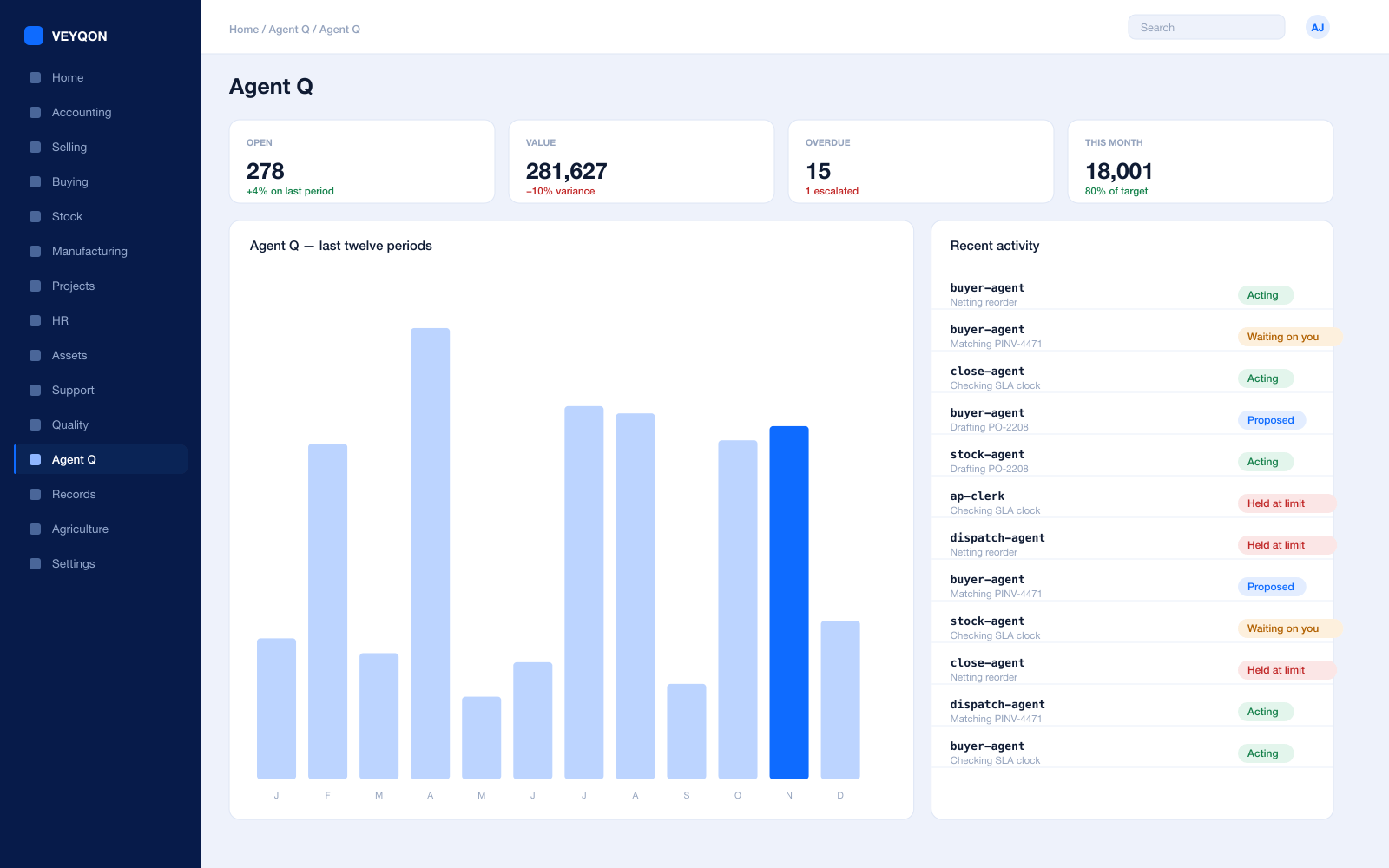
Grounded in live records
Every answer is drawn from your own ledger with your permissions applied, and names the documents it used. Nothing is answered from a snapshot or a summary.
A role, not a prompt
Each agent is scoped like a job — accounts payable, procurement, dispatch, period close — with the same limits you would put on the person doing it.
Explicit tool permissions
An agent holds a named list of the actions it may take. Matching an invoice does not imply paying one.
Value and action limits
A hard ceiling per agent, per period, and per document type, which it cannot cross however it is asked.
The queue
What every agent is working on, what is waiting on a person, and what has been held — in one place, with the reason on each item.
Triggers
An arriving document, a breached threshold, a date, or a state change on a record. Agents start on events, not on somebody remembering.
Human approval gates
Anything over a limit routes to a named person, with the reasoning attached, so approving takes seconds rather than an investigation.
Escalation paths
Who it hands to when it reaches a limit, how long it waits first, and what that person sees when it arrives.
Segregation of duties
An agent cannot approve what it raised. The rule that applies to your people applies to your agents.
Full reasoning log
Every step is written to the audit trail on the document it touched, so a decision can be read back months later.
Ask in plain language
The console answers operational questions from live records and offers the next action, rather than handing back a paragraph.
Spend control
Ceilings per agent and per period, so autonomy runs to a budget you set rather than an open account.
Origination
Assessment, security, and approval before anything is disbursed.
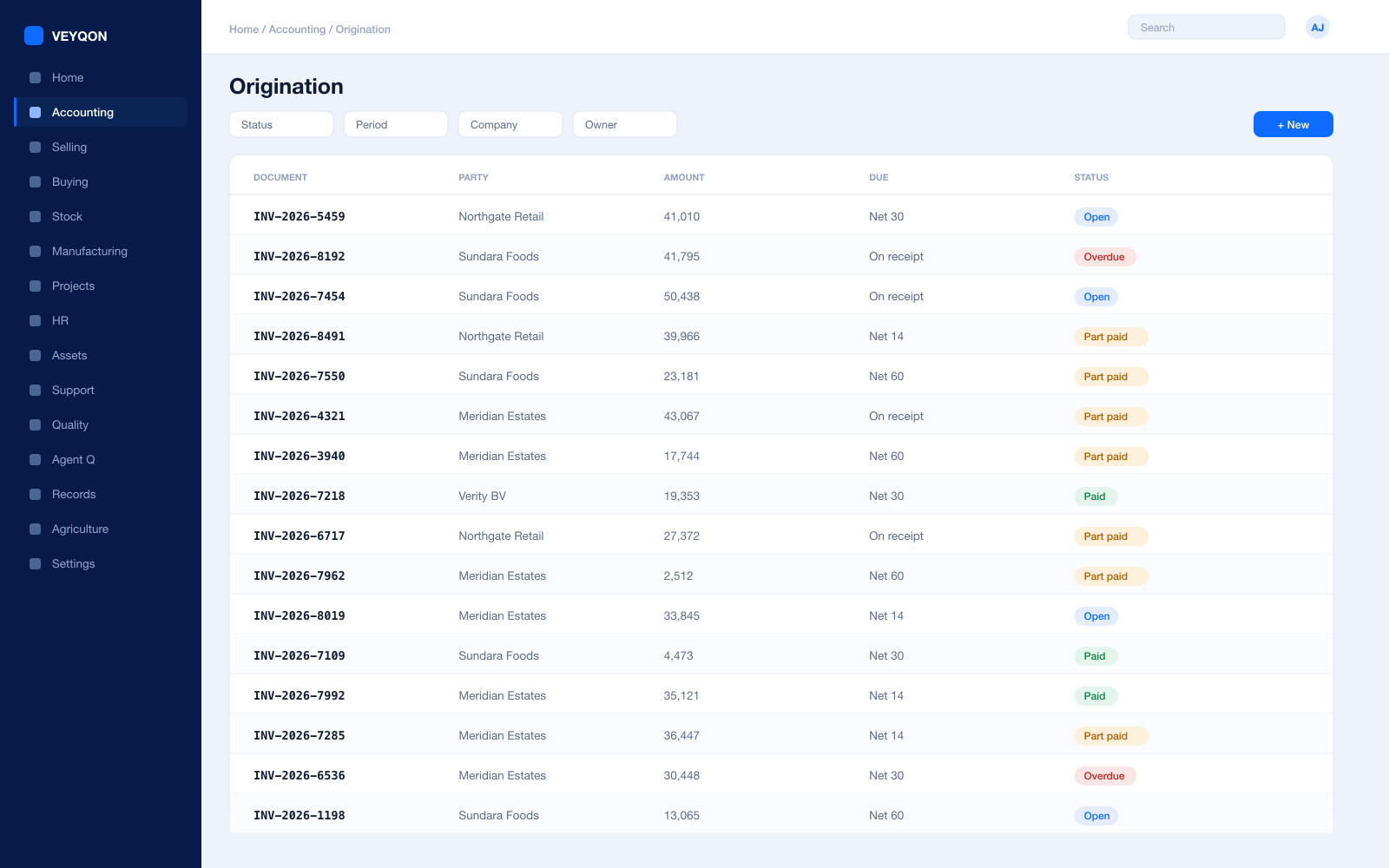
Loan application
The request as a record, with the applicant, the amount, and the purpose captured before anyone assesses it.
Loan products
Product definitions carrying rate, term, and rules, so an application is configured rather than described in free text.
Assessment
Affordability and risk recorded against the application, so an approval has reasoning attached to it.
Approval workflow
States and transitions with the right roles on each, so approval is a controlled act rather than an email.
Segregation of duties
The person who assessed it cannot be the person who approves it — the same rule that applies everywhere else.
Disbursement
Funds released against the approved application, generating the repayment schedule at the same moment.
Schedule generation
The repayment plan produced from principal, rate, and term rather than typed into a spreadsheet and emailed.
Trail from application
Every state, decision, and document retained against the loan for as long as the loan exists.
The Loan Book
Interest accruing daily to the ledger, not calculated at period end.
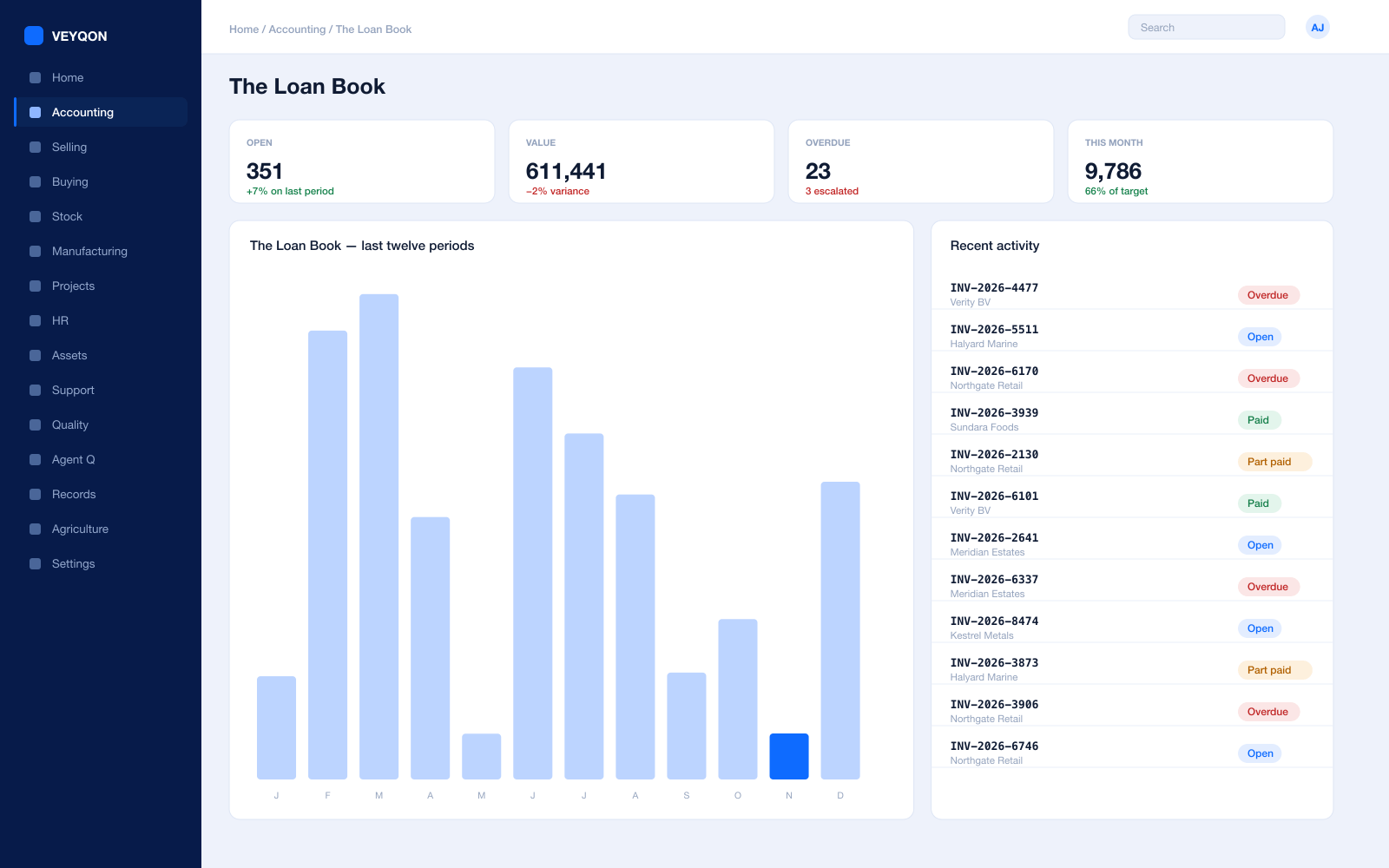
Loan record
Principal, rate, term, and schedule on one record, posting to the general ledger rather than sitting beside it.
Repayment schedule
Each instalment with its date and its split, generated at disbursement and visible to both sides.
Daily interest accrual
Accrual posted as it arises rather than calculated in a month-end journal somebody has to remember.
Rate types
Fixed and variable rates on the product, so a rate change is applied to the book rather than to each loan by hand.
Loan products
The terms and rules behind a class of lending, held once rather than restated on every agreement.
Book position
Outstanding principal, accrued interest, and arrears across the book, from the ledger rather than a report pack.
Multi-currency
Lending in more than one currency, with revaluation posting to the ledger.
Restructure
Term and schedule changes recorded as events on the loan, so the history shows what was agreed and when.
Immutable trail
Every posting carries who, when, and from which document — which is what a regulator actually inspects.
Repayments & Arrears
Allocation in the right order, and arrears that raise themselves.
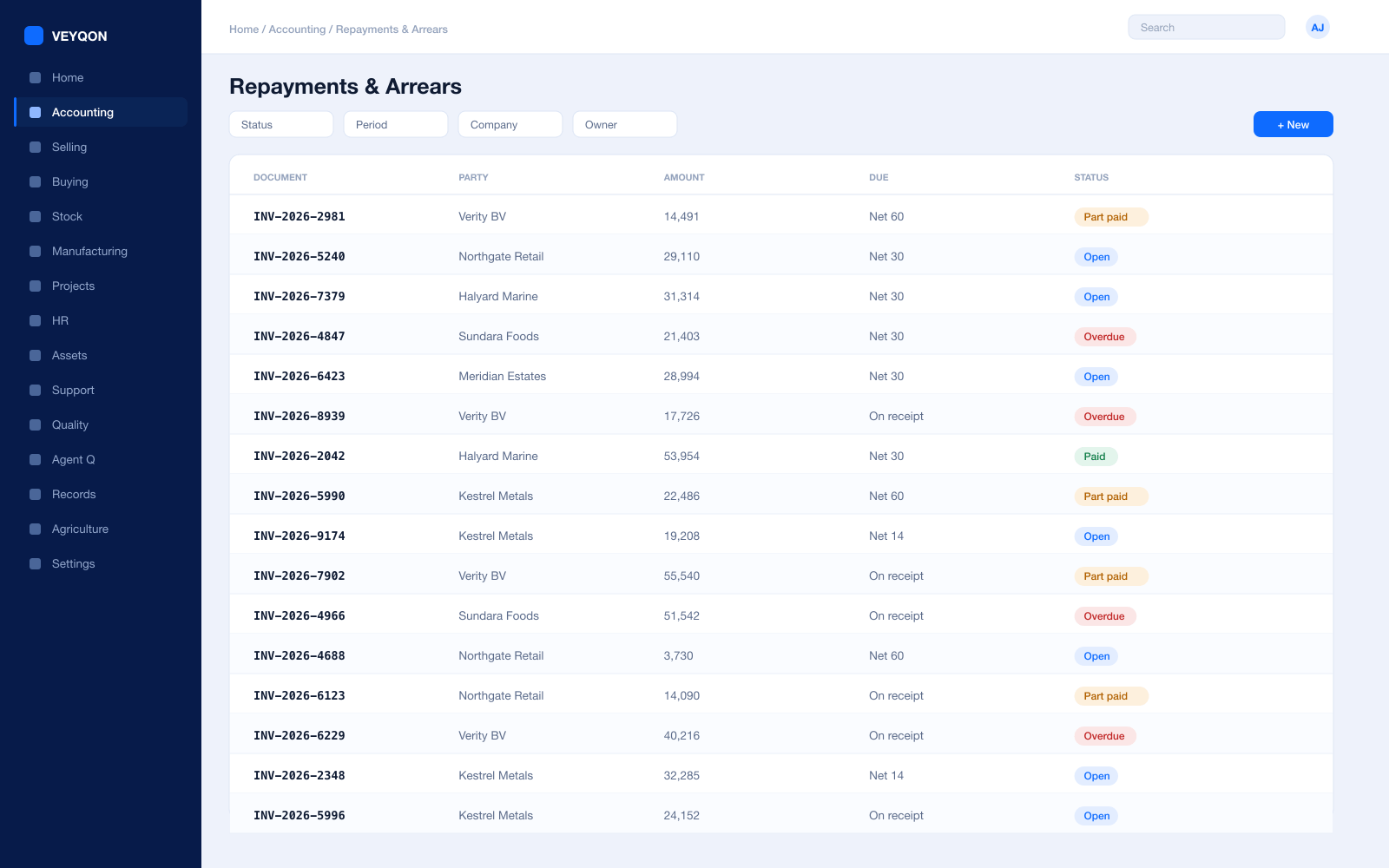
Repayment
A payment recorded against the loan and allocated across the schedule rather than applied to a balance.
Allocation order
Interest, then principal, then penalties — in the order the agreement specifies, applied consistently every time.
Arrears
Missed and partial instalments surfacing as exceptions on time, rather than being noticed in a monthly review.
Penalties
Charges applied by rule against the overdue amount, so two accounts in the same state are treated the same way.
Dunning
Overdue instalments consolidated into a collection document with a fee, an annual interest rate, and the letter text for that stage.
Dunning types
First reminder, second, and final notice, each with its own fee, rate, income account, and cost centre.
Ageing
Arrears by bucket, product, and portfolio, from the same ledger the finance team closes on.
Early settlement
A payoff calculated from the schedule and the accrual to date, rather than negotiated over the phone.
Borrower portal
Statements, schedules, and balances available to the borrower without a call to the servicing team.
Security & Collateral
What is pledged, what it is worth now, and what happens if it falls.
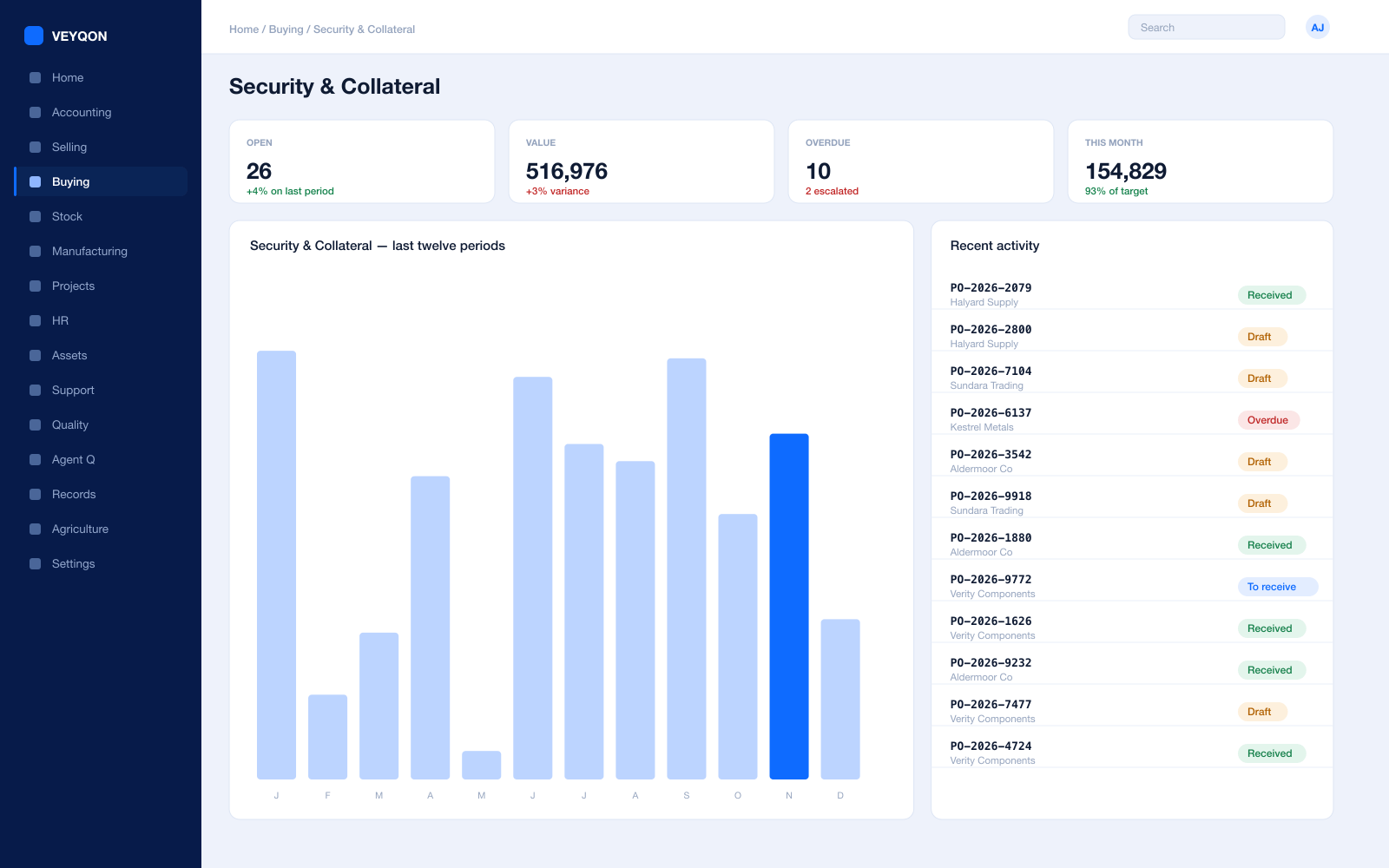
Loan security
Collateral held against the loan as a record, with what it is and who holds it rather than a note in a file.
Valuation
A value on the security with a date, so an assessment is current rather than the one taken at origination.
Revaluation
Values updated on a cycle, which is what makes a coverage ratio meaningful between reviews.
Shortfall
A drop below the required cover raised as an exception when it happens rather than at the next review.
Cover ratio
The required ratio held on the product, so the same rule applies across the book without anybody remembering it.
Release
Security released on settlement, recorded as an event so the discharge has a date and an owner.
Trail
Every valuation, exception, and release retained against the security for the life of the facility.
Provisioning & Write-off
Provision and write-off with approval and a permanent trail.
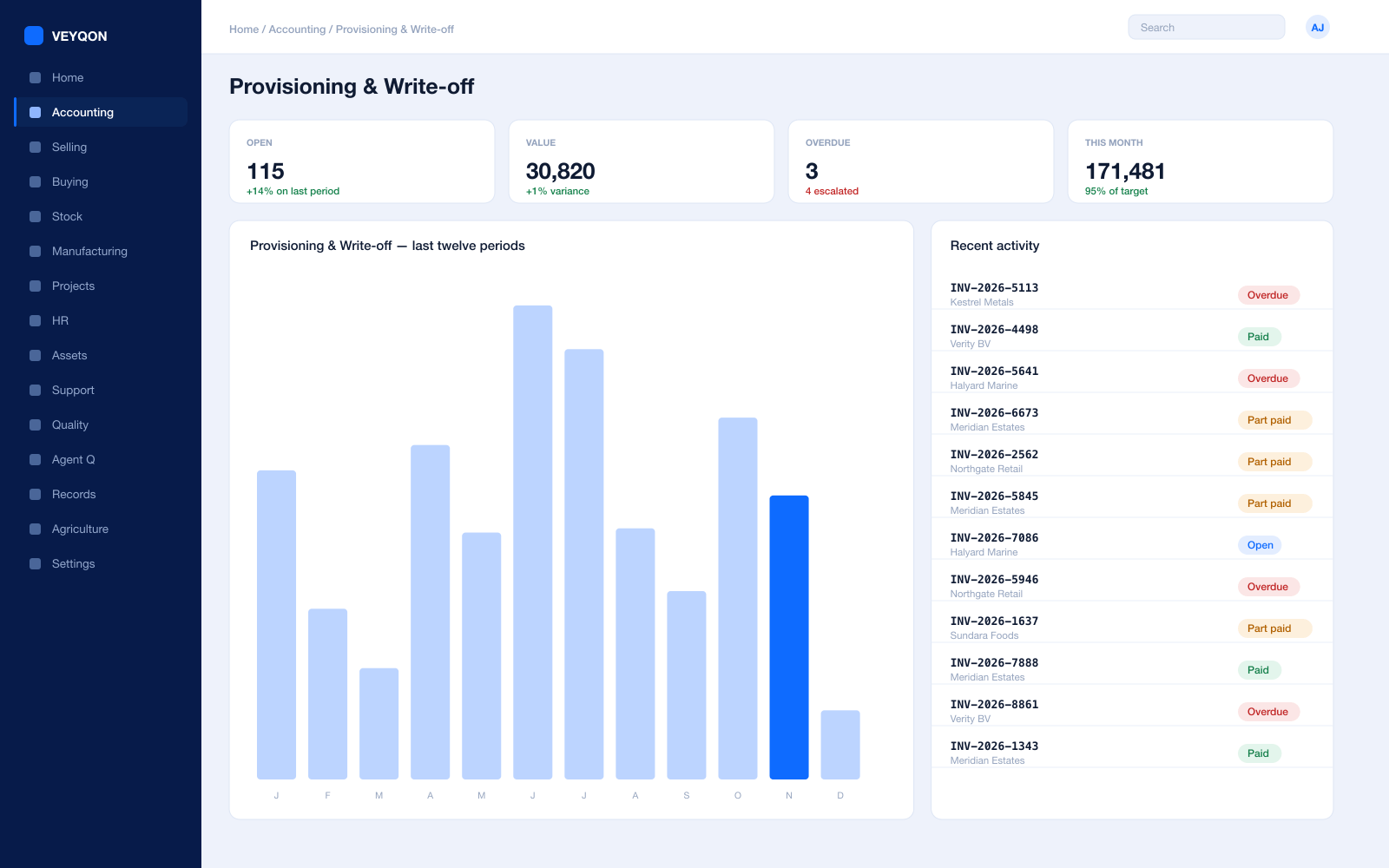
Provisioning
Impairment recognised against the book on a policy, posting to the ledger rather than living in a model.
Staging by arrears
Accounts grouped by how far behind they are, so a provision follows the state of the book rather than a judgement.
Write-off
A loan written off as a controlled document, with the provision released and the entries posted.
Approval
Write-off gated by role, so it is an authorised act with a named approver rather than an adjustment.
Recovery
Amounts recovered after write-off recorded against the original loan, so the history is complete.
Permanent trail
Nothing deleted. A written-off loan keeps its full history, which is the entire point of an audit trail.
Period close
Provisioning and accrual landing inside the period, with a lock that stops anyone reopening it afterwards.
CRM & Pipeline
Where the next loan comes from, and who introduced it.
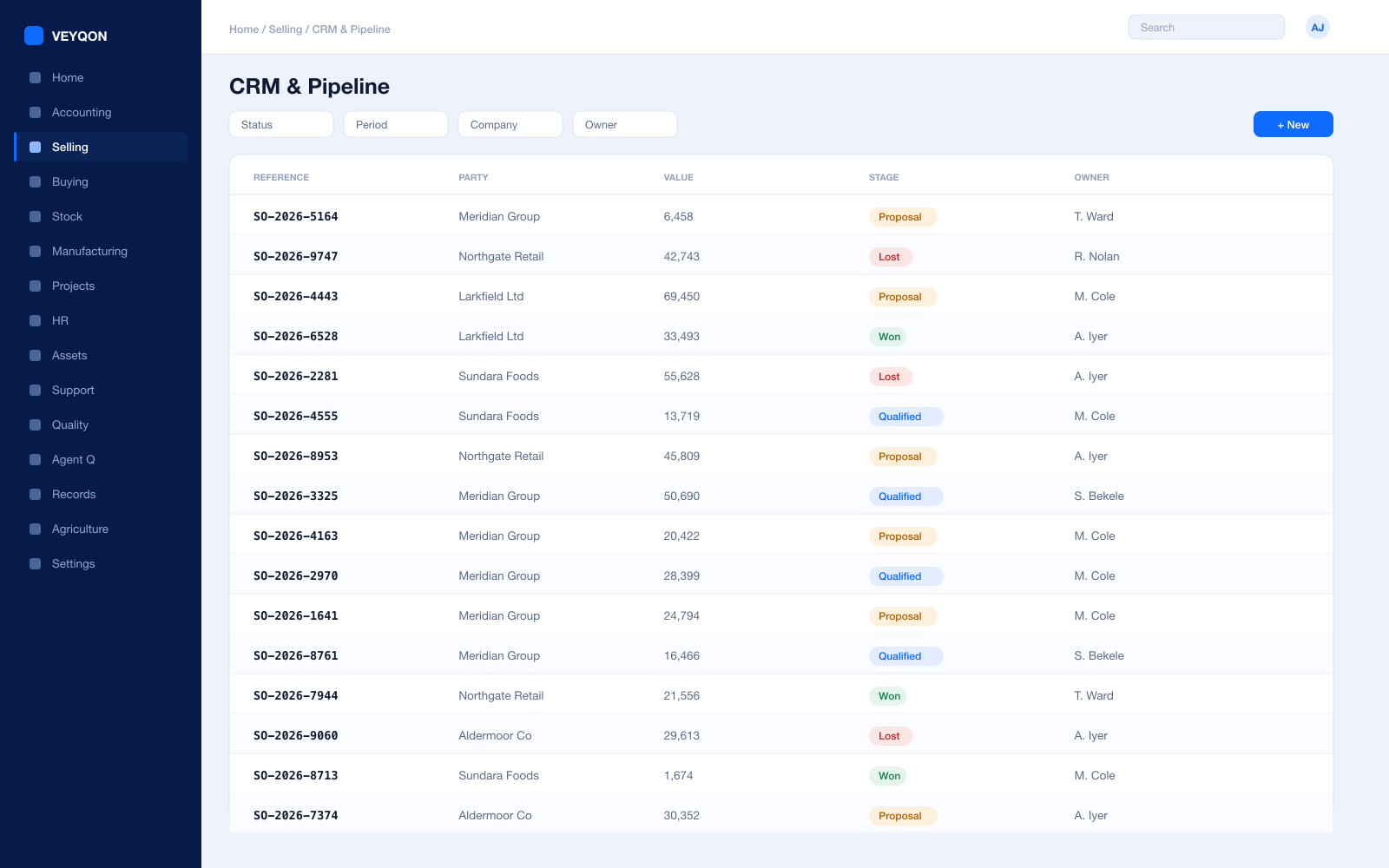
Leads
An enquiry with its source and territory captured at first contact rather than reconstructed later.
Opportunities
Value, probability, timing, and owner — which is what makes a lending forecast something you can fund against.
Stages
Where an application sits in origination, so pipeline reporting matches the operational reality.
Introducers and brokers
Partners with a type, a territory, and a commission rate copied onto the transactions they introduce.
Commission
Calculated and reported on the transaction, with settlement staying a deliberate purchase invoice rather than an automatic payable.
Customers and contacts
Held once and reused across application, loan, repayment, and support rather than retyped.
Contribution split
A percentage per person on the deal, which is how origination credit stops being an argument.
Support & Portal
Borrower queries with a clock, and complaints with a trail.
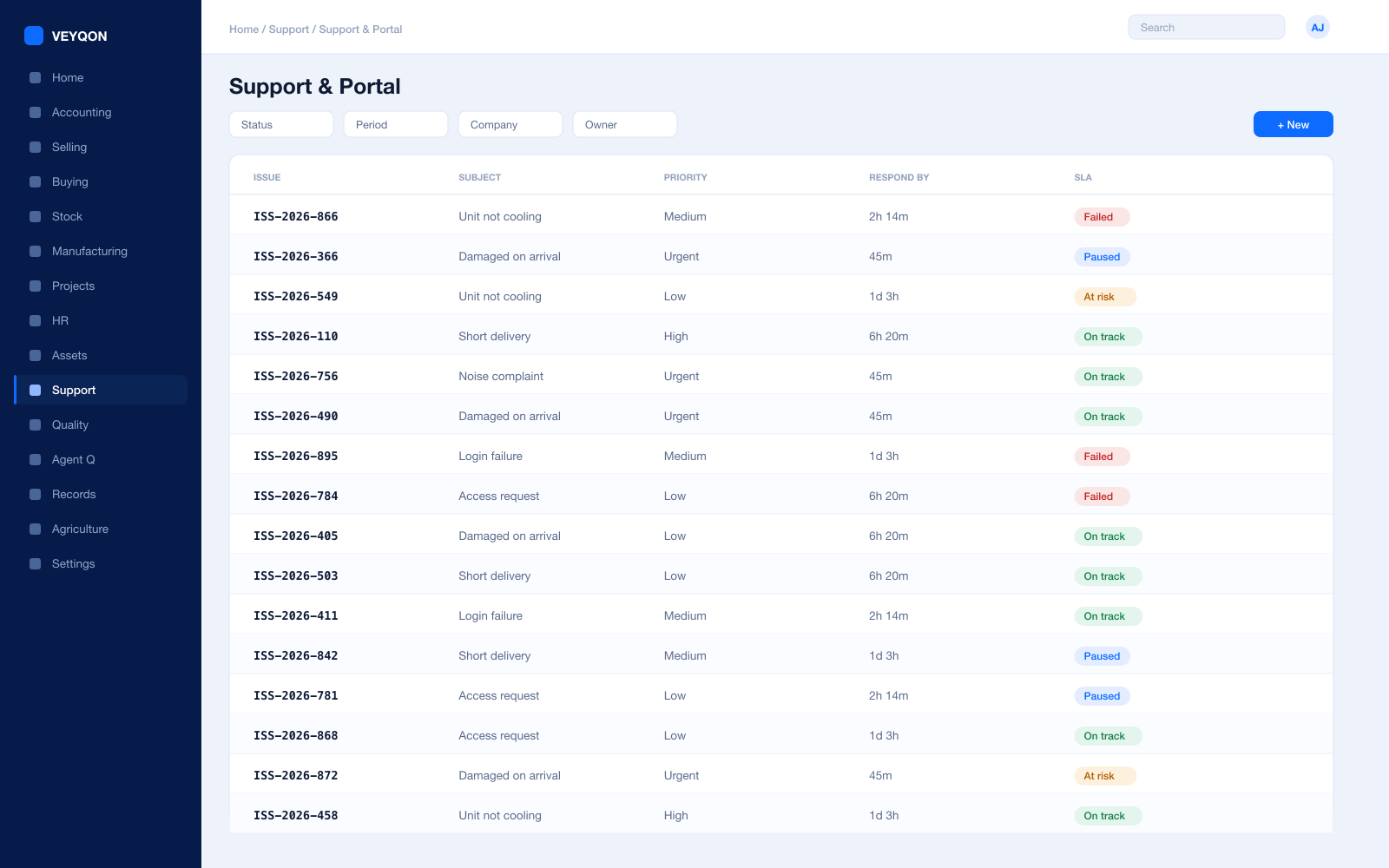
Issues
Raised by email, portal, or phone, and linked to the customer and the loan they concern.
Service level agreements
Priorities with a time to respond and a time to resolve — which a complaints procedure usually has to commit to publicly.
Support hours
The clock runs only in the hours you actually cover, and stops on the days the holiday list says you are shut.
SLA pause
The timer holds while you are waiting on the customer, with the hold time added back when they respond.
Fulfilled and failed
Every issue carrying whether the agreement was met, so a complaints return is a fact rather than an estimate.
Resolution record
What was done, by whom, and when, attached to the issue rather than living in a mailbox.
Borrower portal
Statements, schedules, and requests handled by the customer without a call, on the same permission model as everything else.
Accounts & Reporting
The loan book and the statutory ledger, out of the same postings.
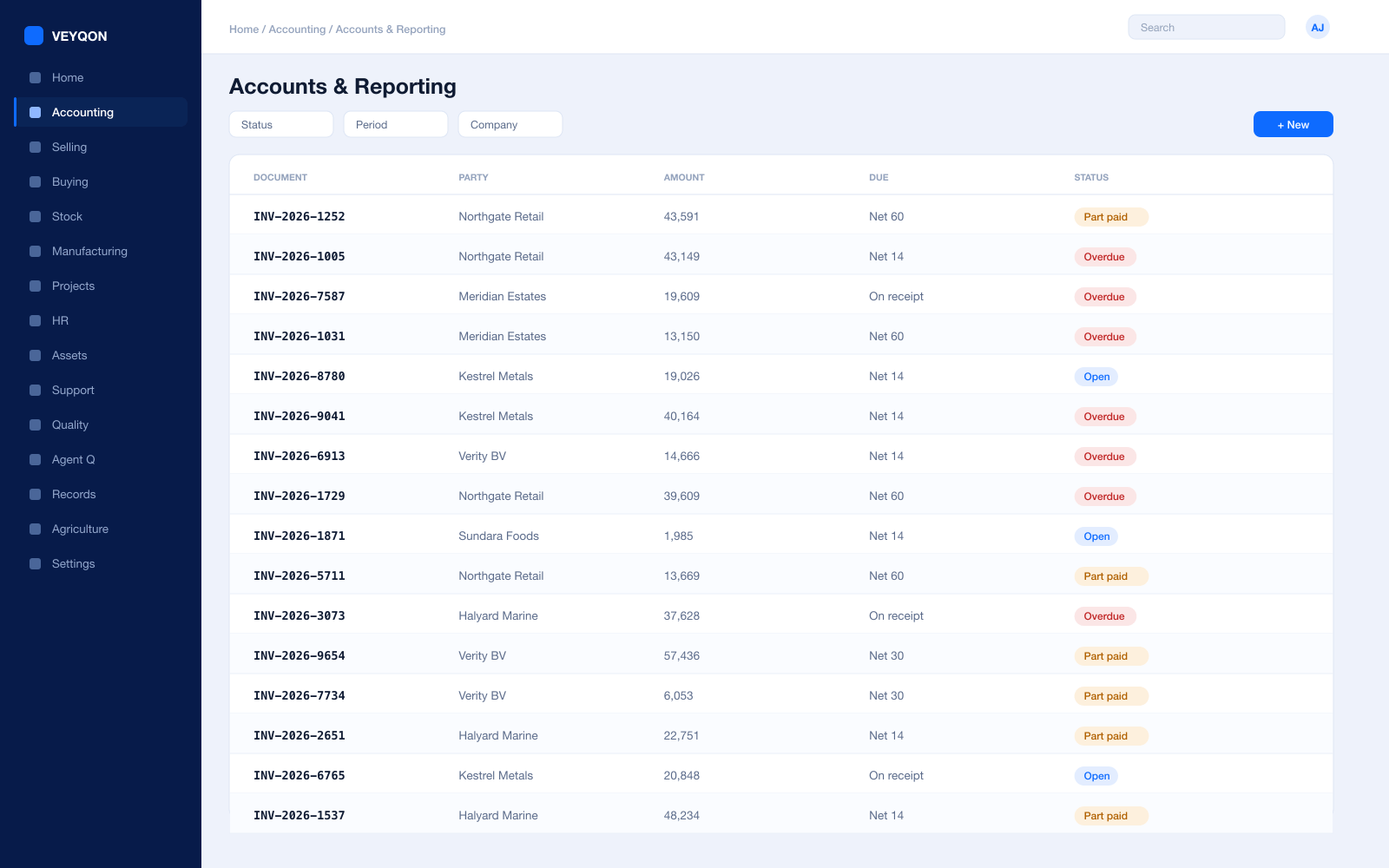
One ledger
Disbursement, accrual, repayment, provision, and write-off all posting to the accounts your statutory reporting comes from.
Cost centres and dimensions
By product, branch, or portfolio, with allocation splitting a central cost across several by percentage.
Budgets
Against cost centres, checked at request, order, and actual, with the action on exceeding set per stage.
Interest income
Recognised as it accrues rather than when it is received, which is the difference between a book and a cashbook.
Multi-currency
Lending and funding across currencies, with revaluation posting to the ledger.
Period close
Accruals, reconciliation, and a period lock that stops anyone back-posting into a month already reported.
Statutory and regulatory
Tax and the returns your regulator expects, from the same postings that produced the management accounts.
Immutable audit trail
Every posting carries who, when, and from which document, readable years later without asking anyone.
HR & Payroll
Regulated people, with the record to prove they are.
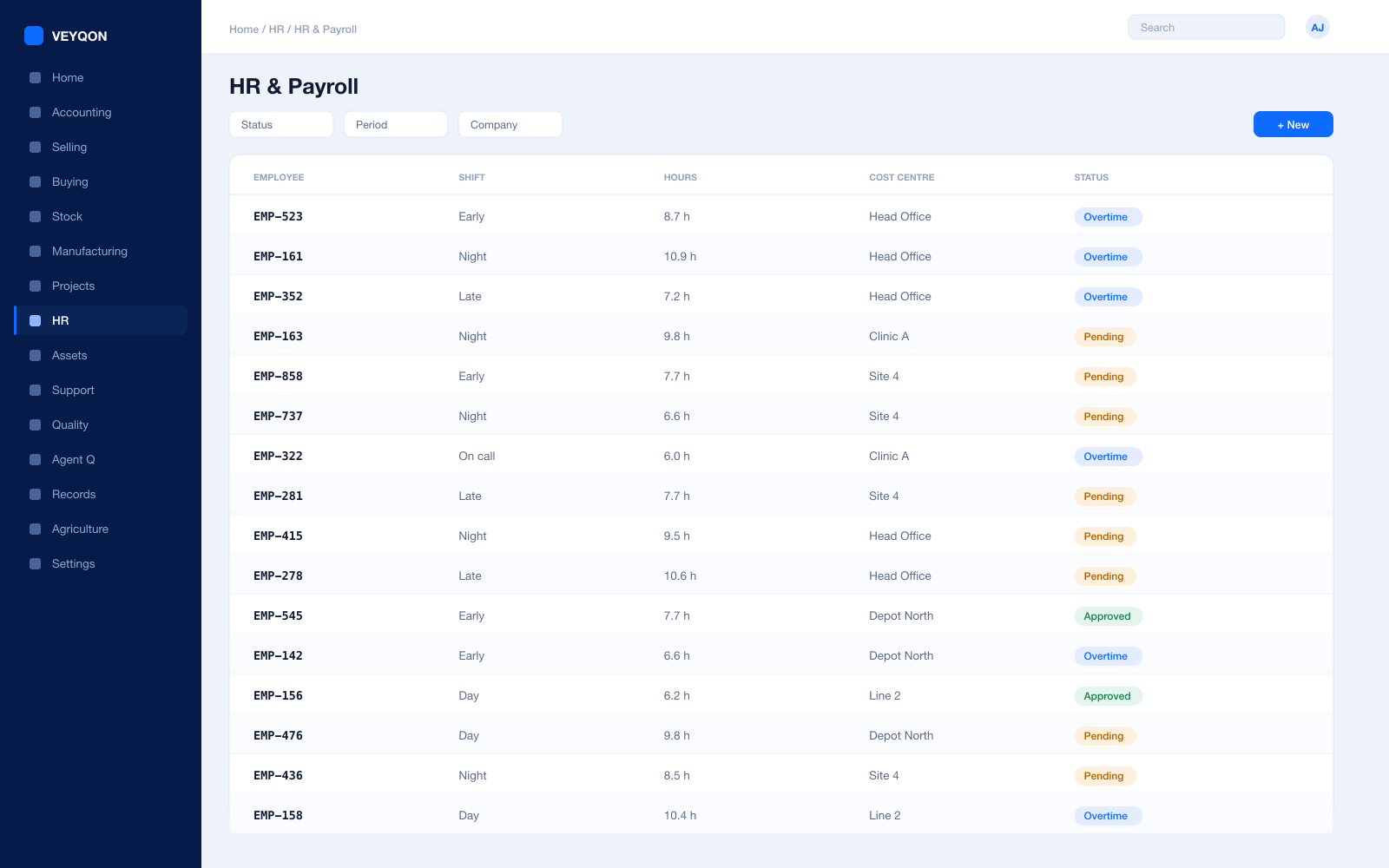
Employees
Staff on one record, with the roles and permissions they hold in the system alongside the job they do.
Competency and certification
Regulatory training and qualifications with expiry dates that surface before they lapse, not during an inspection.
Shifts and cover
Servicing and collections cover rostered, so an obligation with a clock on it has somebody behind it.
Leave and holiday lists
The working calendar that SLA clocks and collections activity are actually measured against.
Expenses
Claims against a cost centre, approved and posted rather than reimbursed on trust.
Payroll
Salary structures and runs with statutory deductions, posted into the same ledger as the book.
One pass through financial services, end to end.
- 01
Originate
Application, assessment, and security captured before approval.
- 02
Disburse
Funds released and the repayment schedule generated automatically.
- 03
Service
Repayments allocate correctly; arrears raise as exceptions on time.
- 04
Provide
Accrual, provisioning, and write-off post to the statutory ledger.
Running financial services on VEYQON, in four steps.
It is a subscription, not a project.
- 1
Subscribe
Pay by card. Provisioned straight away.
Minutes - 2
Bring your data
Balances, items, customers, suppliers.
Day one - 3
Switch modules on
Warehouses, limits, and approvals.
Week one - 4
Go live
Run parallel, then cut over.
You choose
All 10 modules included. Nothing sold separately.