Serial numbers that survive the whole warranty.
Parts traced by serial and batch from supplier to vehicle to claim, with service history that follows the unit rather than the customer.
10 modules·87 features·Configured on the core
The modules behind automotive.
Not a list of module names. Each one below opens onto what is inside it and why a automotive business needs it — so you can check it against how your operation actually runs.
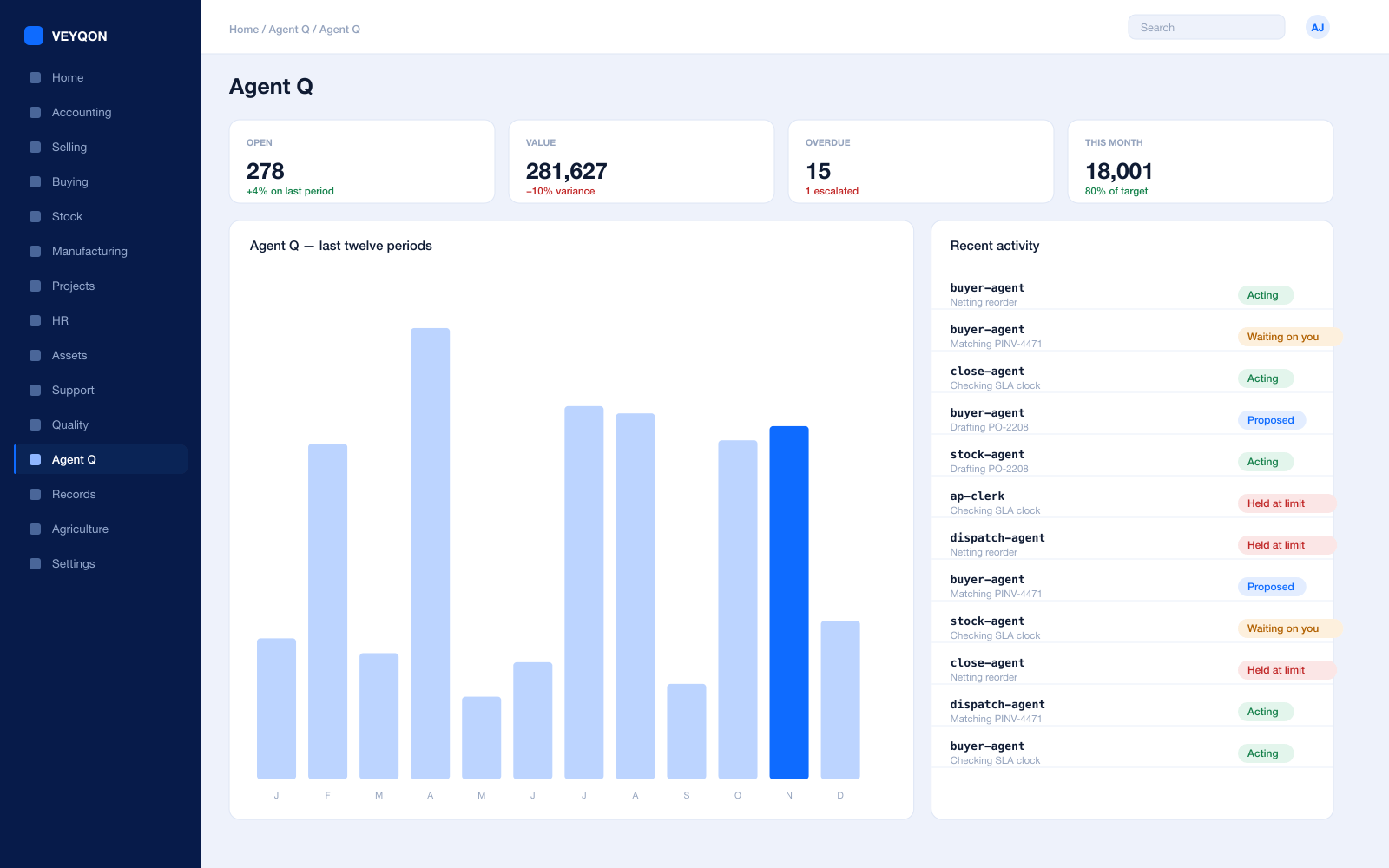
Agent Q
Agents that read your own records and act on them, scoped to how a automotive business runs.
Grounded in live records
Every answer is drawn from your own ledger with your permissions applied, and names the documents it used. Nothing is answered from a snapshot or a summary.
A role, not a prompt
Each agent is scoped like a job — accounts payable, procurement, dispatch, period close — with the same limits you would put on the person doing it.
Explicit tool permissions
An agent holds a named list of the actions it may take. Matching an invoice does not imply paying one.
Value and action limits
A hard ceiling per agent, per period, and per document type, which it cannot cross however it is asked.
The queue
What every agent is working on, what is waiting on a person, and what has been held — in one place, with the reason on each item.
Triggers
An arriving document, a breached threshold, a date, or a state change on a record. Agents start on events, not on somebody remembering.
Human approval gates
Anything over a limit routes to a named person, with the reasoning attached, so approving takes seconds rather than an investigation.
Escalation paths
Who it hands to when it reaches a limit, how long it waits first, and what that person sees when it arrives.
Segregation of duties
An agent cannot approve what it raised. The rule that applies to your people applies to your agents.
Full reasoning log
Every step is written to the audit trail on the document it touched, so a decision can be read back months later.
Ask in plain language
The console answers operational questions from live records and offers the next action, rather than handing back a paragraph.
Spend control
Ceilings per agent and per period, so autonomy runs to a budget you set rather than an open account.
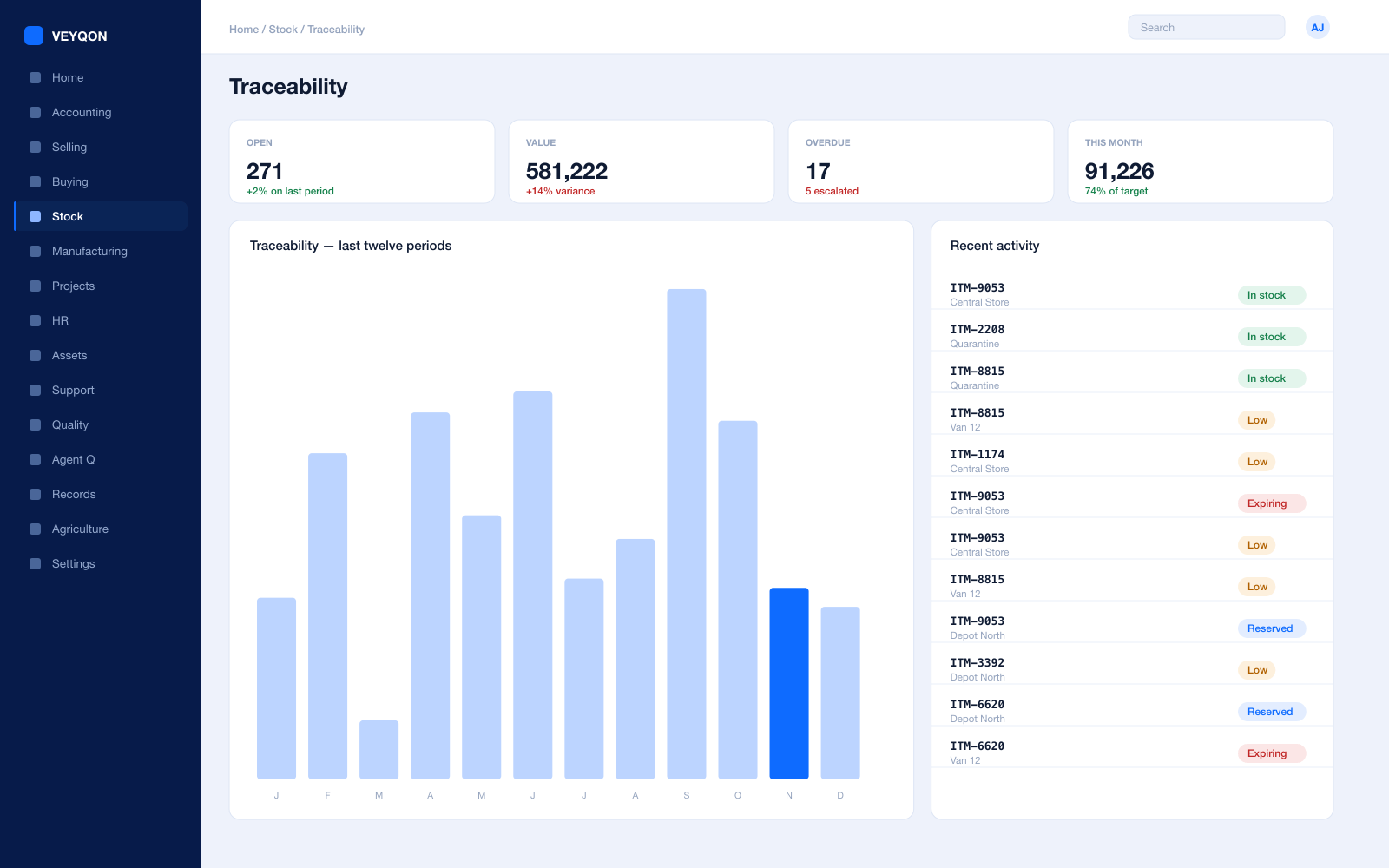
Traceability
The serial that has to survive the whole warranty, and everything hanging off it.
Serial numbers
One record per unit, carried from goods receipt through assembly to a warranty claim years later.
Batch numbers
Where a part is traced by lot rather than by unit, with expiry where it applies, created by hand or generated on receipt.
Created from the work order
Serials and batches generated when the order is raised, so traceability starts before the first unit exists.
Genealogy through assembly
Serials consumed into the parent, so the tree reads downward into components and upward into what they became.
Filtered by warehouse and date
What can be transacted is constrained by item, warehouse, expiry against the posting date, and available quantity.
Splitting and moving
A lot divided or relocated between warehouses without losing what it was or where it came from.
Two-way trace
From a supplier lot to every unit it went into, and from a unit back to every lot inside it — in one query, not a week of spreadsheets.
Warranty and AMC dates
Warranty expiry and AMC expiry on the serial, so “is this covered” is a date rather than a judgement call at the counter.
The inspection that released it
The readings that passed a part into stock, retrievable against the serial or batch that carries them.
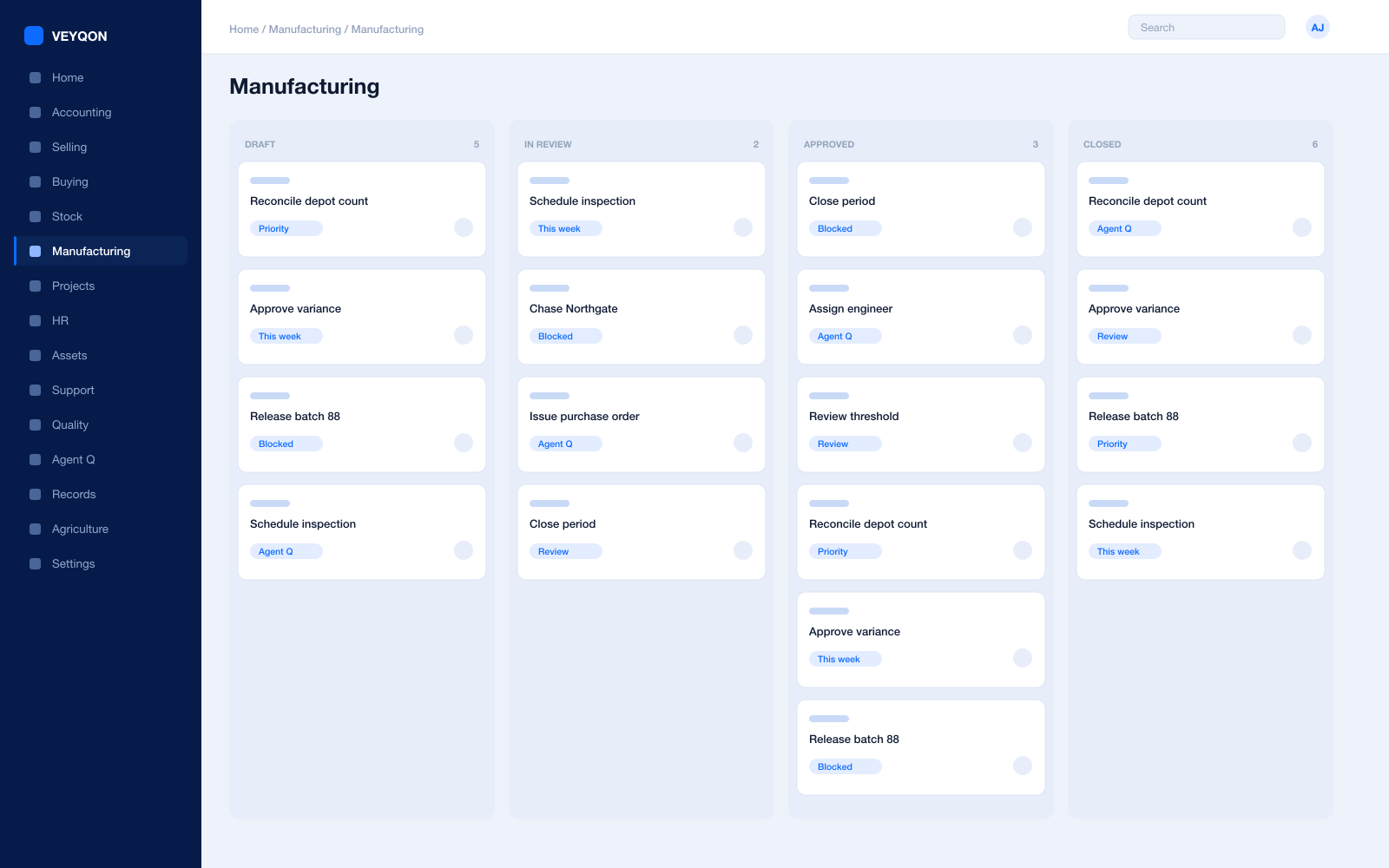
Manufacturing
Building to a takt with the genealogy intact.
Multi-level BOMs
Sub-assemblies exploding into a full raw-material tree, with scrap, by-products, and process loss on the same document.
Routings and operations
A reusable set of operations, each with its workstation, time in minutes, batch size, and hourly rate.
Enforced sequence
A sequence ID per operation. A job card cannot be completed before the one it depends on, and the system refuses rather than warns.
Capacity scheduling
Workstation hours, a holiday list, and how many jobs a station runs at once, all respected when job cards are scheduled.
Production planning
Demand netted against projected stock, with make, buy, or subcontract decided per sub-assembly rather than as a policy.
Work orders
Source, WIP, finished goods, and scrap warehouses, with material backflushed against the BOM or against what was actually transferred.
Job cards
Time logs, the operator who ran it, and completed, scrap, and rejected quantity recorded separately.
Subcontracting
Your material tracked at the supplier’s warehouse, with finished goods and scrap returning on a subcontracting receipt.
Scrap and process loss
Scrap percentage per material, scrap items at their own rate, and process loss where the loss is the finished item itself.
Configurations as variants
Trim, market, and options as attributes on one template rather than a separate item master for every combination.
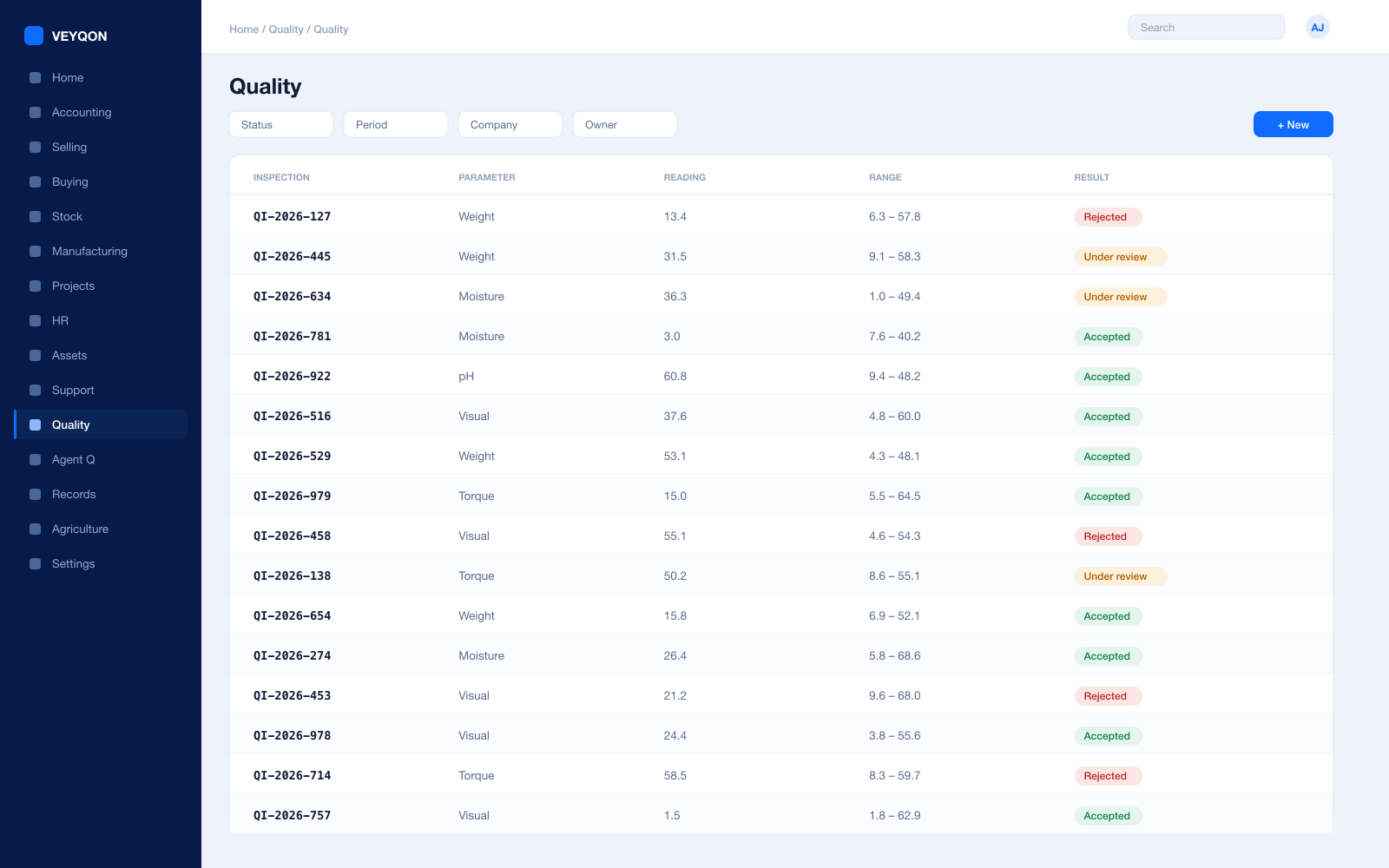
Quality
Catching it before it reaches the line, and before it reaches a customer.
Inspection templates
Reusable parameters and acceptance criteria pulled onto every inspection, so two inspectors check the same things.
Incoming inspection
Supplier parts checked on the purchase receipt before they reach the line, with rejected quantity split off to its own warehouse.
In-process inspection
Raised from the job card at the point the operator sees the problem, rather than at the end of the shift.
Outgoing inspection
Checked on the delivery note before it leaves, so a rejection costs a rework and not a recall.
Numeric criteria
A minimum and maximum per reading, with anything outside the range rejected the moment it is saved.
Formula criteria
Expressions across several readings, for means, derived values, and tolerances that depend on more than one measurement.
Blocking submission
With the criteria enabled on the item, the receipt or the delivery does not post until the inspection is submitted.
Non conformance
An observation that a procedure was not followed, filed by anyone and linked to the procedure it breached.
Procedures and review
Documented processes with owners, and a periodic review that is a record rather than a meeting nobody minuted.
Warranty & Service
A history that follows the unit rather than the owner.
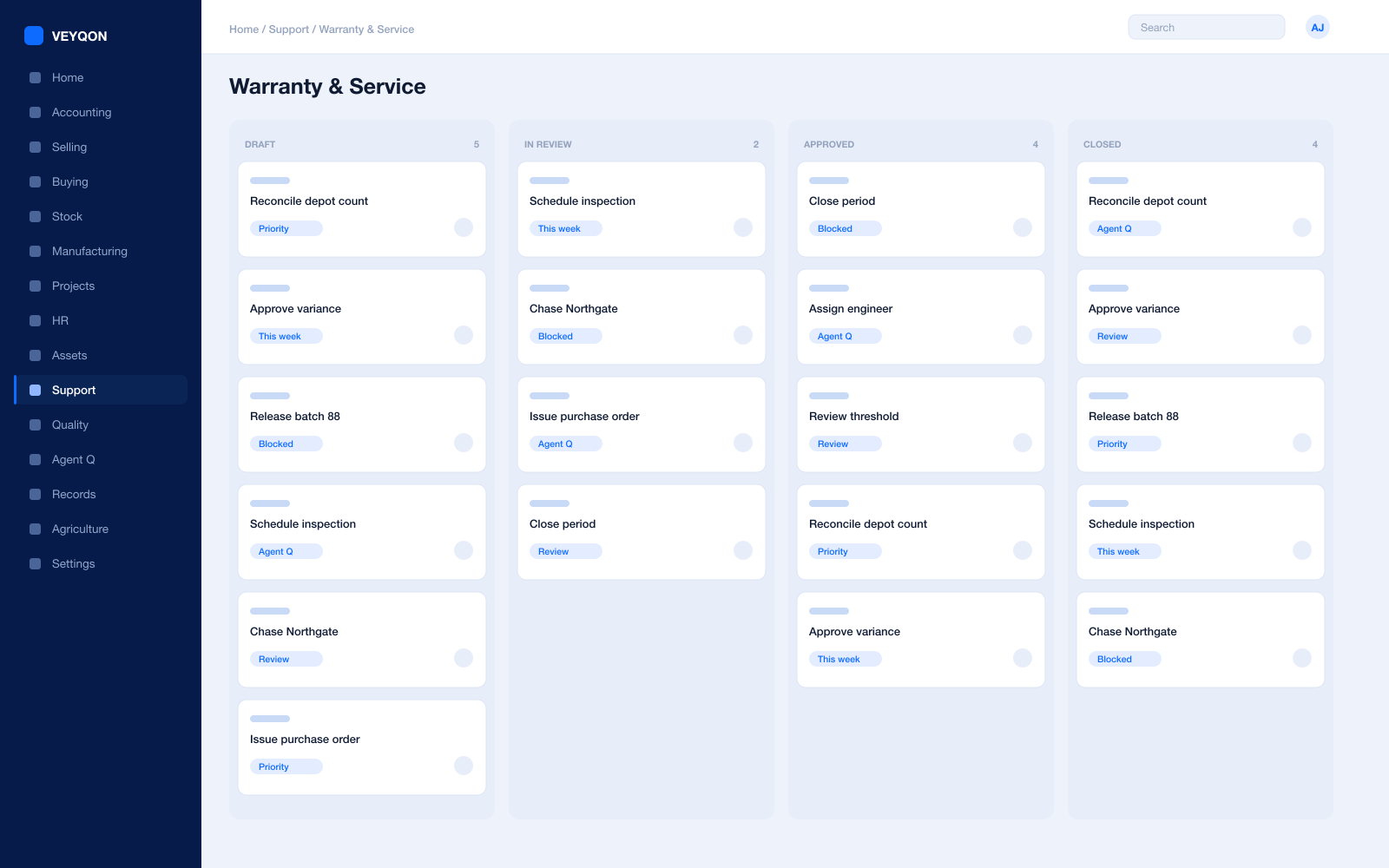
Warranty claim
Raised against the serial number, which pulls the item, its description, and its warranty position onto the claim automatically.
Cover status
Under Warranty, Out of Warranty, Under AMC, or Out of AMC — adjustable by a person where the unit was tampered with or the terms are void.
Resolution record
The resolution date, who resolved it, the detail of what was done, and images attached to the claim itself.
Maintenance schedule
Service intervals generated weekly, monthly, quarterly, half-yearly, yearly, or at random, as a row per visit between two dates.
Allocated to a person
Each item on the schedule allocated to a named sales person, with calendar events created when it is submitted.
Maintenance visit
Raised from a claim or from the schedule, recording the work done on site and closed against the unit.
Parts consumed
Components taken from stock onto the visit, so the cost of the service is the real cost of the service.
Recovery from the supplier
The claim traces to the supplier lot the failed part came from, which is where the recovery conversation starts.
Service history
Every visit and claim against the serial, building a history that outlives the customer who first bought it.
Stock
Parts, line-side, with the serial intact all the way through.
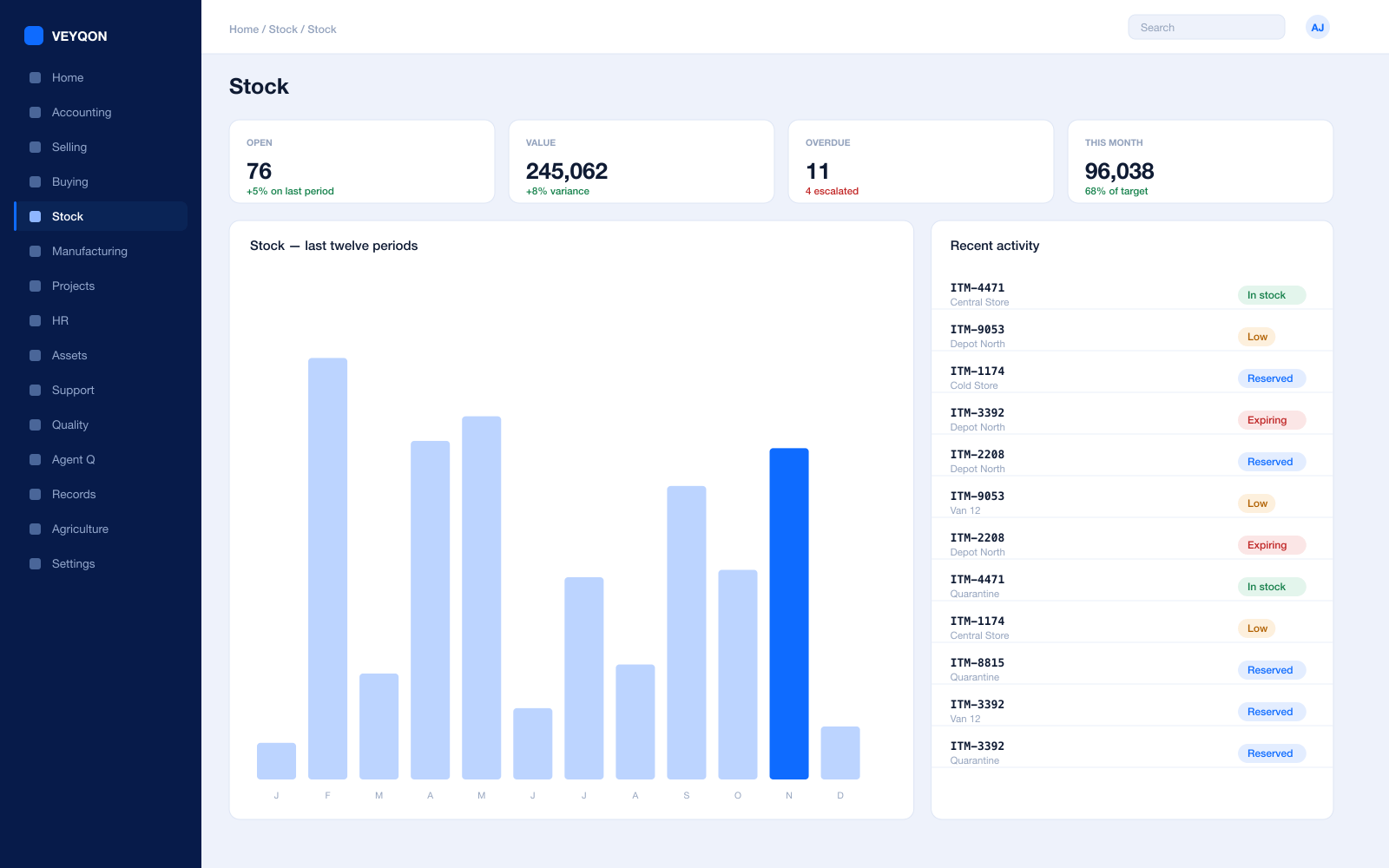
Multi-warehouse tree
Goods-in, quarantine, line-side, WIP, and finished stock in one hierarchy you can report across.
Serial and batch
Serial numbers per unit and batches per lot, selected at pick and carried onto the document that moves them.
Valuation
FIFO or moving average per item, with perpetual inventory posting to the general ledger on every movement.
Landed cost
Freight and duty distributed into item valuation on the receipt rather than into an overhead pot.
Pick lists
Warehouses chosen FIFO, several orders picked in one wave, with a barcode scan mode for the floor.
Putaway rules
Where a receipt lands decided by rule and capacity rather than by whoever is on shift.
Stock reconciliation
Counts posted against book stock, with the difference valued and accounted rather than adjusted quietly.
Returns
A return against the original delivery or receipt, with stock and value reversing together.
UOM conversion
Buy by the box, consume by the unit — one item, with the conversion held on the record.
Procurement
Suppliers whose defects become your recall.
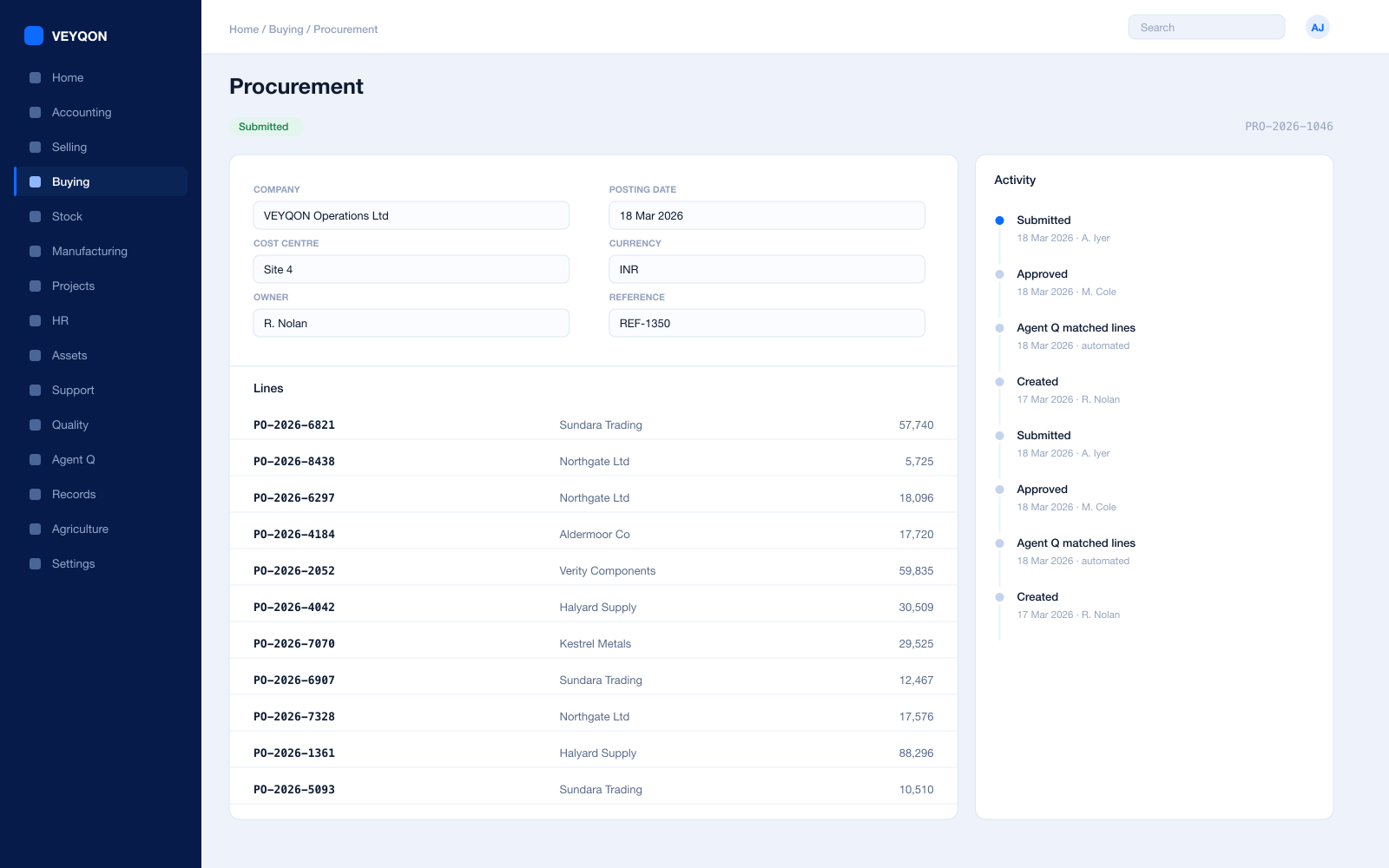
Material requests
Raised from a production plan, a reorder level, or by hand, with approval routing by value and cost centre.
Requests for quotation
Out to several suppliers at once, with a portal for them to respond on rather than a mailbox to chase.
Purchase orders
Against supplier price lists, with a delivery schedule per line rather than one date for the whole order.
Blanket orders
An agreed quantity and price over a period, drawn down by individual orders against it.
Receipts with rejection
Accepted and rejected quantity split on the receipt, with a rejected warehouse and the inspection attached.
Three-way matching
Order, receipt, and invoice reconciled before anything is paid, with the variance visible rather than absorbed.
Supplier scorecards
Quality, delivery, and responsiveness scored from your own receipts over rolling periods, with standings that can block a supplier.
Subcontracting orders
The service item priced separately from the material you supply, with your stock tracked at their site.
Selling
Orders that know exactly which unit they were filled with.
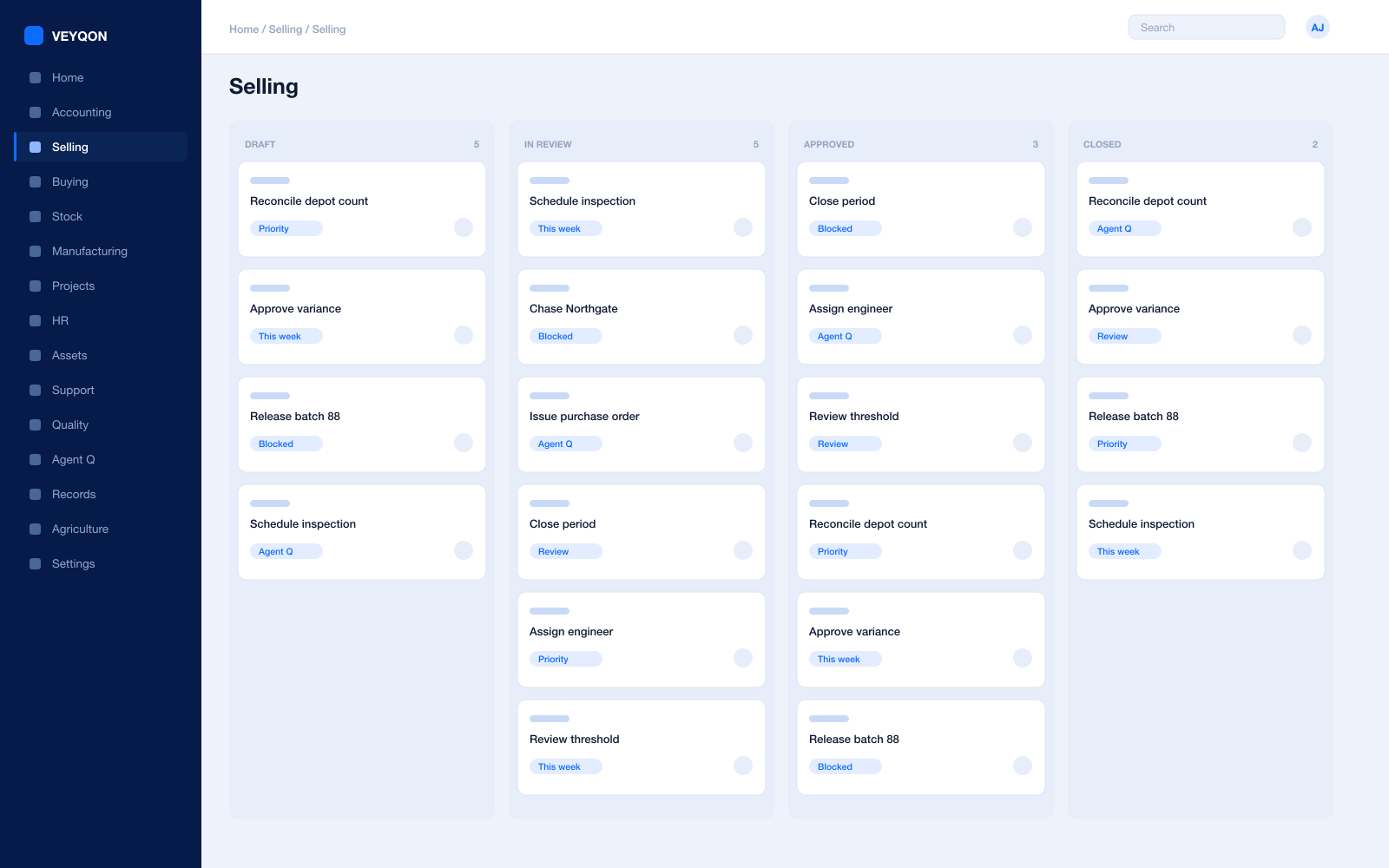
Customers and price lists
A default selling list per customer, by currency and territory, so the contracted price is simply the price.
Quotations
Items, quantities, prices, taxes, validity, and terms, converting to an order in one step.
Sales orders
A delivery date per line, partial delivery, and partial billing across as many documents as the programme takes.
Pricing rules
By item, item group, or brand, for a customer, customer group, or territory, applied at order entry rather than corrected later.
Product bundles
A kit sold as one line and picked as its components, with stock moving for the parts rather than a parent.
Serial at despatch
The specific units allocated at pick and recorded on the delivery, which is what makes a recall a list rather than a guess.
Credit limits
Set on the customer, the customer group, or the company, blocking submission over the ceiling with a named role for exceptions.
Accounts
Cost per unit built, and what the failures cost you.
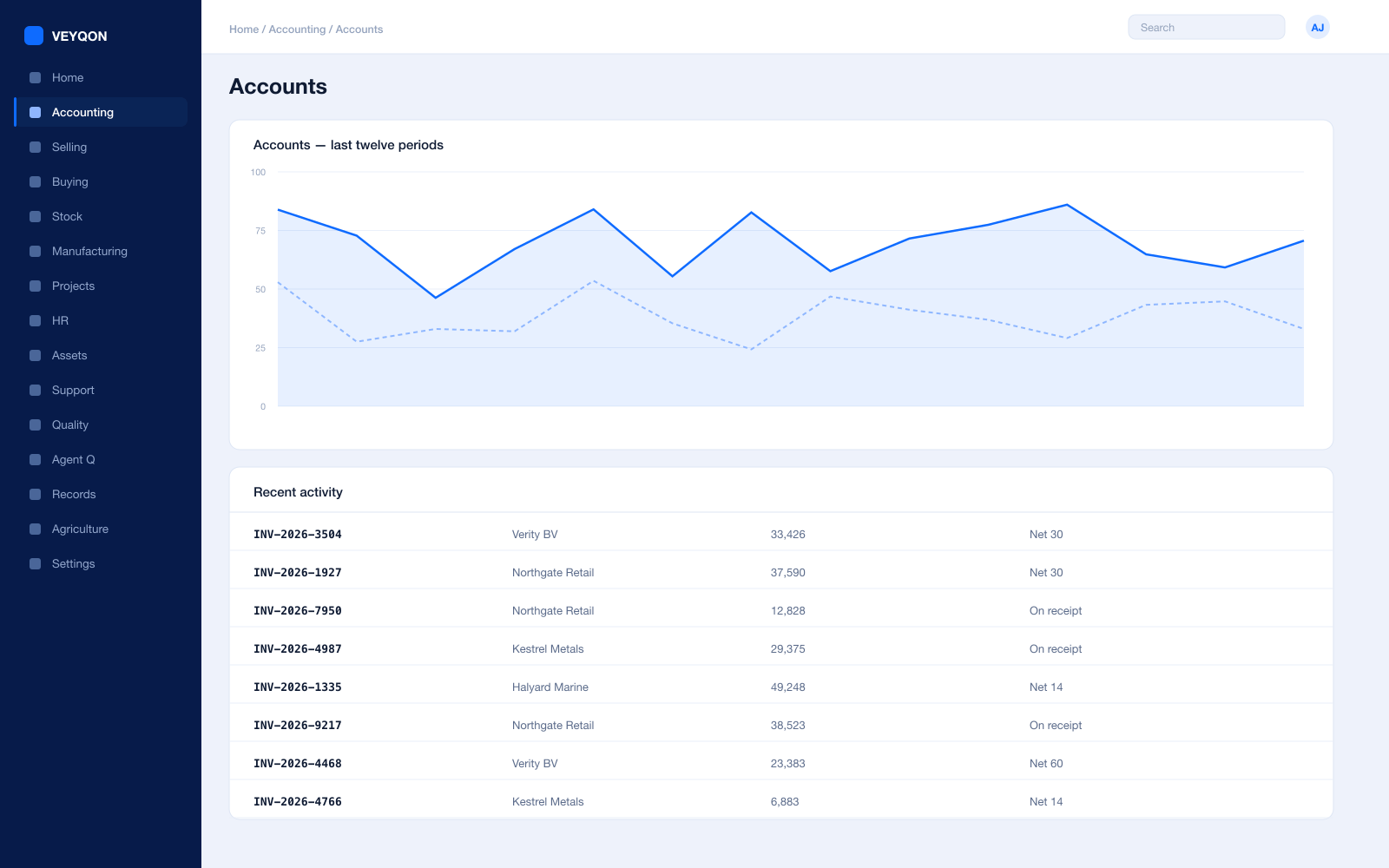
Perpetual inventory
Every stock movement posts to the general ledger as it happens, so the stock account and the stock ledger cannot drift apart.
Cost of production
Material, operating, and subcontracting cost landing in the value of the finished unit rather than in a general overhead pot.
Cost centres and dimensions
By plant, line, or programme, with allocation splitting one amount across several by percentage.
Budgets
Against cost centres and projects, with the action on exceeding set to warn the person or stop the document.
Multi-currency
Parts bought and units sold across borders, with revaluation posting to the ledger.
Period close
Accruals, reconciliation, and a period lock that stops anyone back-posting into a month you have reported.
Statutory tax
VAT, GST, and withholding with your region’s filing formats, including reverse charge on imports.
Immutable audit trail
Every posting carries who, when, and from which document, readable months later without asking anyone.
HR & Payroll
The line, the shifts, and who is signed off to run what.
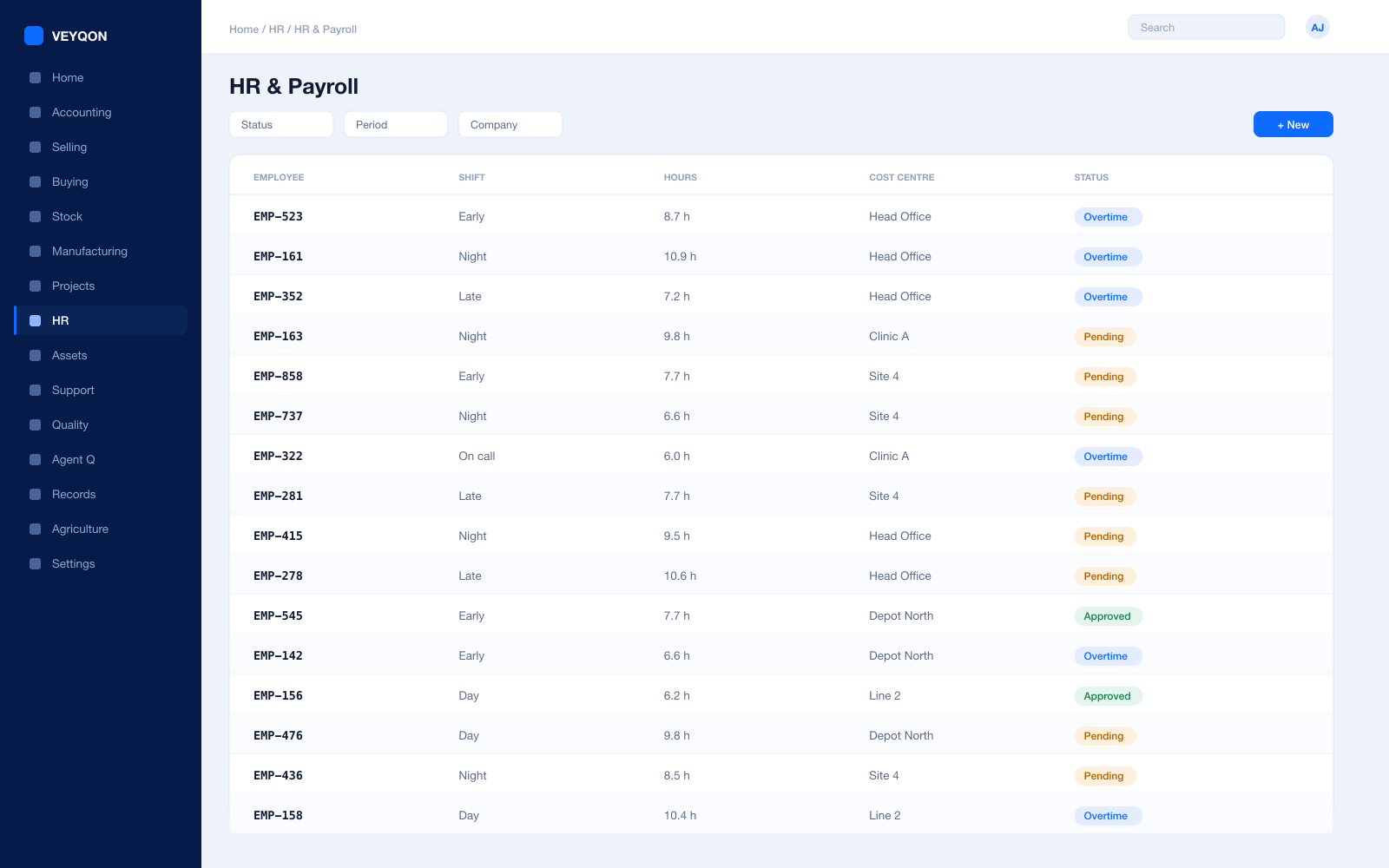
Shifts and rosters
Line and maintenance shifts assigned, with cover and overtime visible before the week starts.
Attendance and check-in
From biometric devices or check-in, feeding shift compliance and overtime instead of a spreadsheet.
Labour on the job card
The operator recorded on the card at their rate, so labour lands in the cost of the run rather than in overhead.
Leave and holiday lists
The working calendar that production scheduling actually respects.
Payroll
Salary structures and runs with statutory deductions, posted into the same ledger as everything else.
Certification
Where an operation requires a certified operator, the certificate is on the employee with a date on it.
One pass through automotive, end to end.
- 01
Receive
Parts arrive serialised and inspected against a quality template.
- 02
Build
Serials consume into the assembly, so the genealogy is retained.
- 03
Service
Visits attach to the serial, building a history that outlives the owner.
- 04
Recover
Claims trace to the supplier batch and recover the cost.
Running automotive on VEYQON, in four steps.
It is a subscription, not a project.
- 1
Subscribe
Pay by card. Provisioned straight away.
Minutes - 2
Bring your data
Balances, items, customers, suppliers.
Day one - 3
Switch modules on
Warehouses, limits, and approvals.
Week one - 4
Go live
Run parallel, then cut over.
You choose
All 10 modules included. Nothing sold separately.