Cost control from tender to final account.
Project budgets, subcontractor commitments, plant, and labour against one cost plan, so a variance shows while there is still time to act on it.
10 modules·85 features·Configured on the core
The modules behind construction.
Not a list of module names. Each one below opens onto what is inside it and why a construction business needs it — so you can check it against how your operation actually runs.
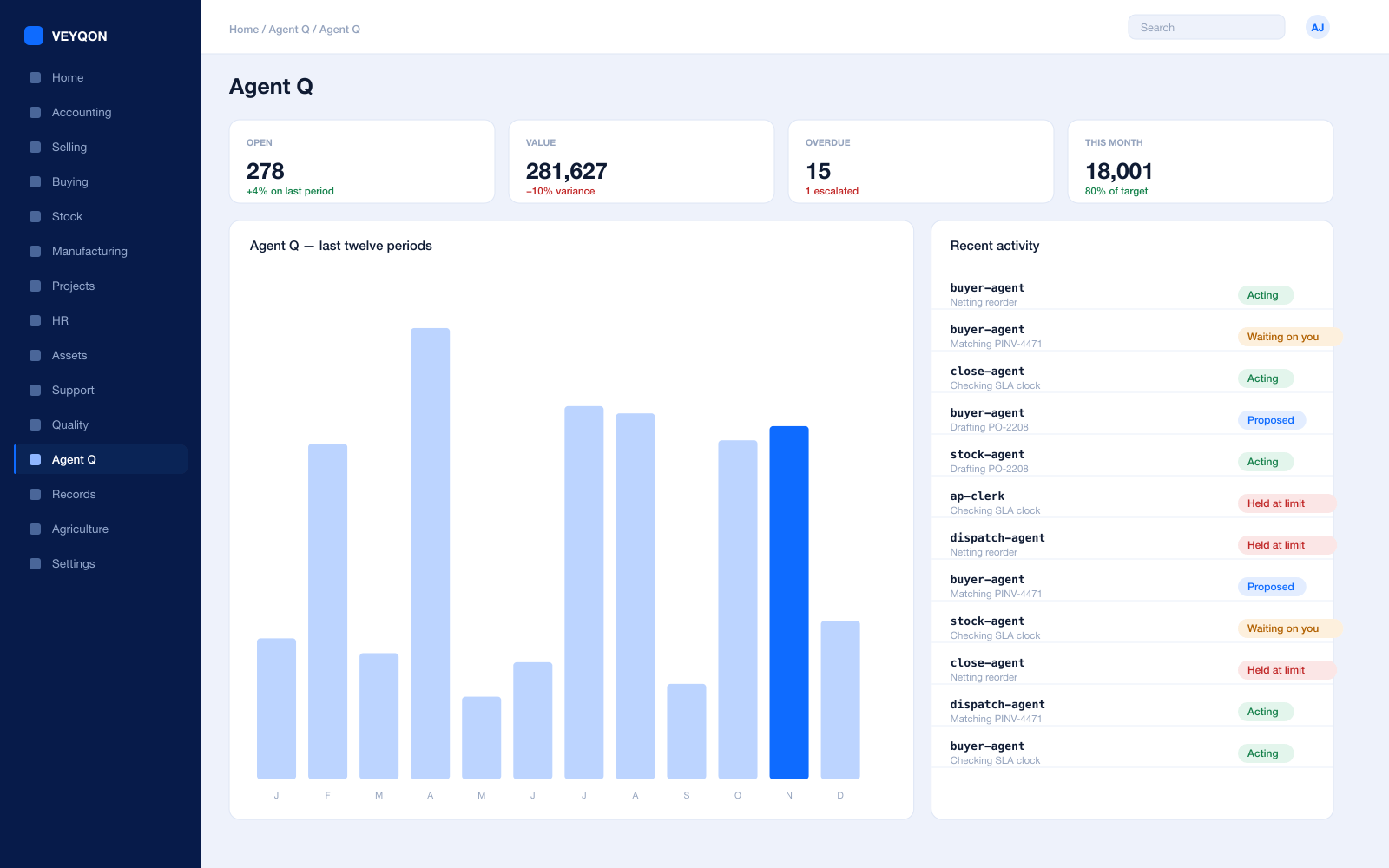
Agent Q
Agents that read your own records and act on them, scoped to how a construction business runs.
Grounded in live records
Every answer is drawn from your own ledger with your permissions applied, and names the documents it used. Nothing is answered from a snapshot or a summary.
A role, not a prompt
Each agent is scoped like a job — accounts payable, procurement, dispatch, period close — with the same limits you would put on the person doing it.
Explicit tool permissions
An agent holds a named list of the actions it may take. Matching an invoice does not imply paying one.
Value and action limits
A hard ceiling per agent, per period, and per document type, which it cannot cross however it is asked.
The queue
What every agent is working on, what is waiting on a person, and what has been held — in one place, with the reason on each item.
Triggers
An arriving document, a breached threshold, a date, or a state change on a record. Agents start on events, not on somebody remembering.
Human approval gates
Anything over a limit routes to a named person, with the reasoning attached, so approving takes seconds rather than an investigation.
Escalation paths
Who it hands to when it reaches a limit, how long it waits first, and what that person sees when it arrives.
Segregation of duties
An agent cannot approve what it raised. The rule that applies to your people applies to your agents.
Full reasoning log
Every step is written to the audit trail on the document it touched, so a decision can be read back months later.
Ask in plain language
The console answers operational questions from live records and offers the next action, rather than handing back a paragraph.
Spend control
Ceilings per agent and per period, so autonomy runs to a budget you set rather than an open account.
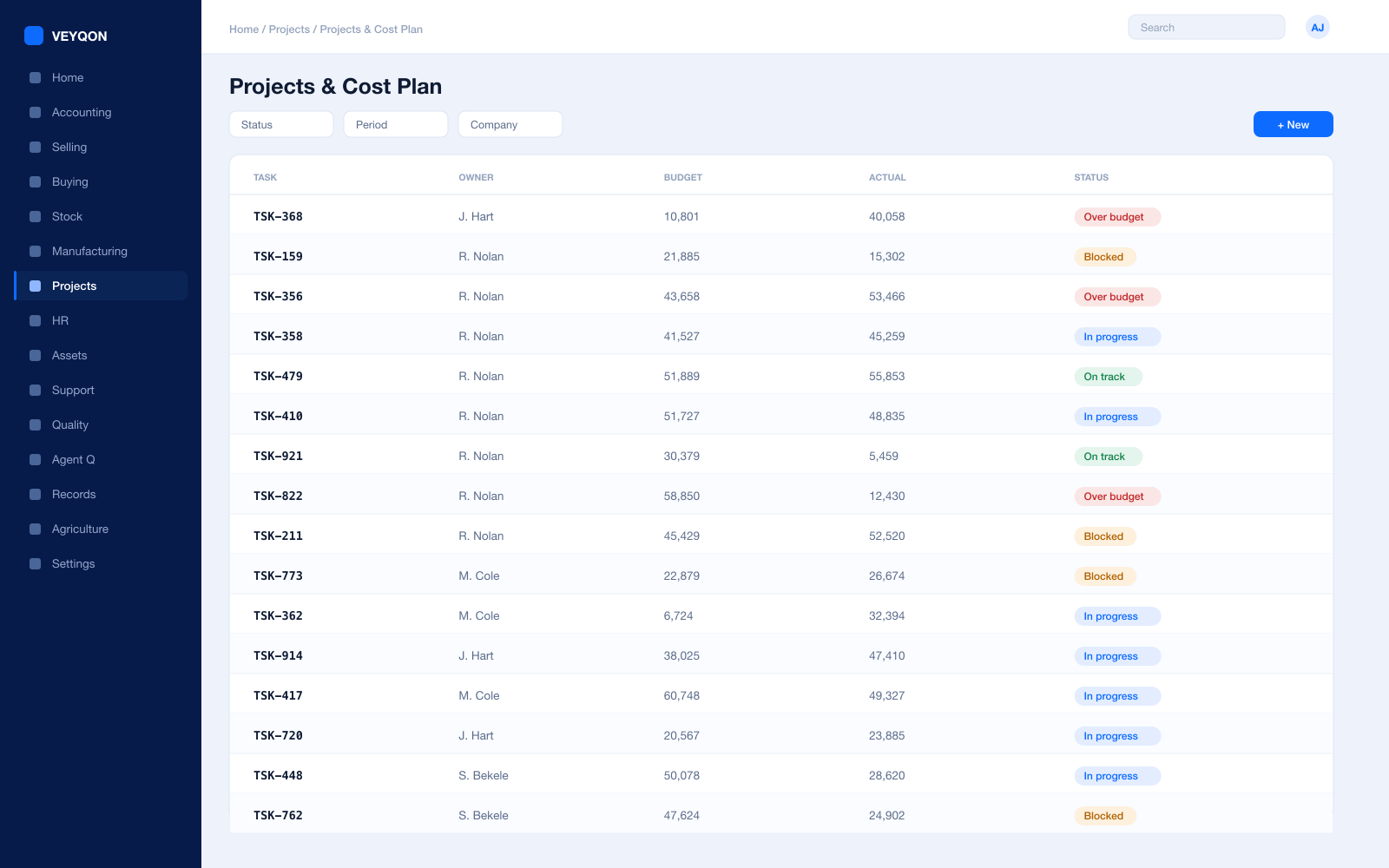
Projects & Cost Plan
The tender turned into a cost plan you can report against every week.
Project and work breakdown
The job as a project with tasks beneath it, so cost reports against the structure the site actually works to.
Project templates
Repeatable job shapes with tasks and estimates prefilled, so a similar scheme is scoped in an afternoon.
Tasks and dependencies
What has to happen before what, so a slipped pour shows as a slipped programme rather than as a surprise.
Budget per line
Estimated cost and estimated billing on the plan, which is the baseline every variance is measured against.
Percent complete
Driven by task completion or by measured work, for the valuation conversation rather than a feeling.
Programme dates
Start, end, and float on the tasks, so a delay has a date attached to it and not just an opinion.
Material to the task
Issues booked to the task rather than to the site in general, so the cost lands where the work happened.
Cost to complete
Actual and committed against budget, so the remaining exposure is a number rather than an estimate.
Multiple sites
Several jobs running at once, each with its own plan, reporting up to a single view.
Project on every document
The reference carried on orders, timesheets, stock entries, and invoices — which is what makes the cost figure true.
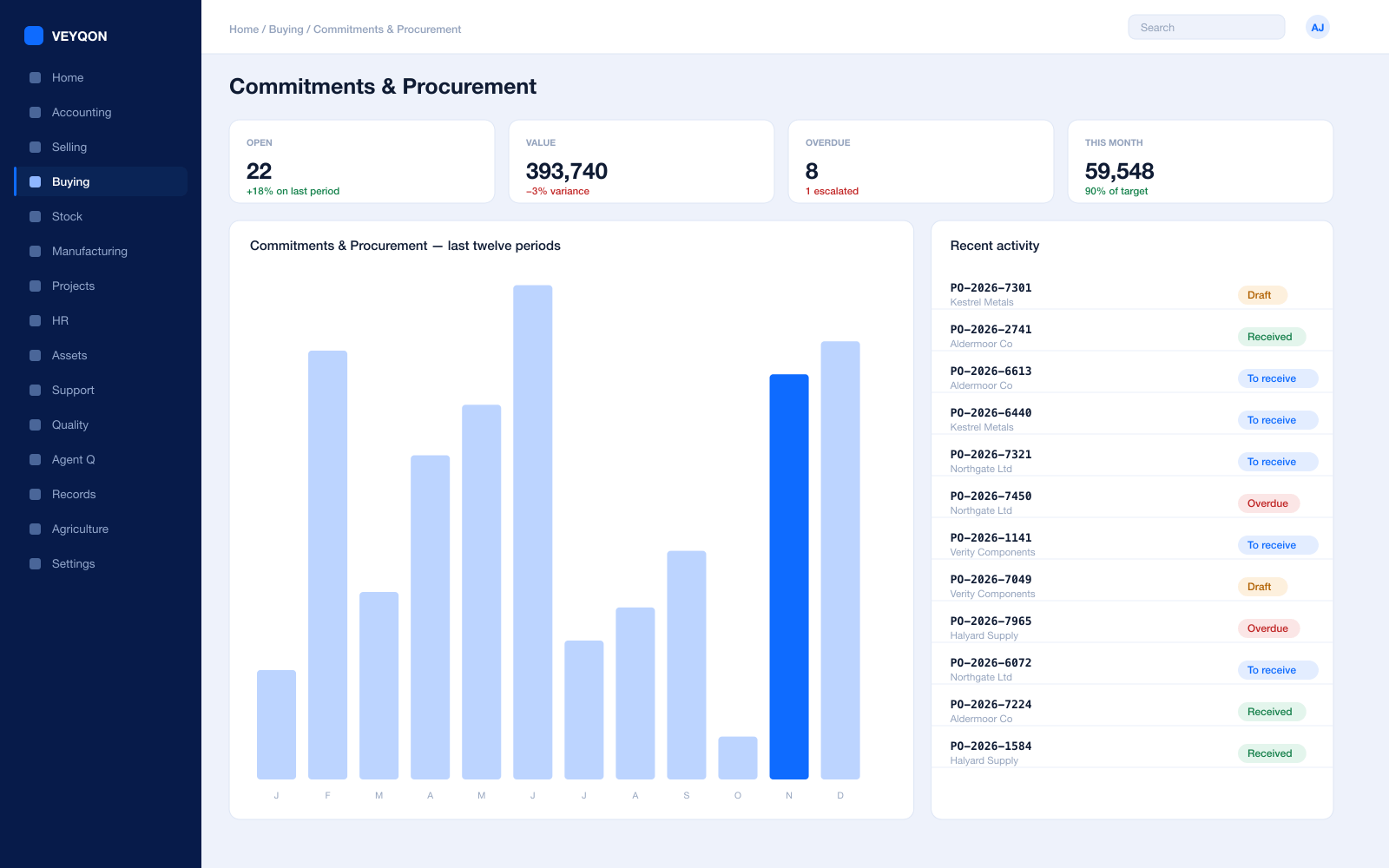
Commitments & Procurement
Every order reducing the remaining budget the moment it is raised.
Budget against the project
Budgets set against a project or a cost centre for a fiscal year, on the accounts you actually want controlled.
Stop, warn, or ignore
Three control actions per stage. Stop blocks the submission outright; warn lets it through and tells someone.
Checked at commitment
Budget tested on the material request and again on the purchase order — not only when the invoice finally arrives.
Annual and periodic limits
An annual ceiling and a period ceiling checked independently, so a job cannot spend all of next quarter in this one.
Material requests
Raised from site or from the plan, with approval routing by value, cost centre, and project.
Requests for quotation
Out to several suppliers at once, with a portal for them to respond on and the responses kept comparable.
Purchase orders
Against supplier price lists, with a delivery schedule per line matched to the programme.
Three-way matching
Order, receipt, and invoice reconciled before anything is paid, with the variance visible rather than absorbed.
Supplier scorecards
Quality, delivery, and responsiveness scored from your own receipts, with standings that can block a supplier.
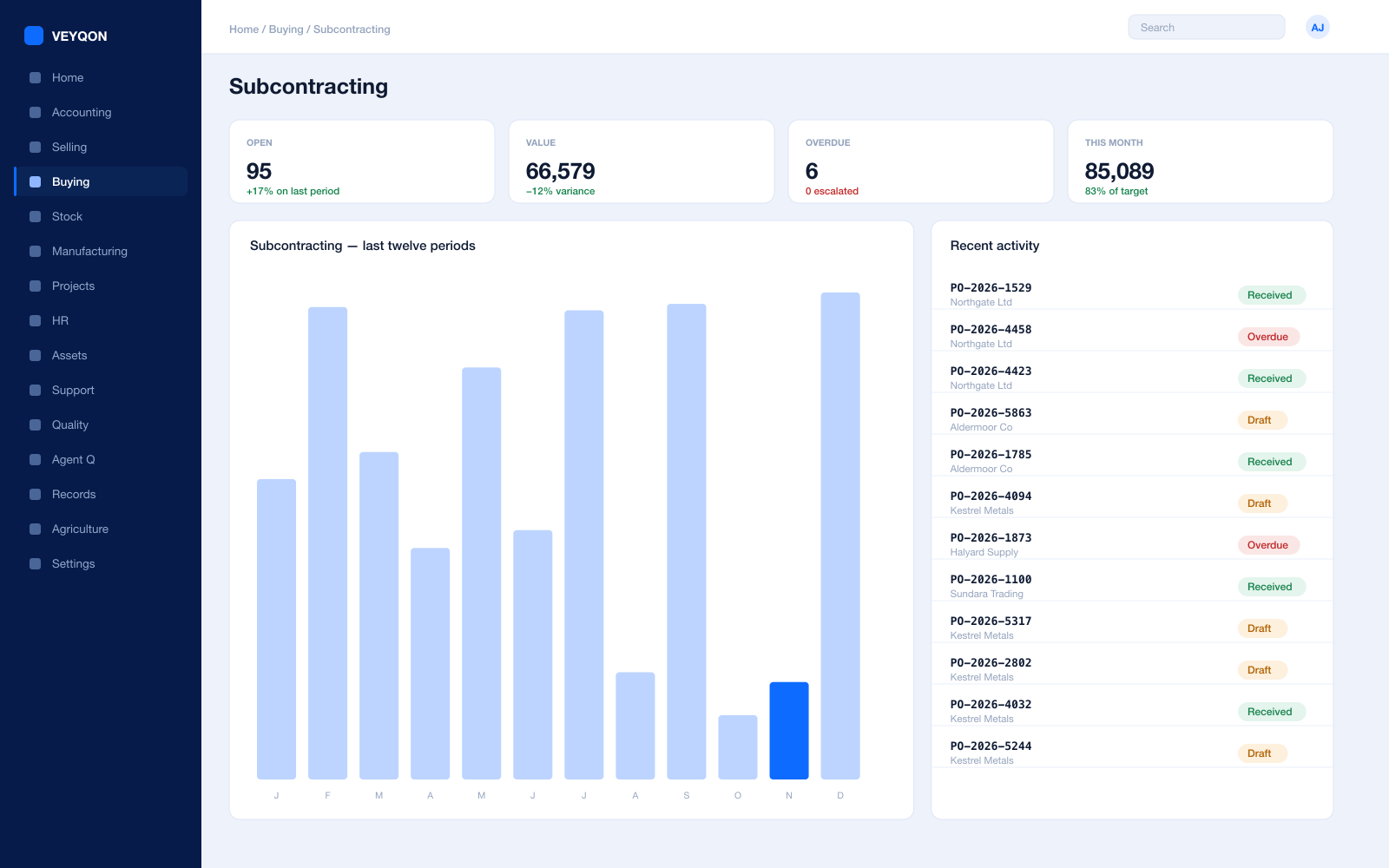
Subcontracting
Packages let, material supplied, and the cost still yours.
Subcontracting orders
The package let to a trade, with the supplied-items table built from the bill of materials so both sides agree.
Service items
The labour element priced and accounted separately from the material it is performed on.
Material at the subcontractor
A send-to-subcontractor entry moving material to a supplier warehouse — still your stock, in a place you can report on.
Subcontracting receipt
Finished work and scrap coming back, with material consumed by the backflush rule you chose.
Subcontracting BOM
A stored relationship between the service item and the finished item, so the mapping is not retyped each package.
Stock reservation
Committed material reserved so it cannot be picked for another job while it is earmarked.
Commitment against budget
The subcontract order reduces the remaining budget as it is raised, like any other commitment.
Stock & Site Materials
What arrived on site, what went into the works, and what was wasted.
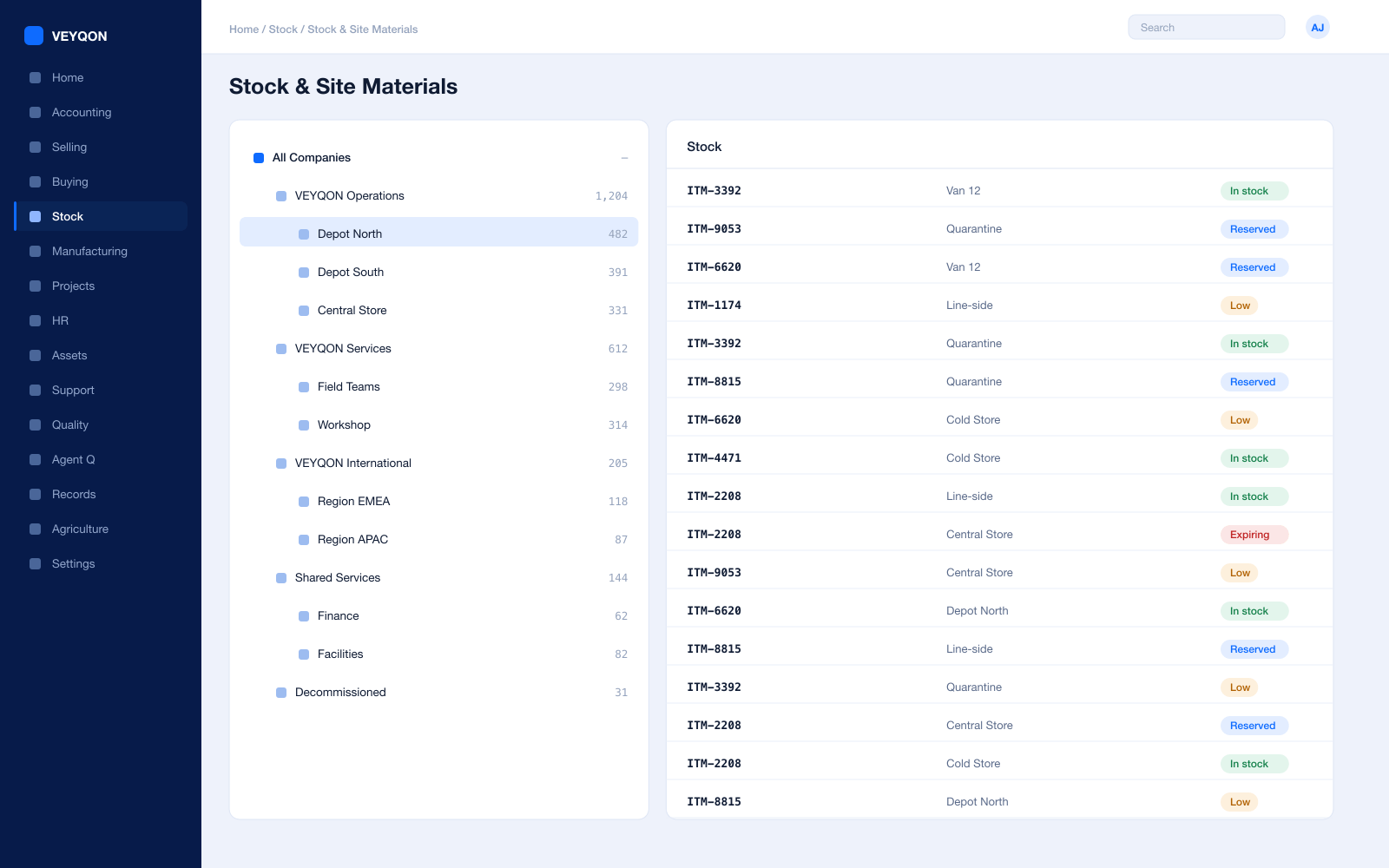
Site stores
A warehouse per site and compound, so stock is somewhere real rather than in a single company-wide pile.
Issue to the task
Material booked out against the task it was used on, which is the only way a cost plan means anything.
Waste with a reason
Breakage, over-order, and offcut recorded with a reason rather than absorbed into a variance nobody explains.
Landed cost
Haulage and duty distributed into item valuation on the receipt rather than written off to preliminaries.
Valuation
FIFO or moving average per item, with perpetual inventory posting to the ledger on every movement.
Stock reconciliation
Site counts posted against book stock, with the difference valued and accounted.
Transfers between sites
Plant and material moved between jobs through an in-transit warehouse, so nothing goes missing in the move.
UOM conversion
Buy by the tonne, issue by the bag — one item, with the conversion on the record.
Plant & Assets
Owned or hired, costed to the site it is standing on.
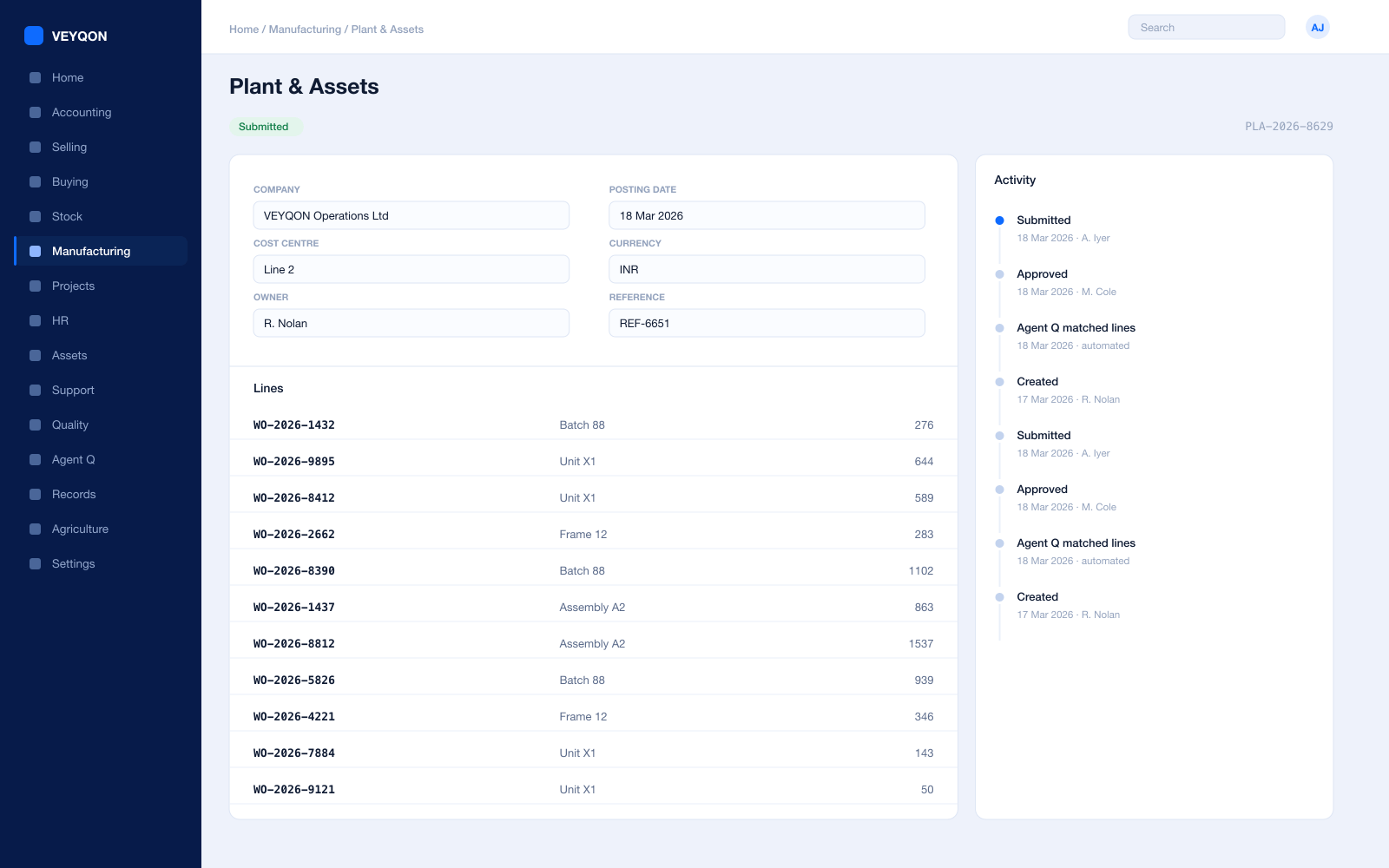
Asset register
Plant, cabins, and equipment with categories, locations, and custodians, so what is on which site is a query.
Location and site
The asset’s current site on the record, which is what lets plant cost be recharged to the job holding it.
Depreciation per finance book
A different method, useful life, and residual value for the statutory book and the management book.
Servicing and inspection
Scheduled with a periodicity, assigned to a team, generating a log for each occurrence.
Certification required
A task marked as needing a certificate — lifting inspections and thorough examinations — with the log held open until one is attached.
Repair and downtime
A failure record with the date, the downtime, and the cost, with parts consumed from stock onto the repair.
Movement between sites
Transfers between jobs and custodians, with a history rather than a recollection.
Disposal
Sale or scrapping with the gain or loss posted, and the asset closed properly.
Valuation & Billing
Applications for payment against measured work, with the trail behind them.
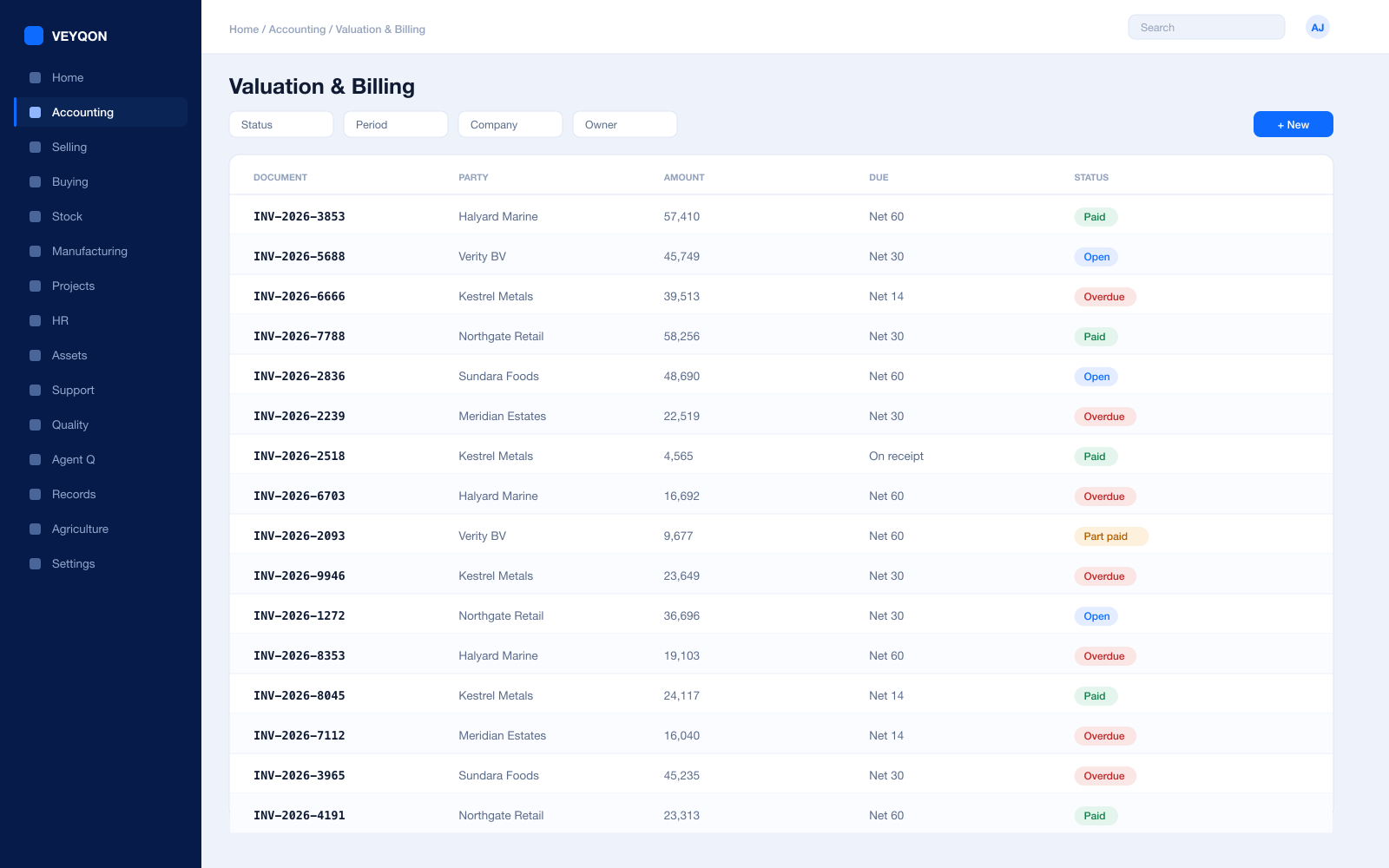
Applications for payment
Invoicing on percentage completion or on measured work, with the detail attached rather than summarised away.
Milestones
Billing events agreed at the point of sale and held on the project rather than negotiated each month.
Variations
Additional work as its own line with its own value, so a final account is assembled rather than reconstructed.
Value against cost
What has been certified against what has been spent, while there is still a job left to correct it on.
Work in progress
Cost incurred and not yet certified carried as WIP against the project rather than showing as a loss.
Payment terms
Instalments with a portion each, credit days, and month-end due dates driving the schedule overdue runs from.
Retention
Held amounts tracked against the contract as a payment term, so release is a scheduled event and not a phone call.
Multi-currency
Cross-border work billed in its own currency, with revaluation posting to the ledger.
Accounts
Job cost and statutory reporting out of the same postings.
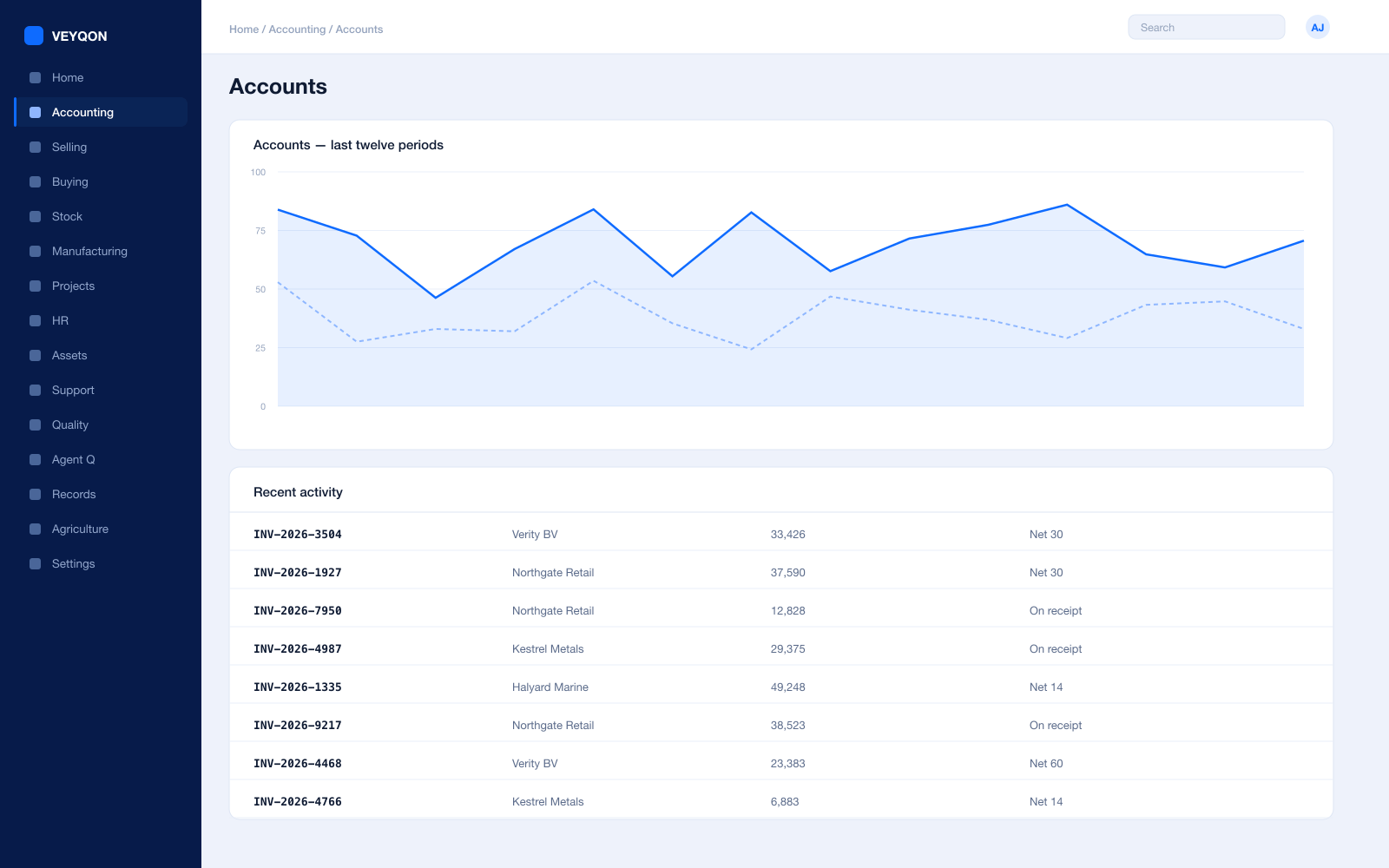
Cost centres and dimensions
By site, contract, or division, with allocation splitting a head-office cost across several by percentage.
Budgets
Against cost centres and projects, checked at request, order, and actual, with the action set per stage.
Perpetual inventory
Every stock movement posts to the ledger as it happens, so site stores and accounts cannot drift apart.
Capital and revenue
Work in progress capitalised where it belongs, and cost expensed where it does not, on the document rather than at year end.
Multi-company
Joint ventures and special-purpose companies kept separate, with intercompany transfers between them.
Period close
Accruals, reconciliation, and a period lock that stops anyone back-posting into a month you have reported.
Statutory tax
VAT, GST, withholding, and construction-industry deduction schemes with your region’s filing formats.
Immutable audit trail
Every posting carries who, when, and from which document — which is what a final account argument turns on.
HR & Payroll
Site labour costed to the task and paid from the same entry.
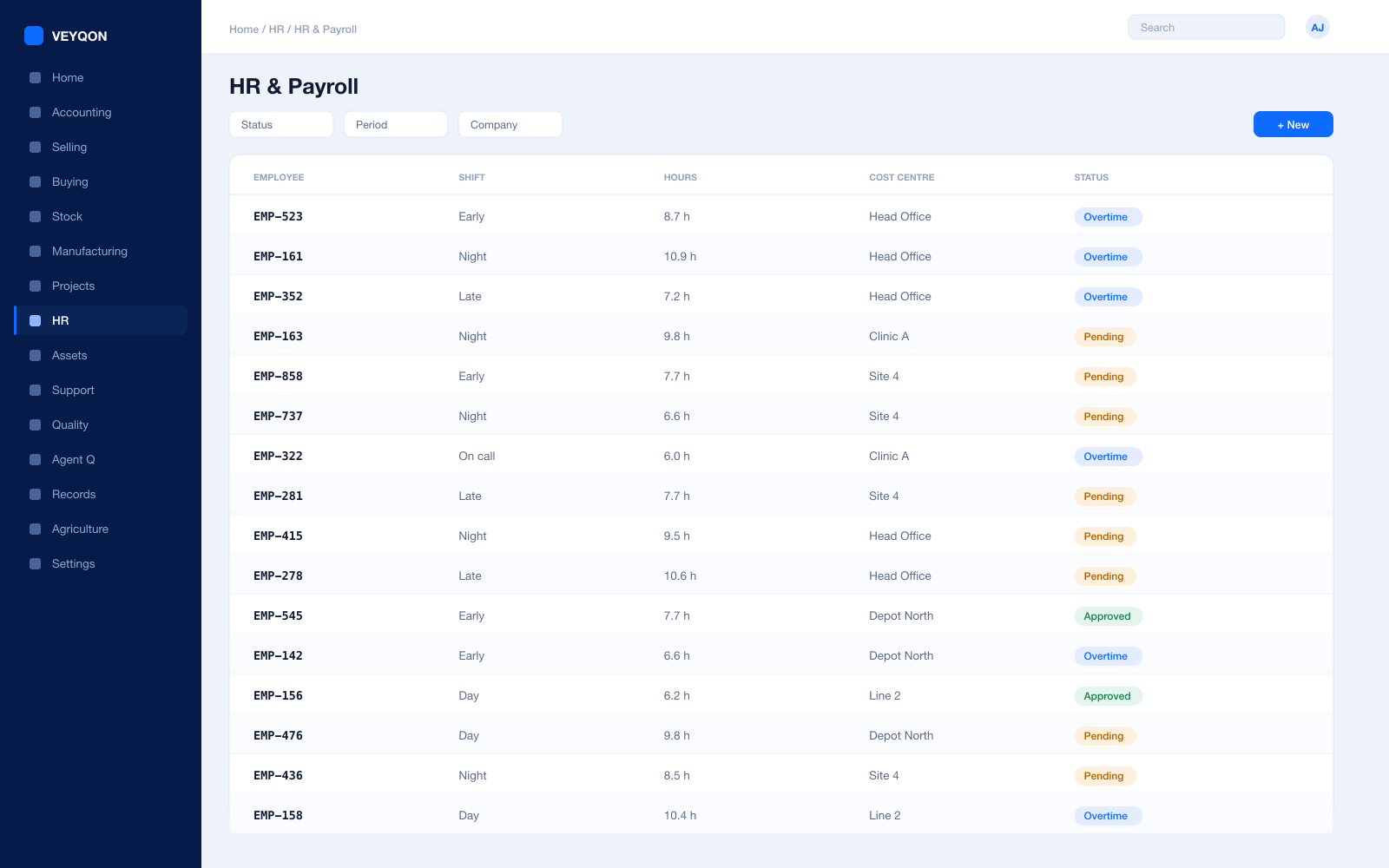
Timesheets from site
Hours booked against the task daily, at a costing rate, so labour cost is current rather than monthly.
One entry, two outputs
The same submitted timesheet feeding job cost and the salary slip, so two systems cannot disagree about a week.
Attendance and check-in
From devices or check-in at the gate, feeding shift compliance and overtime instead of a signing-in book.
Shifts and rotas
Site cover planned with the roster visible before the week starts rather than patched on the morning.
Cards and certification
Skills cards, tickets, and inductions held against the employee, with expiry dates that surface before they lapse.
Leave and holiday lists
The working calendar that programme planning is actually built against.
Expenses
Travel, lodging, and site spend claimed against a project cost centre, approved and posted.
Payroll
Salary structures and runs with statutory deductions, posted into the same ledger as everything else.
Quality & Safety
Inspections that hold a document, and observations that get closed.
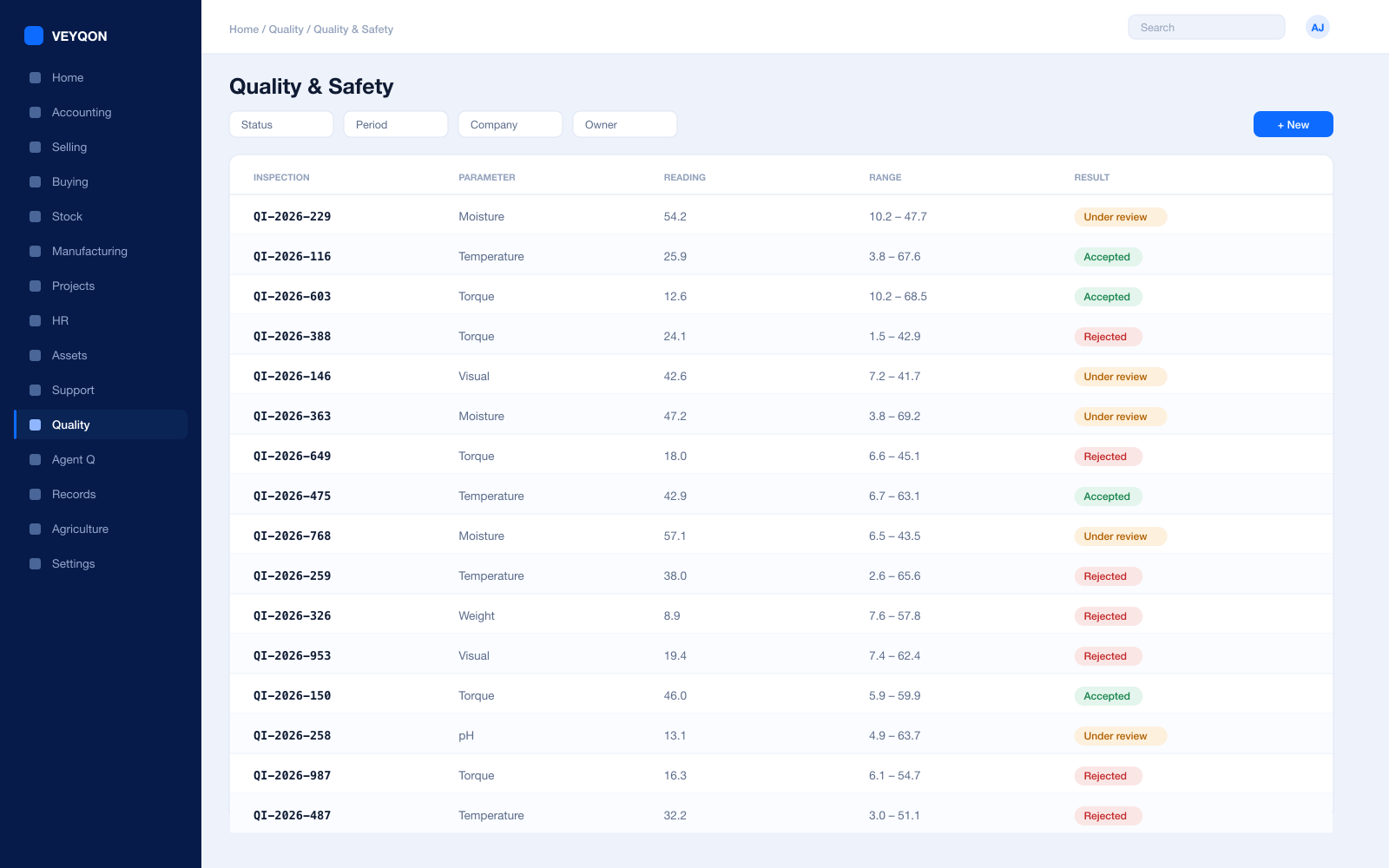
Inspection templates
Reusable parameters and acceptance criteria, so the same check means the same thing on every site.
Incoming inspection
Material checked on the goods receipt before it goes into the works, with rejected quantity split off.
Numeric criteria
A minimum and maximum per reading, with anything outside the range rejected the moment it is saved.
Blocking submission
With the criteria enabled on the item, the receipt does not post until the inspection is submitted.
Quality procedures
Documented method statements with owners and steps, and a review that is a record rather than a meeting.
Non conformance
An observation that a procedure was not followed, filed by anyone on site rather than only by the quality manager.
Corrective action
Recorded against the non conformance with a status through to close, so the fix has an owner and a date.
One pass through construction, end to end.
- 01
Budget
The tender becomes a cost plan with lines you can report against.
- 02
Commit
Every order and subcontract reduces the remaining budget as it is raised.
- 03
Record
Labour, plant, and materials post to the task, daily, from site.
- 04
Value
Applications and variations against measured work, with the trail.
Running construction on VEYQON, in four steps.
It is a subscription, not a project.
- 1
Subscribe
Pay by card. Provisioned straight away.
Minutes - 2
Bring your data
Balances, items, customers, suppliers.
Day one - 3
Switch modules on
Warehouses, limits, and approvals.
Week one - 4
Go live
Run parallel, then cut over.
You choose
All 10 modules included. Nothing sold separately.