Buy well, hold little, ship on time.
Purchasing, multi-warehouse stock, and pricing in one place, so landed cost and true margin are visible on the order rather than at month-end.
10 modules·95 features·Native ERPNext domain
The modules behind distribution.
Not a list of module names. Each one below opens onto what is inside it and why a distribution business needs it — so you can check it against how your operation actually runs.
Agent Q
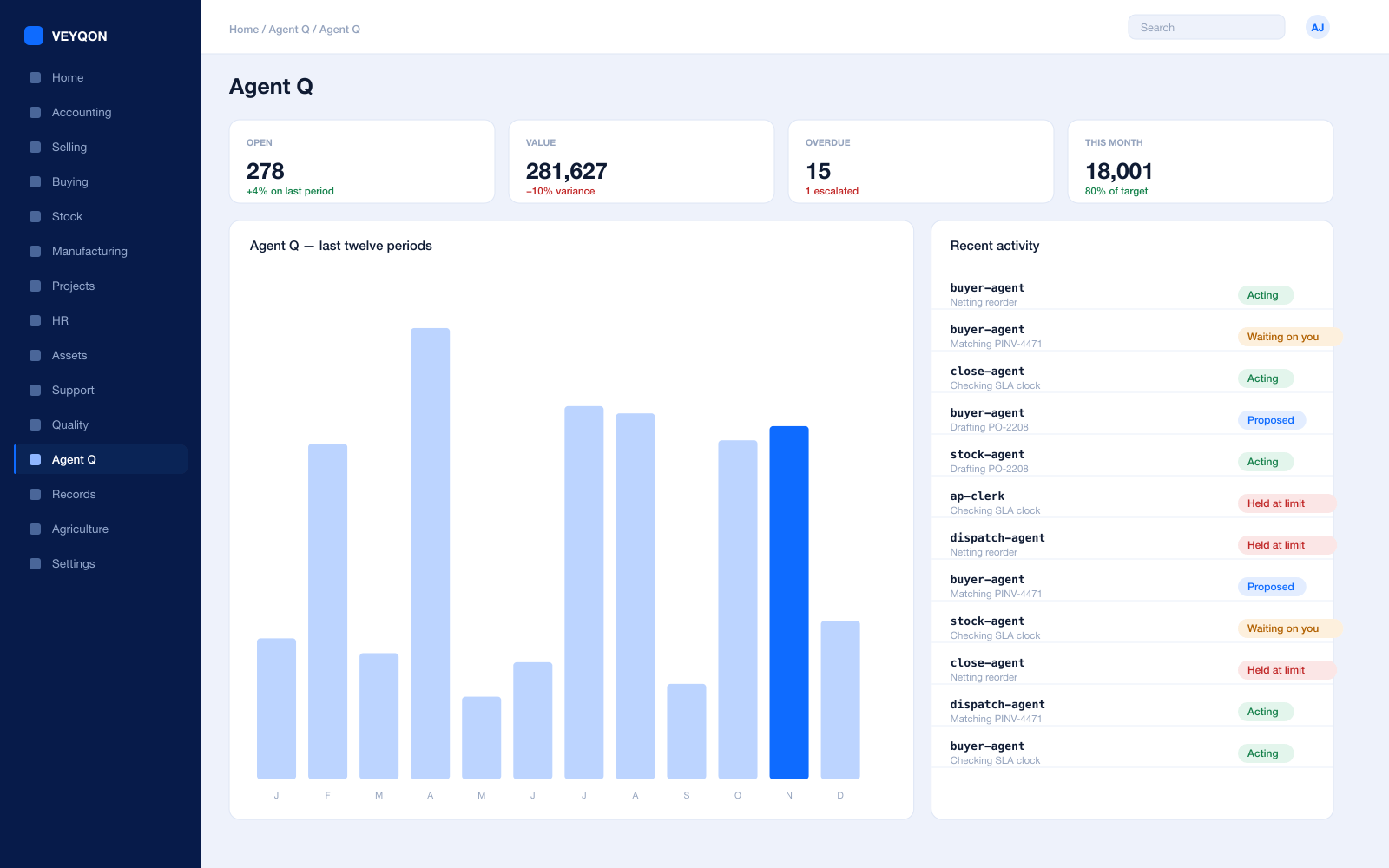
Agents that read your own records and act on them, scoped to how a distribution business runs.
Grounded in live records
Every answer is drawn from your own ledger with your permissions applied, and names the documents it used. Nothing is answered from a snapshot or a summary.
A role, not a prompt
Each agent is scoped like a job — accounts payable, procurement, dispatch, period close — with the same limits you would put on the person doing it.
Explicit tool permissions
An agent holds a named list of the actions it may take. Matching an invoice does not imply paying one.
Value and action limits
A hard ceiling per agent, per period, and per document type, which it cannot cross however it is asked.
The queue
What every agent is working on, what is waiting on a person, and what has been held — in one place, with the reason on each item.
Triggers
An arriving document, a breached threshold, a date, or a state change on a record. Agents start on events, not on somebody remembering.
Human approval gates
Anything over a limit routes to a named person, with the reasoning attached, so approving takes seconds rather than an investigation.
Escalation paths
Who it hands to when it reaches a limit, how long it waits first, and what that person sees when it arrives.
Segregation of duties
An agent cannot approve what it raised. The rule that applies to your people applies to your agents.
Full reasoning log
Every step is written to the audit trail on the document it touched, so a decision can be read back months later.
Ask in plain language
The console answers operational questions from live records and offers the next action, rather than handing back a paragraph.
Spend control
Ceilings per agent and per period, so autonomy runs to a budget you set rather than an open account.
Procurement
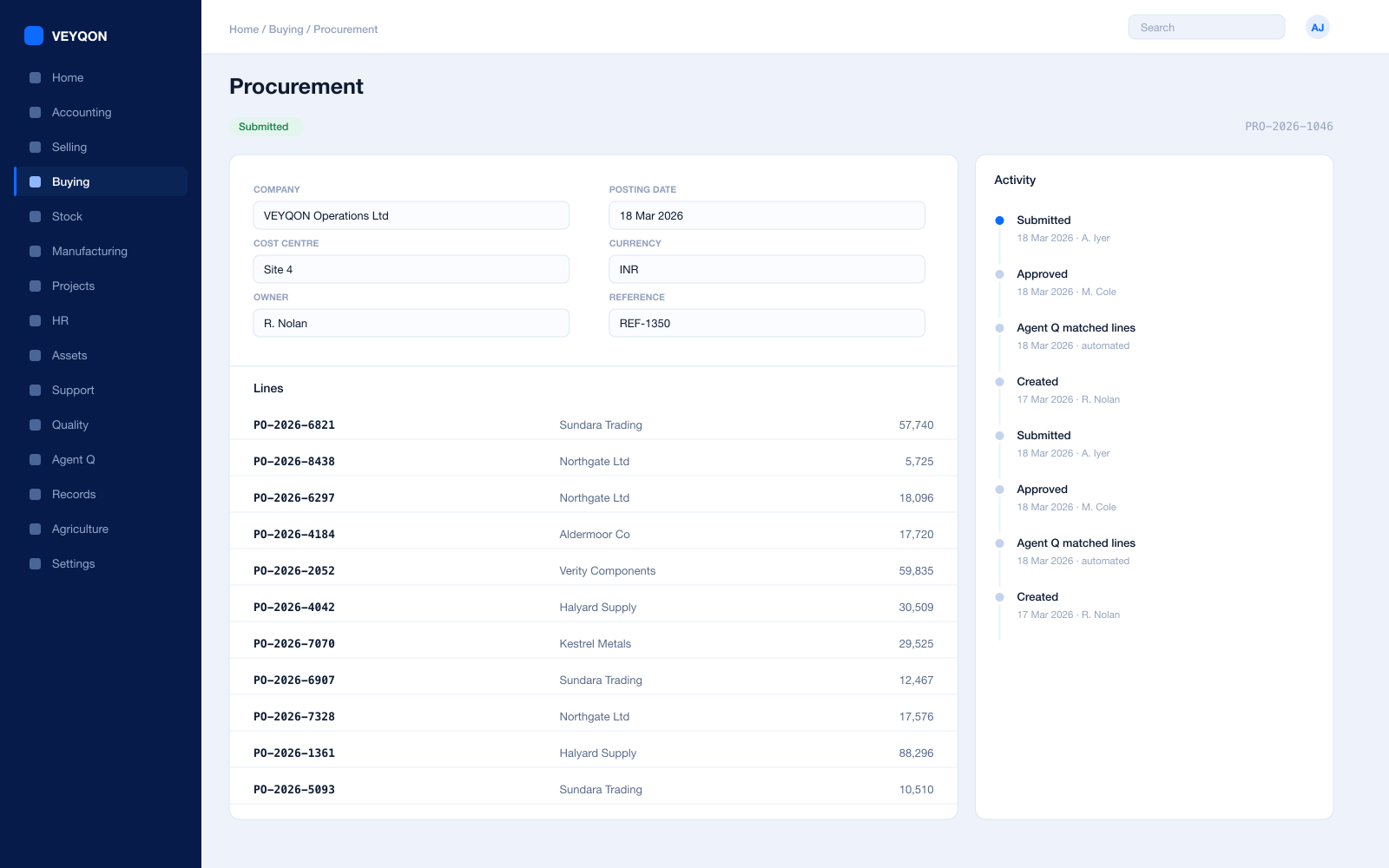
Buying well is the whole margin. This is where it is decided.
Reorder-driven requests
A material request raised automatically when projected quantity falls below the level you set for that item and that warehouse.
Requests for quotation
Out to several suppliers at once, with a portal for them to respond on rather than a mailbox to chase.
Quotation comparison
Supplier quotations side by side on price, lead time, and terms before an order is raised.
Purchase orders
Against supplier price lists, with a delivery schedule per line rather than one date for the whole order.
Blanket orders
An agreed quantity and price over a period, drawn down by individual orders against it.
Receipts with rejection
Accepted and rejected quantity split on the receipt, with a rejected warehouse and the inspection attached.
Landed cost
Freight, duty, and insurance distributed into item valuation on the receipt, so they never sit in overhead pretending not to be cost of goods.
Three-way matching
Order, receipt, and invoice reconciled before anything is paid, with the variance visible rather than absorbed.
Supplier scorecards
Quality, delivery, and responsiveness scored from your own receipts over rolling periods, with standings that can block a supplier from an RFQ or a PO.
Drop ship
Mark a line delivered by the supplier and the purchase order carries your customer's address. Stock you never touch never enters your warehouse.
Tax and charges templates
Import duty, reverse charge, and purchase taxes applied by template rather than typed onto every order.
Supplier terms
Payment terms and supplier groups held on the record and defaulted onto the order, so terms are not renegotiated by accident.
Stock
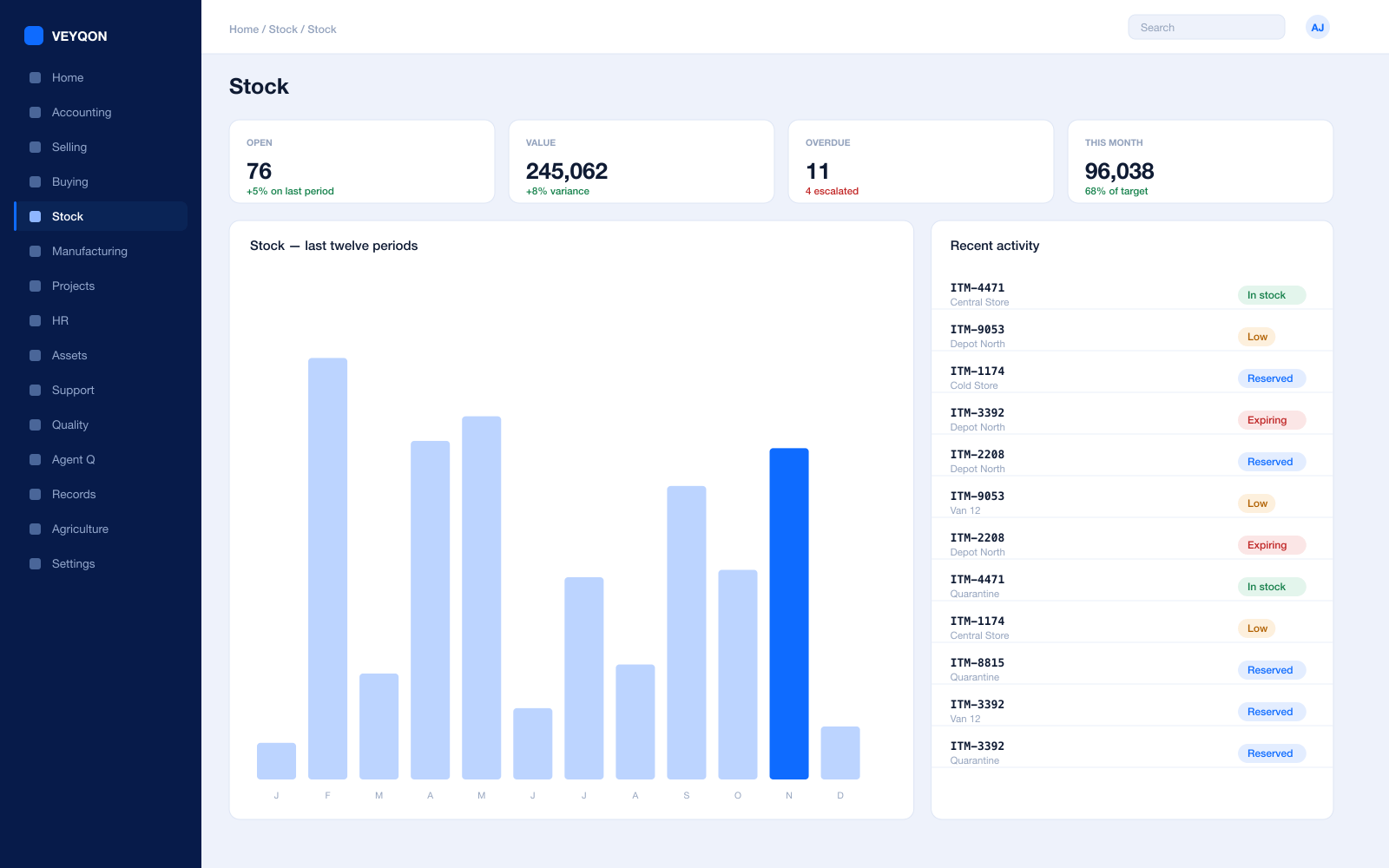
Everything you hold, where it is, and what it actually cost to get there.
Multi-warehouse tree
Regional depots, bonded stock, returns, and in-transit warehouses in a single hierarchy you can report across.
Batch and serial tracking
Batch numbers with expiry and serial numbers per unit, so a recall or a warranty claim is a query rather than a fire drill.
Valuation
FIFO or moving average per item, with perpetual inventory posting to the general ledger on every movement.
Landed cost in valuation
Freight and duty land in the value of the goods, so margin is right on the first sale rather than corrected at month end.
Reorder levels and lead time
A reorder level and quantity per item and warehouse, sized against the supplier's lead time.
Stock reconciliation
Physical counts posted against book stock, with the difference valued and accounted rather than adjusted quietly.
Pick lists
Warehouses chosen FIFO, batches nearest expiry picked first, several sales orders picked in one wave, and a barcode scan mode for the floor.
Partial picking
A pick list can only be raised where the order is under fully picked, and current stock refreshes if availability moves before fulfilment.
Putaway rules
Where a receipt lands decided by rule and warehouse capacity, rather than by whoever is on shift.
Stock in transit
Transfers between depots through an in-transit warehouse, so stock on a lorry is still stock you can see and account for.
UOM conversion
Buy in pallets, hold in cases, sell in units — one item, with the conversion on the record rather than in someone's head.
Variants and barcodes
Size, grade, and pack as attributes on one template, with multiple barcodes per item for whichever one the scanner reads.
Selling
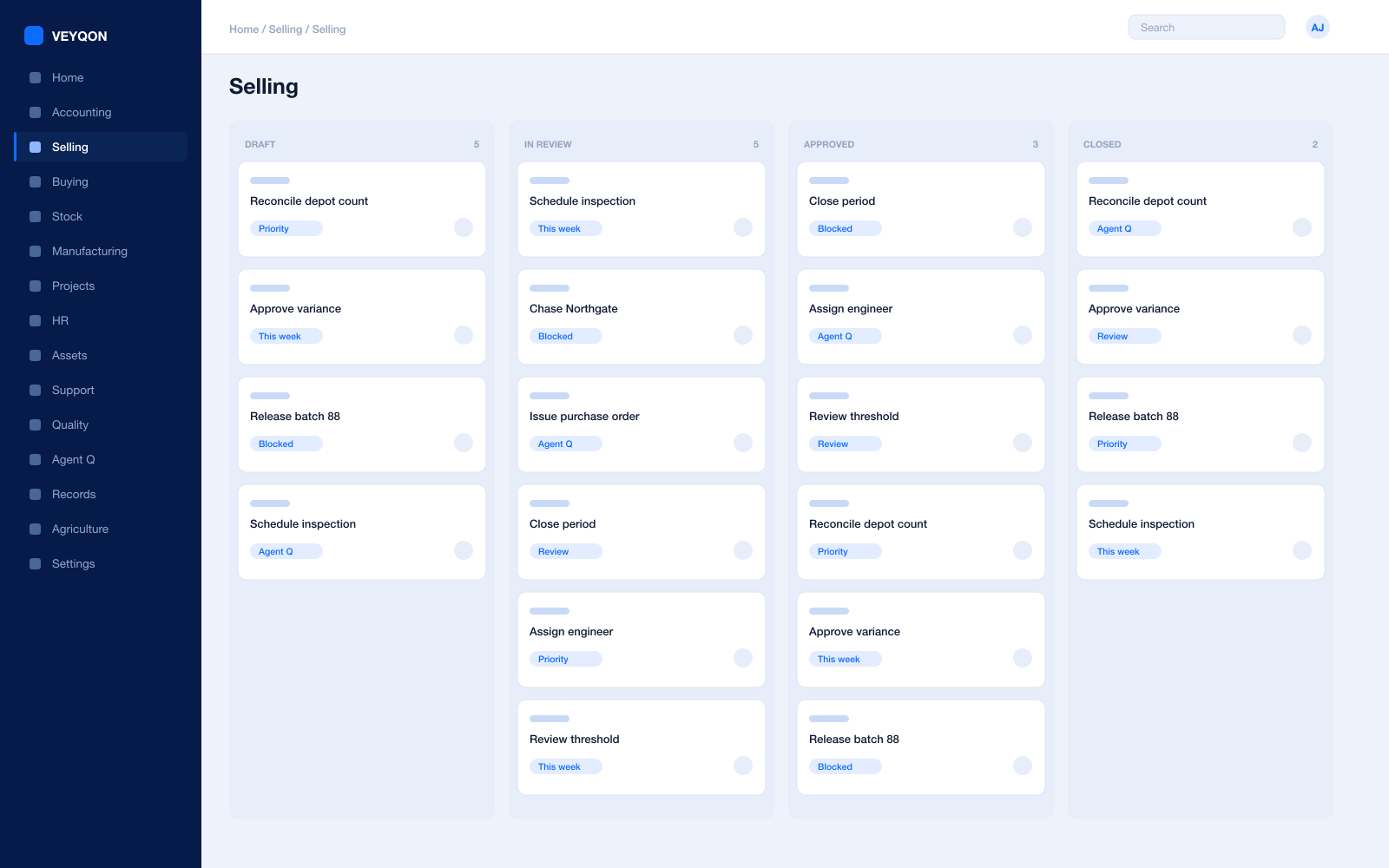
The order, the price on it, and the promise attached to it.
Quotations
Items, quantities, prices, taxes, validity, and commercial terms, converting to an order in one step when the customer says yes.
Sales orders
A delivery date per line, partial delivery, and partial billing across as many documents as the order takes.
Price lists
Separate selling lists by currency, region, or channel, with item prices valid between dates and above a minimum quantity.
Pricing rules
By item, item group, or brand — for a customer, customer group, territory, or sales partner. As a rate, a percentage, a fixed amount, or a margin.
Quantity and amount slabs
Minimum and maximum thresholds per rule, with mixed conditions that total quantity across a set of items before the threshold is tested.
Cumulative pricing
Eligible transactions counted across a whole period, so a customer earns the tier on what they have bought, not just the order in front of you.
Free-item promotions
Buy-multiple-get-free on the same item, or a different item entirely, with its own quantity, UOM, and rounding.
Promotional schemes and coupons
A campaign with several slabs generating the rules underneath it, and coupon codes where a rule should only fire for someone holding one.
Priority and stacking
A priority across overlapping rules, whether several may apply at once, and whether a discount compounds on an already discounted rate.
Credit limits
Set on the customer, the customer group, or the company, blocking order and invoice submission — with a Credit Manager role for the exceptions you actually want to make.
Stock reservation
Available stock allocated to an order so it cannot be picked for someone else while your customer waits for it.
Shipment and tracking
Carrier, service, AWB number, parcel dimensions, and Incoterm on a shipment raised straight from the delivery note.
CRM
Who is buying, who nearly did, and which account is quietly slipping.
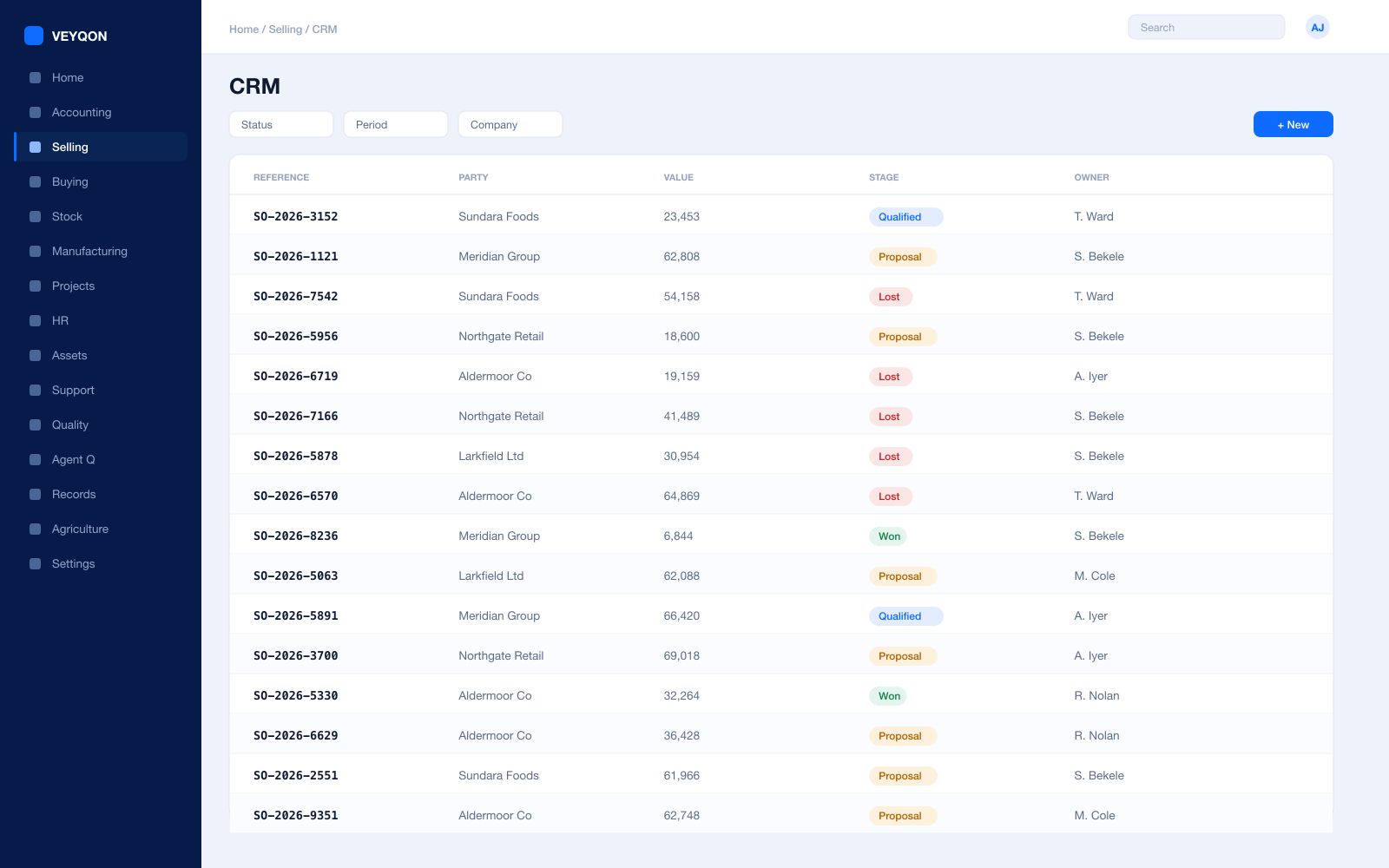
Leads
An unqualified person or organisation, with the source, territory, and contact detail captured at first touch rather than reconstructed later.
Opportunities
A qualified deal with value, probability, timing, the items involved, and a named owner.
Sales stages
Where a deal actually sits, so early discovery is not reported to the board as negotiation.
Sources and campaigns
Which channel produced the deal, traceable from the lead all the way through to the invoice it became.
Customers, contacts, addresses
Held once and reused across quotation, order, delivery, and invoice, rather than retyped into each of them.
Sales person hierarchy
Group nodes over individuals, so a manager reads the person and the rolled-up team from the same report.
Contribution split
A sales team table on the order with a percentage per person — which is what actually attributes the revenue when two people worked the deal.
Targets and commission
Item-group targets by fiscal year and a default commission rate per person, so the incentive is calculated rather than argued.
Campaigns and appointments
Scheduled email sequences from templates, and meetings recorded against the account they were about.
Accounts
Margin visible on the order, not discovered at month end.
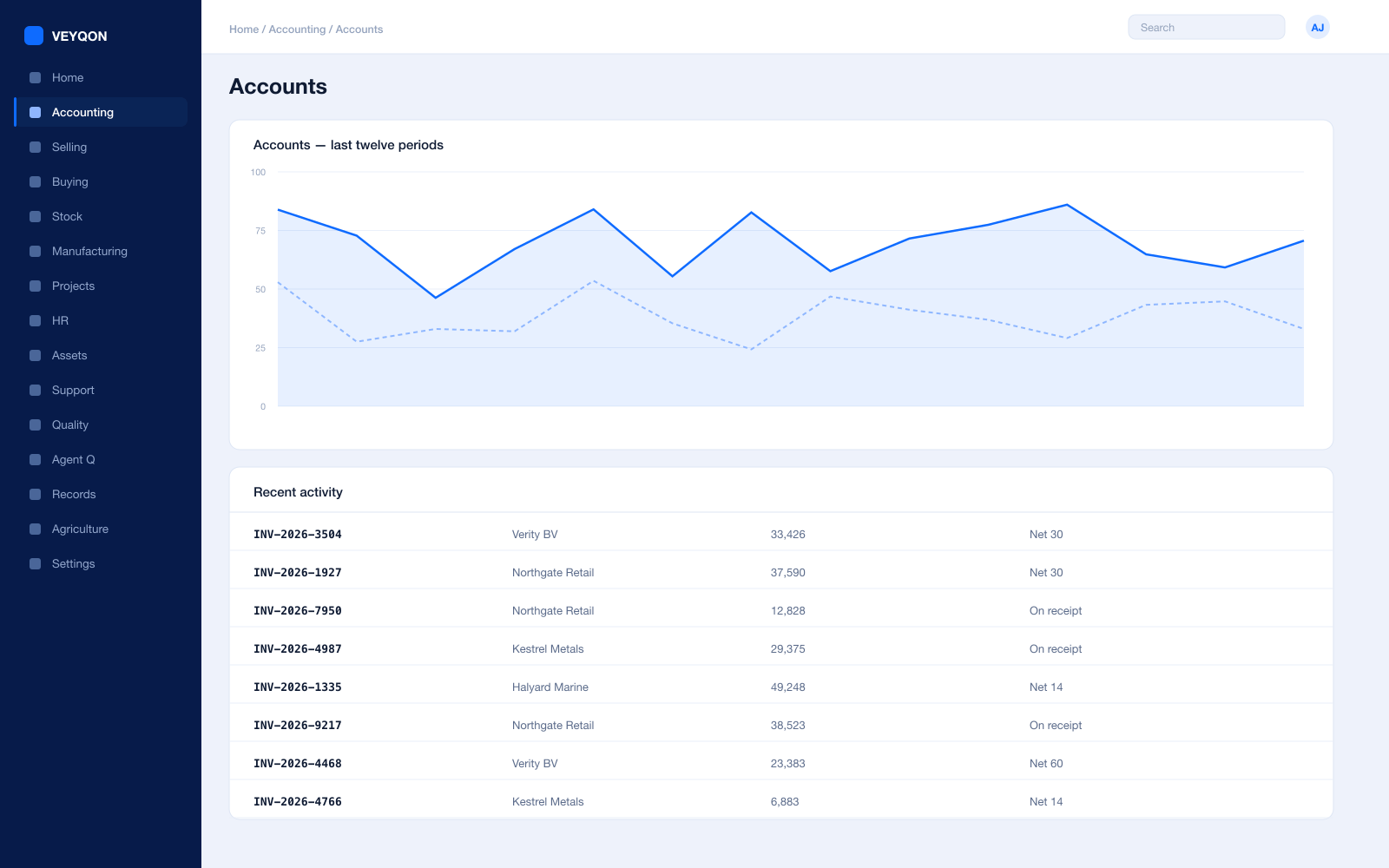
Perpetual inventory
Every stock movement posts to the general ledger as it happens, so the stock account and the stock ledger cannot drift apart.
Landed cost in the ledger
Freight and duty sit in the value of the goods rather than in a general overhead pot, which is the difference between real gross margin and a guess.
Receivables and exposure
Ageing by customer and the outstanding balance the credit limit is checked against — including open orders, not just invoices.
Payment terms
When an amount falls due, per customer and per order. Separate from the exposure ceiling, because they answer different questions.
Payables and payment runs
Scheduled against supplier terms, with the three-way match behind every line on the run.
Cost centres and dimensions
By depot, channel, or region, with allocation splitting one amount across several by percentage.
Budgets
Against cost centres and projects, with the action on exceeding set to warn the person or stop the document.
Multi-currency
Buy in one currency and sell in another, with revaluation posting to the ledger rather than living in a spreadsheet.
Period close
Accruals, reconciliation, and a period lock that stops anyone back-posting into a month you have already reported.
Tax and audit trail
VAT, GST, and withholding with your region's filing formats, and an immutable trail on every posting.
Integrations & EDI
Trading partners, marketplaces, and carriers, all talking to the same records.
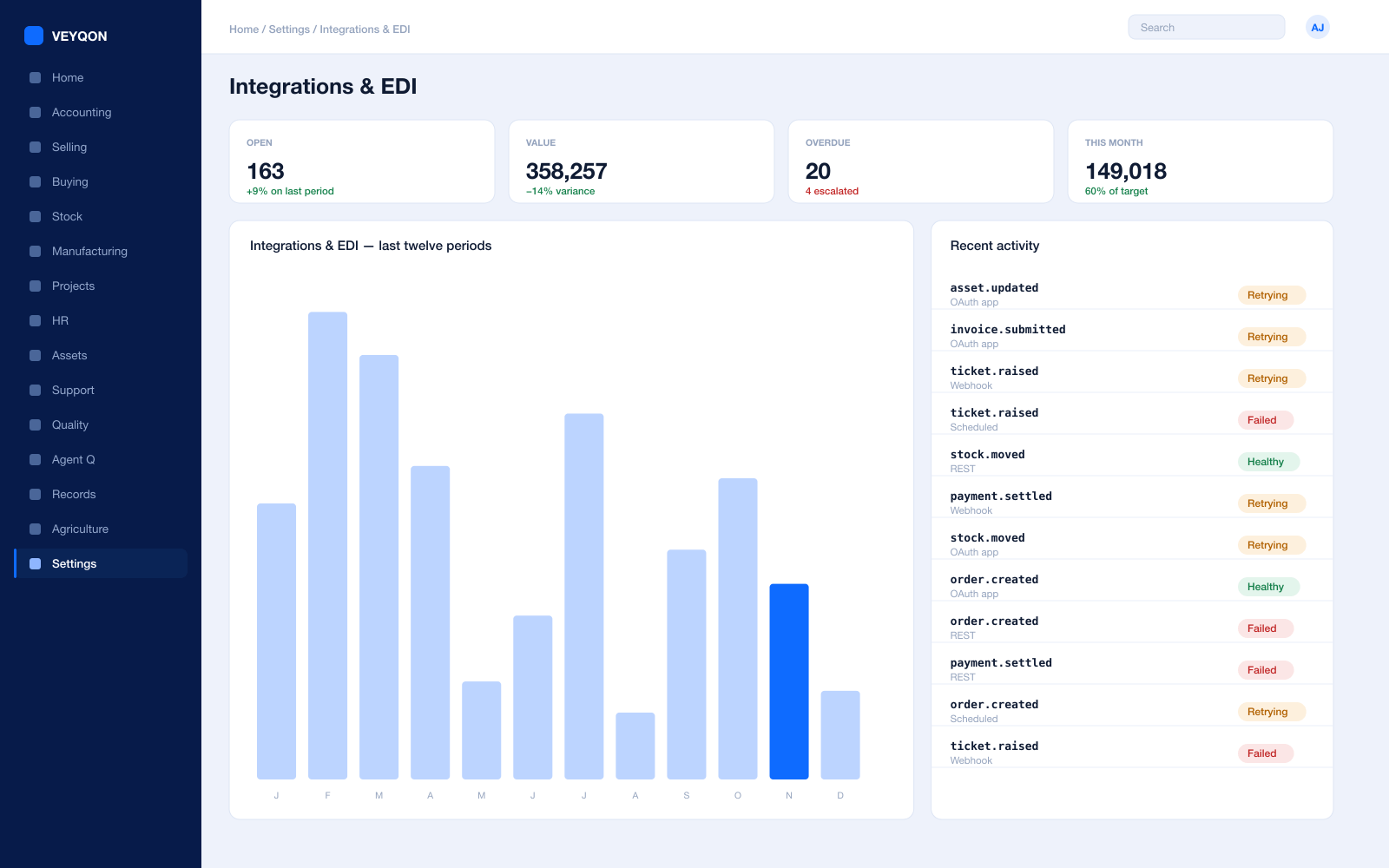
REST API on every record
Every document type is addressable over the API, with the same permissions the interface applies. There is no second, weaker door.
Webhooks
A state change on any document pushed to a partner endpoint as it happens, rather than discovered on a nightly poll.
Scheduled jobs
Recurring imports, exports, and reconciliations on a calendar, with a log of what ran and what it did.
Bulk import and export
Spreadsheet import with validation for supplier price files and catalogue updates, and export of anything you can see.
Connected apps and OAuth
A partner system authorised against a scoped role, rather than given somebody's password and hoped about.
Carrier integration
Rate comparison, label generation, and tracking against the shipment record instead of three courier websites.
Shipment records
Carrier, service, AWB number, parcel dimensions, weight, and Incoterm, created straight from a delivery note.
Customer and supplier portals
Order status, quotations, and RFQ responses handled in a portal rather than in an email thread nobody can audit.
Support & Returns
What happens after the lorry leaves, and what it costs you.
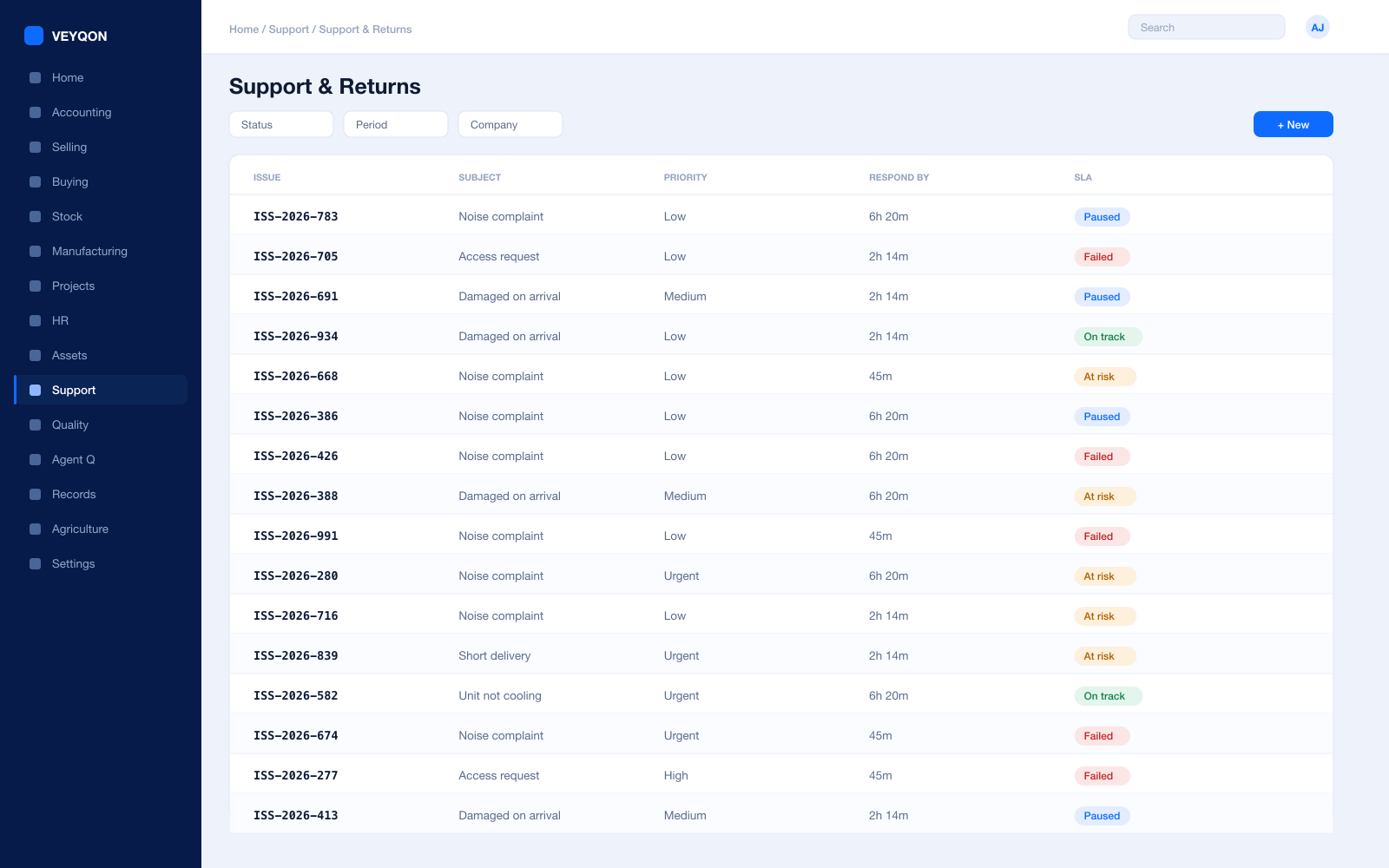
Issues
Raised by email, through the portal, or by hand — linked to the customer, the order, and the item they are about.
Service level agreements
Priorities with a time to respond and a time to resolve, applied by customer, customer group, or territory.
Support hours and holidays
The clock runs only in the hours you actually cover, and stops on the days your holiday list says you are shut.
SLA pause
The timer holds while you are waiting on the customer, and the hold time is added back when they reply.
Fulfilled and failed
Every issue carries whether the agreement was met. The SLA report is a fact rather than an opinion.
Sales and purchase returns
A return against the original delivery or receipt, with stock and value reversing together instead of separately.
Credit notes
Raised against the return, with the receivable adjusted and the reason on the record.
Warranty claims
Against a serial number, with the item's warranty period on the record so the answer is not a judgement call.
Assets & Fleet
The forklifts, racking, and vehicles the whole operation depends on.
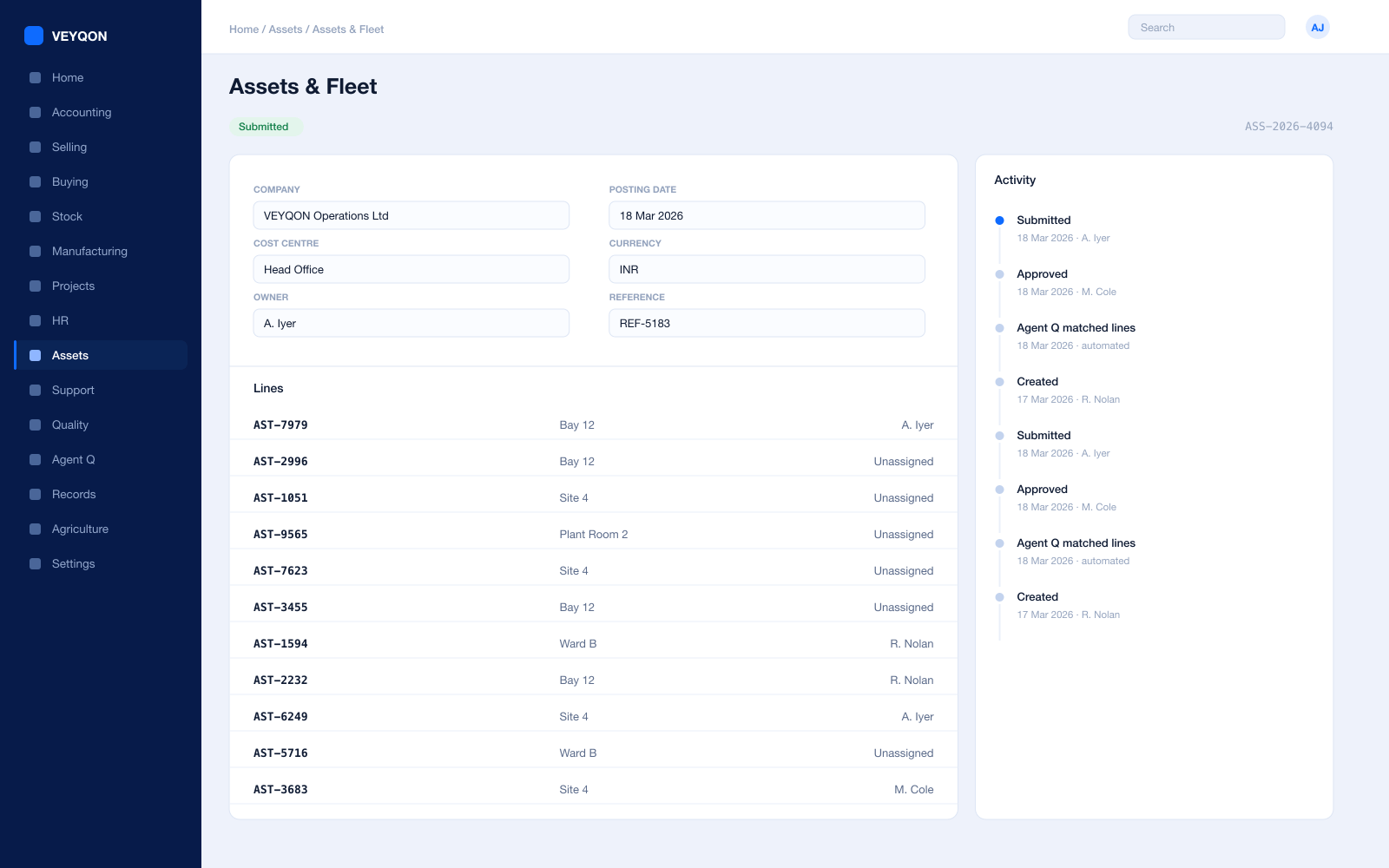
Asset register
Categories, locations, and custodians for vehicles, racking, and handling equipment, held where the rest of the business can see them.
Depreciation per finance book
A different method, useful life, residual value, and posting frequency for the statutory book and the management book.
Preventive maintenance
Servicing scheduled with a periodicity, assigned to a maintenance team, generating logs on the calendar you set.
Maintenance logs
What was done and by whom, with certificates attached where the task requires one.
Repair and downtime
A failure record carrying downtime and cost, capitalised where the repair genuinely improves the asset.
Movement and disposal
Transfers between depots and custodians, and sale or scrapping with the gain or loss posted.
HR & Payroll
The warehouse floor and the road team, costed on the same ledger.
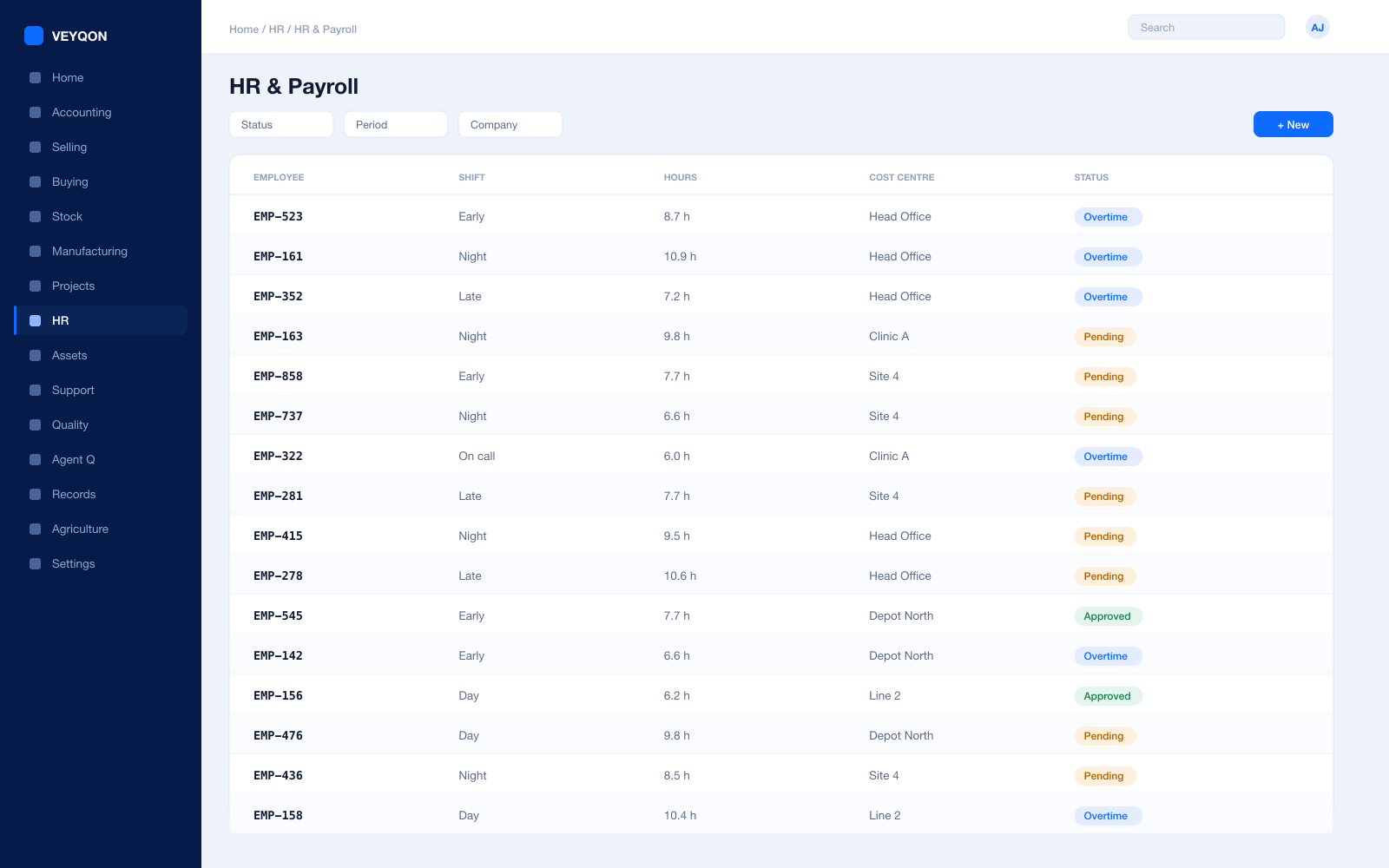
Shifts and rosters
Pick, pack, and night shifts assigned, with the roster visible to the people doing the planning rather than pinned to a wall.
Attendance and check-in
From biometric devices or check-in, feeding shift compliance and overtime instead of a spreadsheet.
Leave and holiday lists
The working calendar that SLA clocks and delivery promises are actually measured against.
Expenses and mileage
Driver and rep claims against a cost centre, approved and posted rather than reimbursed on trust.
Payroll
Salary structures and runs with statutory deductions, posted into the same ledger as everything else.
Licences and certification
Driver licences and handling certification held against the employee, with expiry dates that surface before they lapse.
One pass through distribution, end to end.
- 01
Replenish
Reorder levels and lead times raise material requests before you run out.
- 02
Land
Receipts absorb freight and duty, so margin is right from the first sale.
- 03
Allocate
Stock reserves against orders, with backorder handling that is visible.
- 04
Ship
Pick, pack, deliver note, and invoice from one flow.
Running distribution on VEYQON, in four steps.
It is a subscription, not a project.
- 1
Subscribe
Pay by card. Provisioned straight away.
Minutes - 2
Bring your data
Balances, items, customers, suppliers.
Day one - 3
Switch modules on
Warehouses, limits, and approvals.
Week one - 4
Go live
Run parallel, then cut over.
You choose
All 10 modules included. Nothing sold separately.