From land unit to ledger.
Crop cycles, soil and water analysis, and input costs tracked against the land they were applied to, with the harvest received into stock.
9 modules·73 features·Configured on the core
The modules behind agriculture.
Not a list of module names. Each one below opens onto what is inside it and why a agriculture business needs it — so you can check it against how your operation actually runs.
A maintained Frappe app adding Crop, Crop Cycle, Land Unit, and the analysis records below.
Agent Q
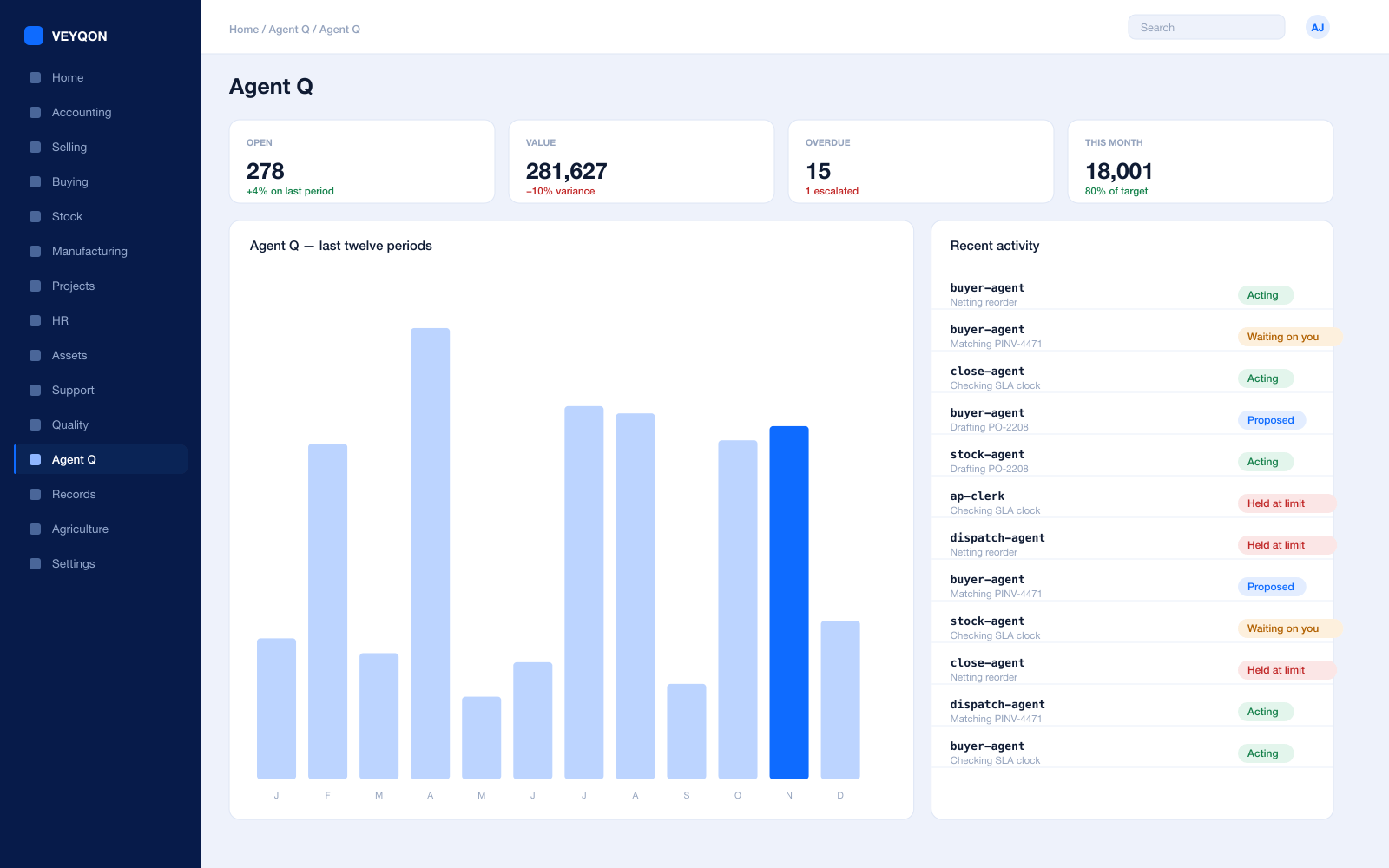
Agents that read your own records and act on them, scoped to how a agriculture business runs.
Grounded in live records
Every answer is drawn from your own ledger with your permissions applied, and names the documents it used. Nothing is answered from a snapshot or a summary.
A role, not a prompt
Each agent is scoped like a job — accounts payable, procurement, dispatch, period close — with the same limits you would put on the person doing it.
Explicit tool permissions
An agent holds a named list of the actions it may take. Matching an invoice does not imply paying one.
Value and action limits
A hard ceiling per agent, per period, and per document type, which it cannot cross however it is asked.
The queue
What every agent is working on, what is waiting on a person, and what has been held — in one place, with the reason on each item.
Triggers
An arriving document, a breached threshold, a date, or a state change on a record. Agents start on events, not on somebody remembering.
Human approval gates
Anything over a limit routes to a named person, with the reasoning attached, so approving takes seconds rather than an investigation.
Escalation paths
Who it hands to when it reaches a limit, how long it waits first, and what that person sees when it arrives.
Segregation of duties
An agent cannot approve what it raised. The rule that applies to your people applies to your agents.
Full reasoning log
Every step is written to the audit trail on the document it touched, so a decision can be read back months later.
Ask in plain language
The console answers operational questions from live records and offers the next action, rather than handing back a paragraph.
Spend control
Ceilings per agent and per period, so autonomy runs to a budget you set rather than an open account.
Crops & Land
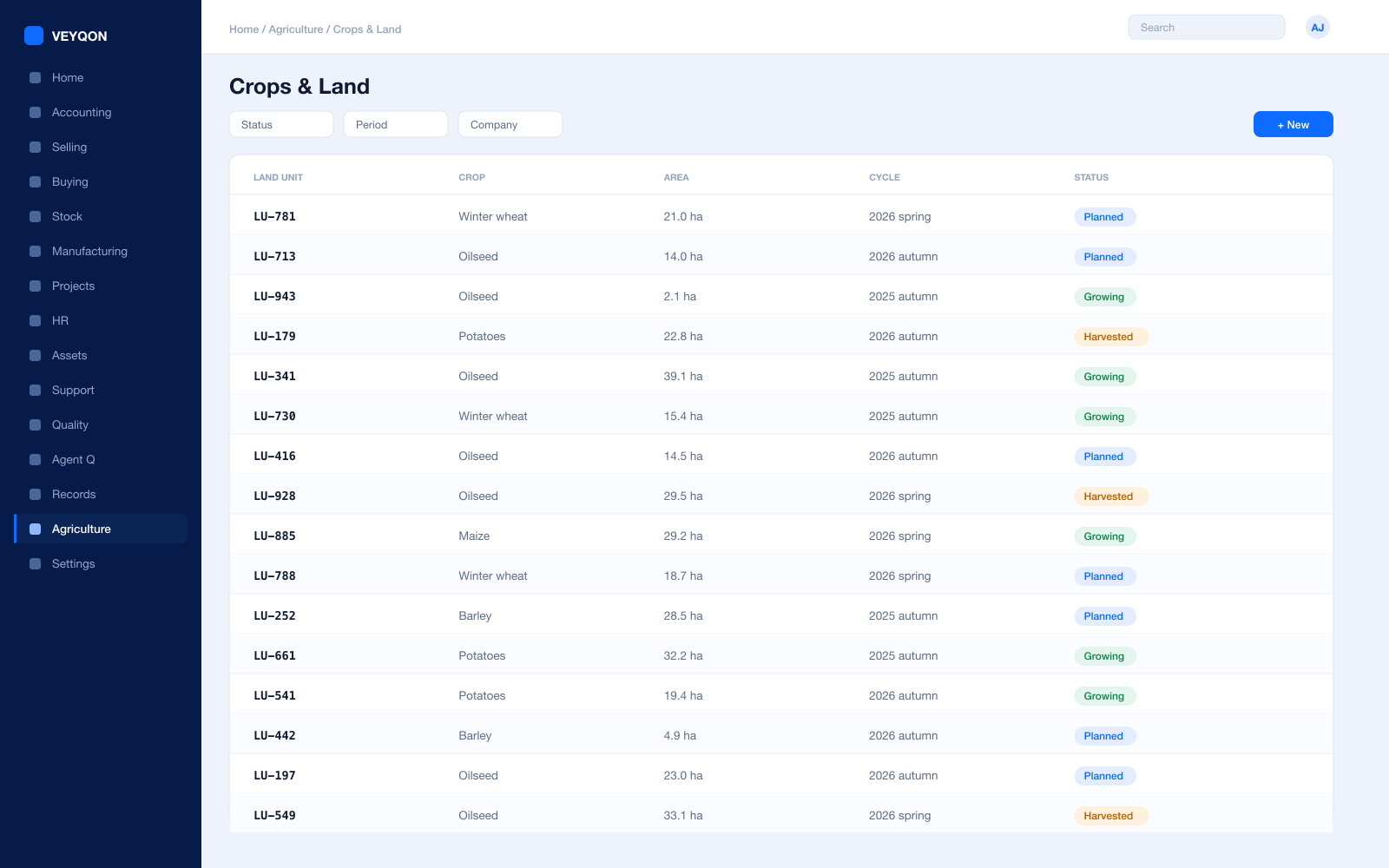
The parcel, the cycle, and everything measured on it.
Crop
The plant, its expected yield, and the tasks a cycle of it requires — held once and reused every season rather than rebuilt each spring.
Crop cycle
Planting through to harvest as a single record, with the task list generated from the crop and dated against the season.
Land unit
Fields mapped and nested, so cost and yield attach to a real parcel rather than to “the north field”.
Soil analysis
Test results recorded against the land unit and the date taken, so a decision three years from now has the history behind it.
Water analysis
The same treatment for irrigation and run-off, measured against the parcel it applies to.
Plant analysis
Tissue results tracked across a cycle, to inform the next application rather than only the next season.
Disease
An identified disease on a crop generating the treatment tasks that answer it, on the cycle it was found in.
Fertiliser
Composition held on the record, so an application is a known quantity of a known thing and the cost follows it.
Weather
Conditions logged against the period, sitting next to the yield they produced.
Stock & Inputs
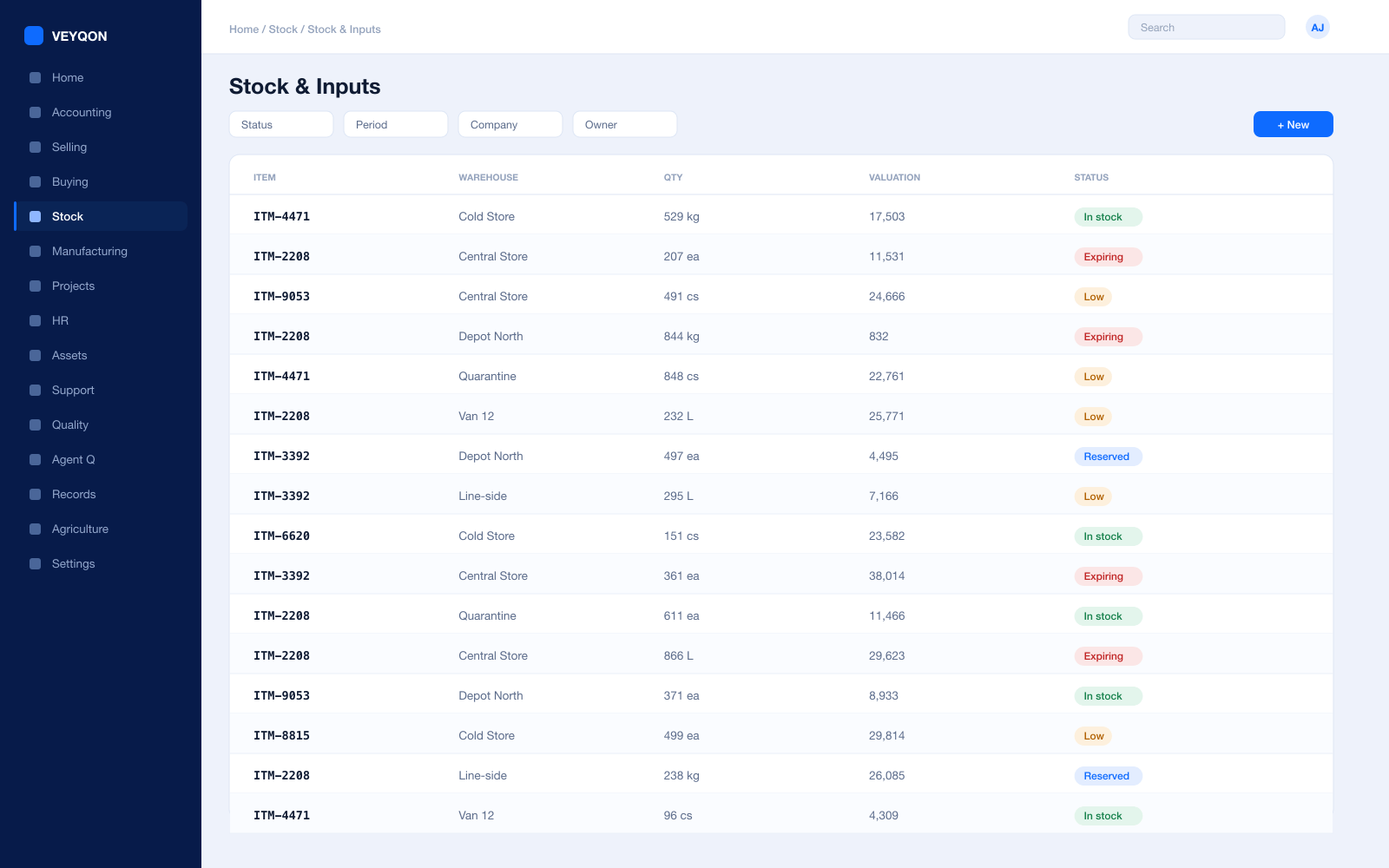
Seed, chemical, feed, and fuel going out; harvest coming back in.
Stores and warehouses
Sheds, tanks, and field stores in one hierarchy, so what is where is a query rather than a walk.
Batch and expiry
Seed lots and chemical batches with expiry, which matters both for efficacy and for the inspector who asks.
Valuation
FIFO or moving average per item, with perpetual inventory posting to the general ledger on every movement.
Issue against the cycle
Inputs issued to a crop cycle rather than to a general cost code, so the parcel carries what was actually put on it.
Reorder levels
A material request raised automatically when projected quantity falls below the level you set, before the window closes on you.
Stock reconciliation
Counts posted against book stock, with the difference valued and accounted rather than absorbed.
Harvest into stock
Yield received into stock and valued like any other produced item, which is what makes cost per tonne fall out of the ledger.
UOM conversion
Buy in tonnes, store in kilograms, apply in litres per hectare — one item, with the conversion on the record.
Landed cost
Freight and duty distributed into the value of the input, so the cost of growing is the real cost.
Procurement
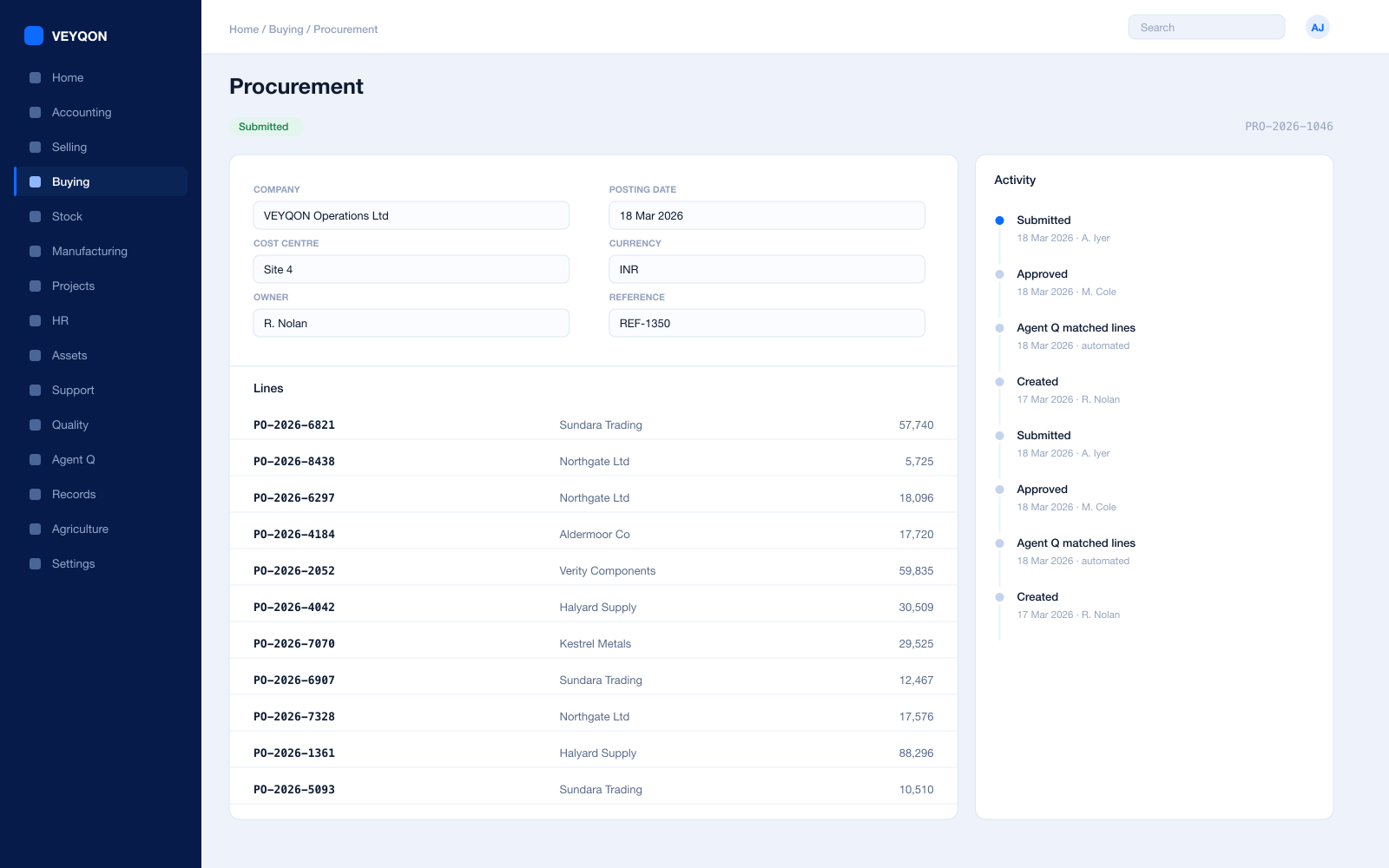
Buying inputs in a window that does not wait for you.
Material requests
Raised from a reorder level, from a crop cycle, or by hand, with approval routing by value and cost centre.
Requests for quotation
Out to several suppliers at once, with a portal for them to respond on rather than a mailbox to chase.
Purchase orders
Against supplier price lists, with a delivery schedule per line — which for a planting window is the whole point.
Receipts with rejection
Accepted and rejected quantity split, with a rejected store and the inspection attached.
Landed cost
Freight and duty into item valuation on the receipt rather than into a general overhead pot.
Three-way matching
Order, receipt, and invoice reconciled before anything is paid, with the variance visible.
Supplier scorecards
Quality, delivery, and responsiveness scored from your own receipts, with standings that can block a supplier.
Tax and charges templates
Duty and purchase taxes applied by template rather than typed onto every order.
Assets & Machinery
Tractors, irrigation, and the kit that has to work in a three-week window.
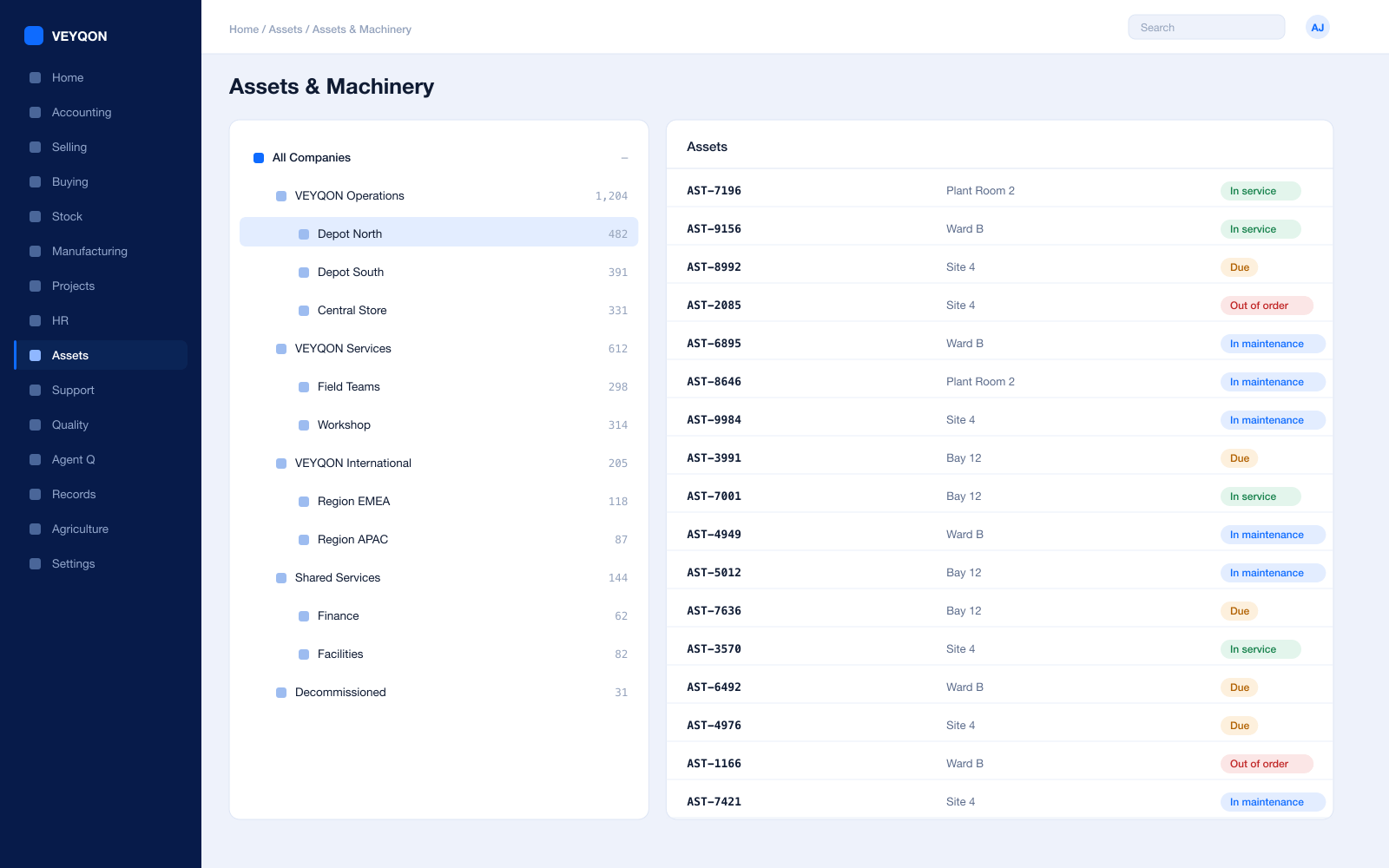
Asset register
Tractors, implements, irrigation, and buildings with categories, locations, and custodians.
Depreciation per finance book
A different method, useful life, and residual value for the statutory book and the management book.
Preventive maintenance
Servicing scheduled by hours or by season, assigned to a team, generating logs before the window rather than during it.
Maintenance logs
What was done and by whom, with certificates attached where the task requires one.
Repair and downtime
A failure record with the date, the downtime, and the cost, with spare parts consumed from stock onto the repair.
Movement
Transfers between holdings and custodians, with a history rather than a recollection.
Disposal
Sale or scrapping with the gain or loss posted, and the asset closed properly.
Projects & Cycle Costing
What a block cost to grow, while there is still time to change it.
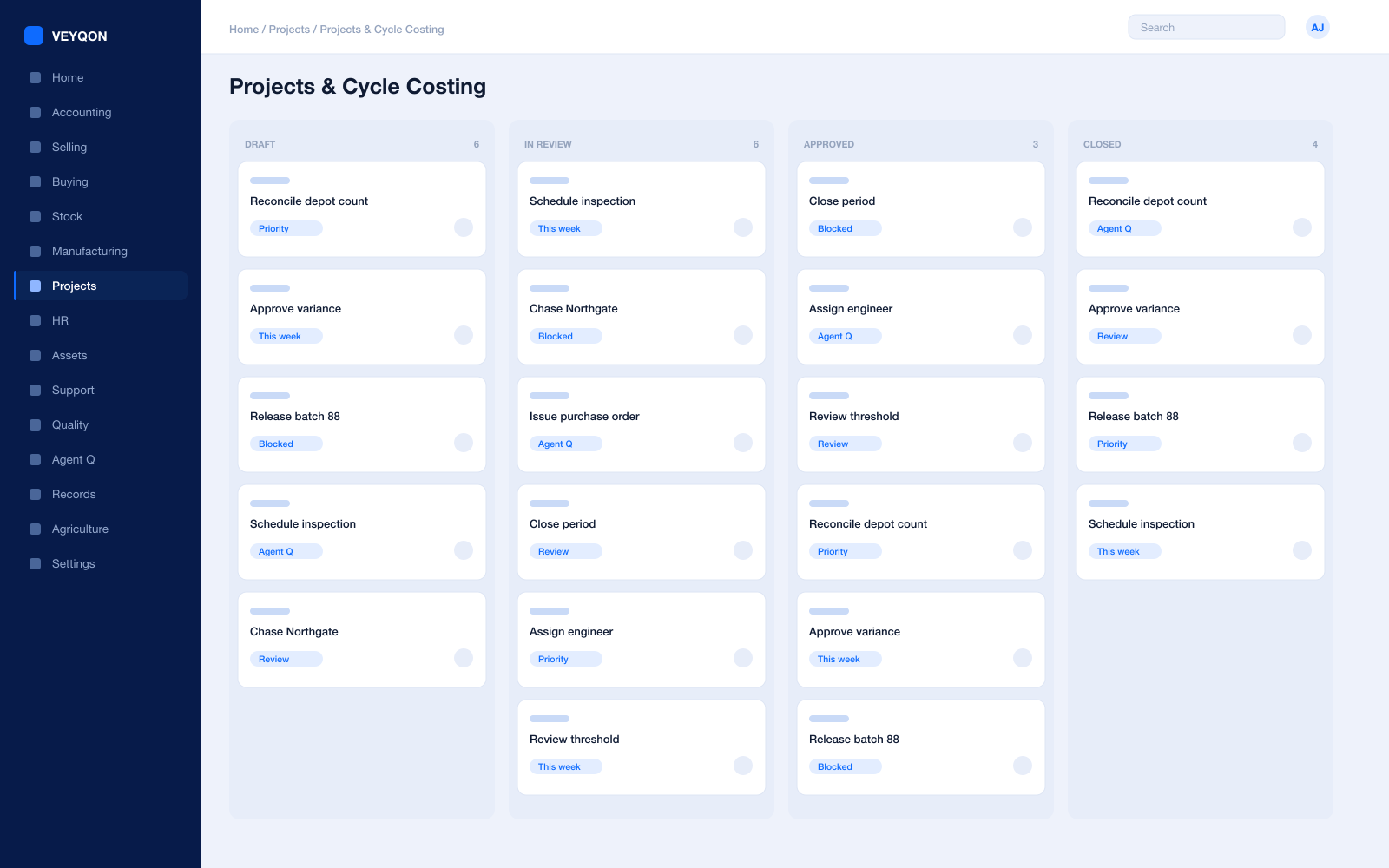
A project per block or cycle
The season’s work on a parcel as a project, with tasks and a schedule the field work hangs off.
Tasks and dependencies
What has to happen before what, so a slipped operation shows as a slipped harvest rather than a surprise in August.
Timesheets
Labour hours booked against tasks at employee rates, feeding both cycle cost and payroll from one entry.
Input cost on the cycle
Seed, fertiliser, and chemical issued to the cycle, so the parcel carries what went onto it.
Cost per tonne
Input, labour, and machinery cost against the yield received, out of the ledger rather than out of a spreadsheet.
Profitability
Actual cost against the value of the crop, per block, while the next decision is still in front of you.
Selling
Selling a crop that has a batch, a grade, and a date on it.
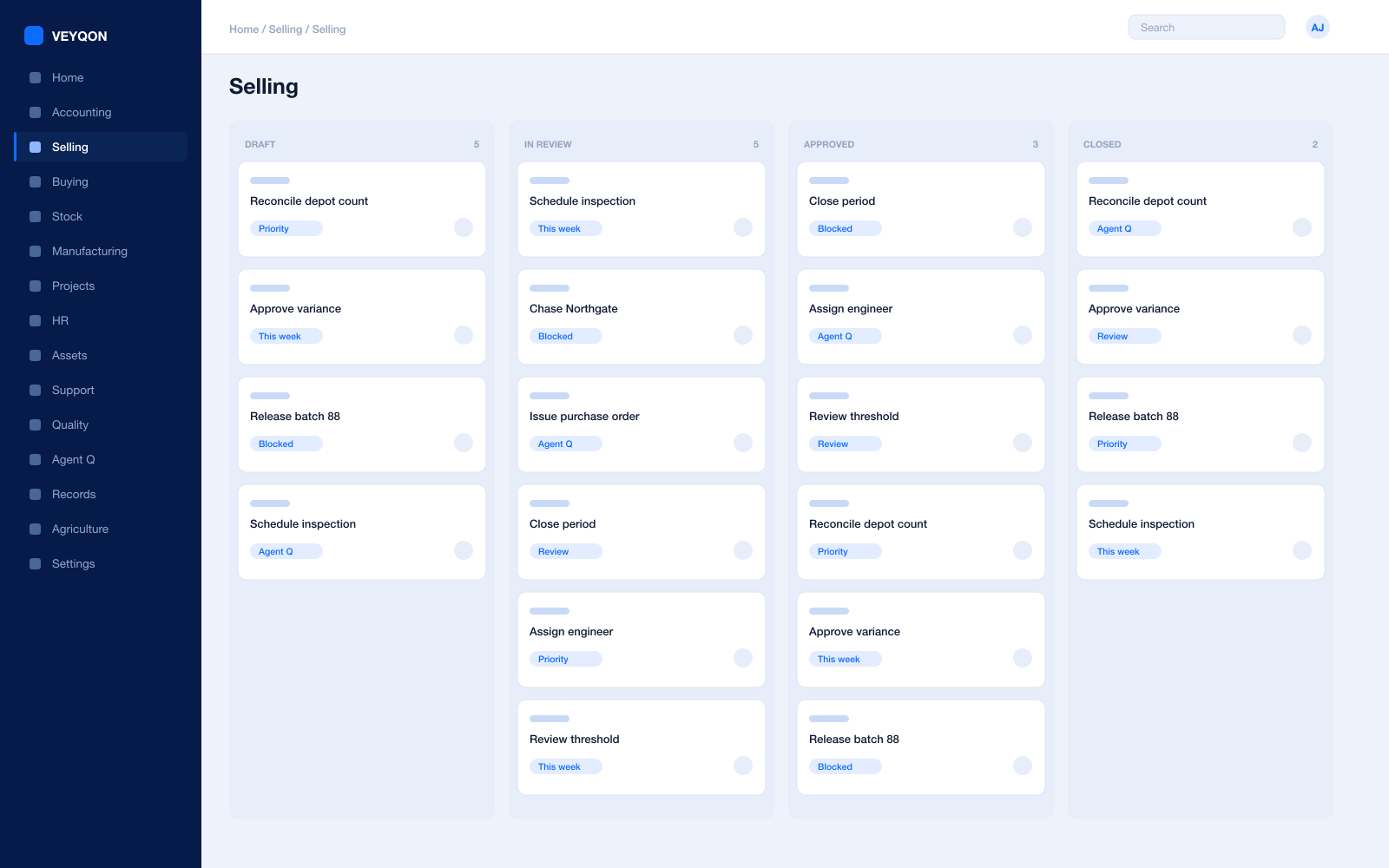
Customers and price lists
A default selling list per buyer, by currency and territory, so the contracted price is simply the price.
Quotations
Items, quantities, prices, validity, and terms, converting to an order in one step.
Sales orders
A delivery date per line, partial delivery, and partial billing across as many loads as the contract takes.
Pricing rules
By item, grade, or buyer, as a rate, a percentage, or a margin, applied at order entry rather than corrected later.
Batch on despatch
The batch selected at pick, so what left is traceable back to the parcel and the cycle it grew in.
Delivery notes
What left, in what quantity, against which order, with the weighbridge figure on the record.
Credit limits
Set on the customer, the customer group, or the company, blocking submission over the ceiling with a named role for exceptions.
Accounts
Cost per hectare and per tonne, from the ledger rather than an estimate.
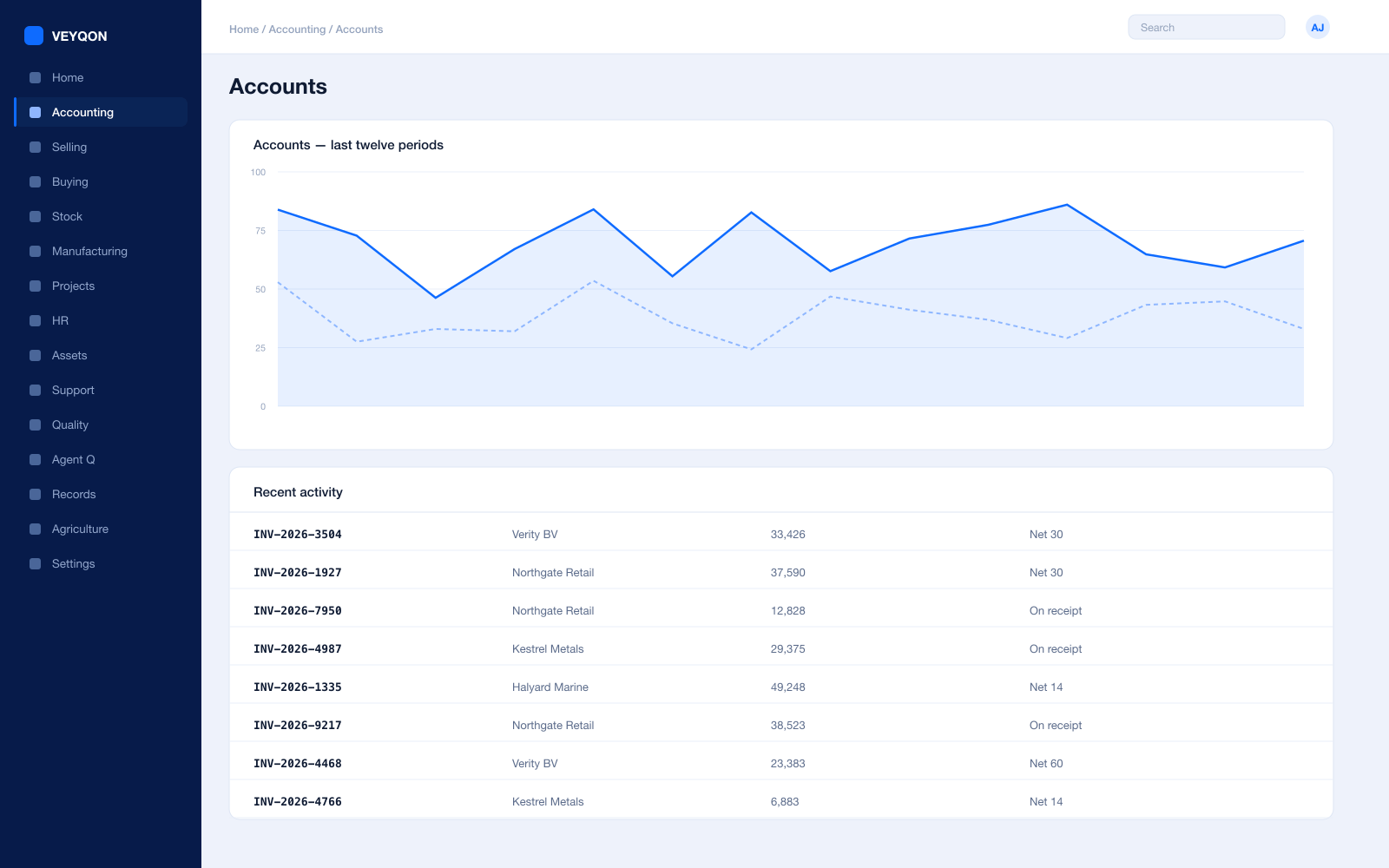
Perpetual inventory
Every stock movement posts to the general ledger as it happens, so the store and the accounts cannot drift apart.
Cost of production
Input, labour, and machinery cost landing in the value of the harvested item rather than in a general overhead pot.
Cost centres and dimensions
By holding, block, or enterprise, with allocation splitting one amount across several by percentage.
Budgets
Against cost centres and projects, with the action on exceeding set to warn the person or stop the document.
Multi-currency
Sell across a border in its own currency, with revaluation posting to the ledger rather than a spreadsheet.
Period close
Accruals, reconciliation, and a period lock that stops anyone back-posting into a season you have reported.
Statutory tax
VAT, GST, and withholding with your region’s filing formats.
Audit trail
Every posting carries who, when, and from which document — which matters when a subsidy claim is checked.
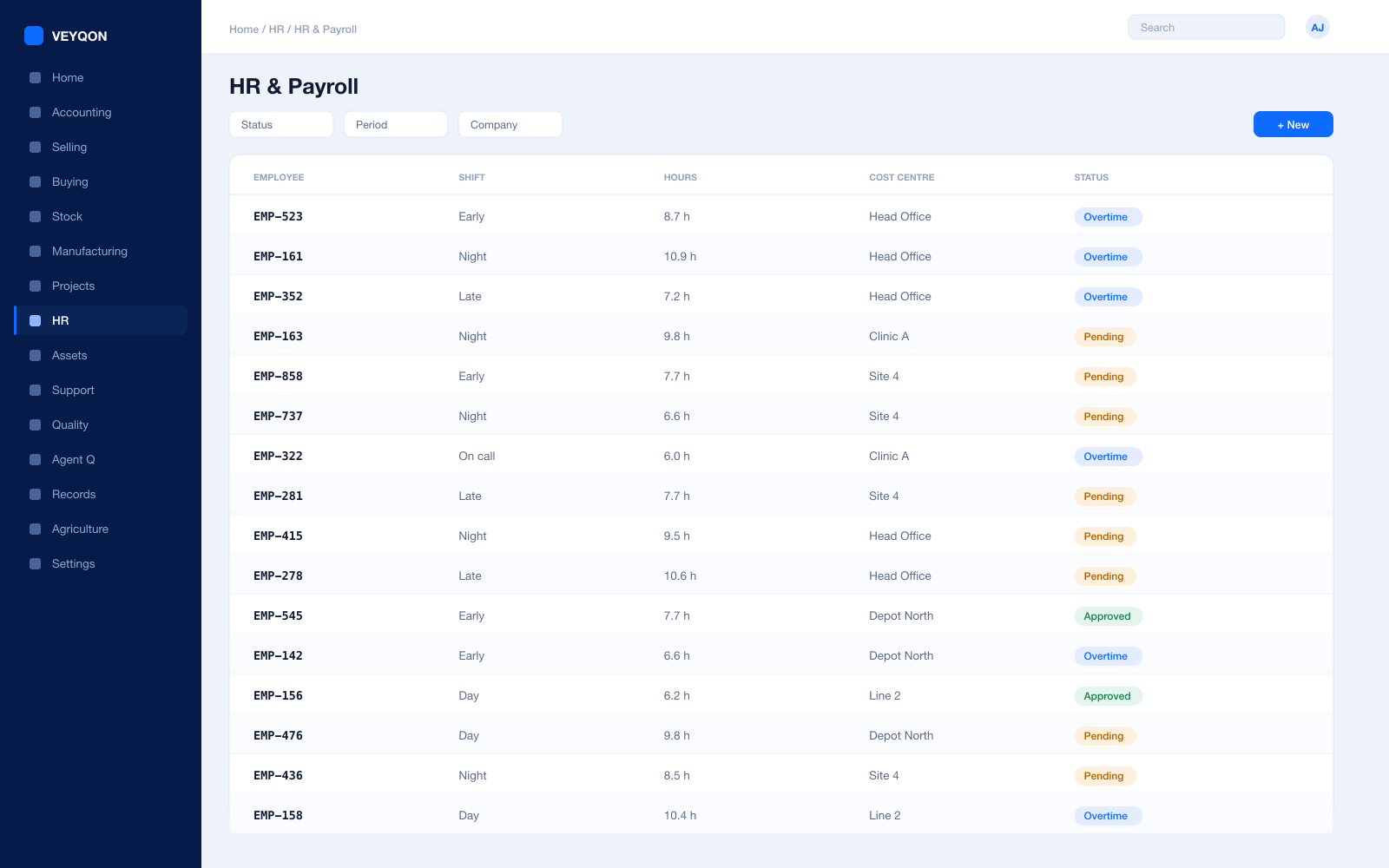
HR & Payroll
Permanent staff and seasonal labour, on the same ledger.
Seasonal shifts
Rotas for a workforce that trebles for six weeks, planned rather than improvised on the morning.
Attendance and check-in
From devices or check-in, feeding hours and overtime instead of a tally on a clipboard.
Labour on the cycle
Hours booked to the crop cycle they were worked on, so labour cost lands on the parcel it belongs to.
Leave and holiday lists
The working calendar that field scheduling is actually planned against.
Expenses
Claims against a cost centre or a holding, approved and posted rather than settled from petty cash.
Payroll
Salary and piece-rate structures with statutory deductions, posted into the same ledger as everything else.
Certification
Spray certificates and machinery tickets held against the employee, with expiry dates that surface before they lapse.
One pass through agriculture, end to end.
- 01
Prepare
Land units defined, soil tested, and the crop cycle planned with tasks.
- 02
Apply
Seed, fertiliser, and labour issued from stock against the cycle.
- 03
Monitor
Analysis and disease records adjust the remaining tasks in the cycle.
- 04
Harvest
Yield receives into stock, and cost per tonne comes out of the ledger.
Running agriculture on VEYQON, in four steps.
It is a subscription, not a project.
- 1
Subscribe
Pay by card. Provisioned straight away.
Minutes - 2
Bring your data
Balances, items, customers, suppliers.
Day one - 3
Switch modules on
Warehouses, limits, and approvals.
Week one - 4
Go live
Run parallel, then cut over.
You choose
All 9 modules included. Nothing sold separately.