Utilisation you can see before the month ends.
Projects, timesheets, and billing on the same ledger, so recoverability is a number you watch rather than one you discover.
10 modules·84 features·Native ERPNext domain
The modules behind professional services.
Not a list of module names. Each one below opens onto what is inside it and why a professional services business needs it — so you can check it against how your operation actually runs.
Agent Q
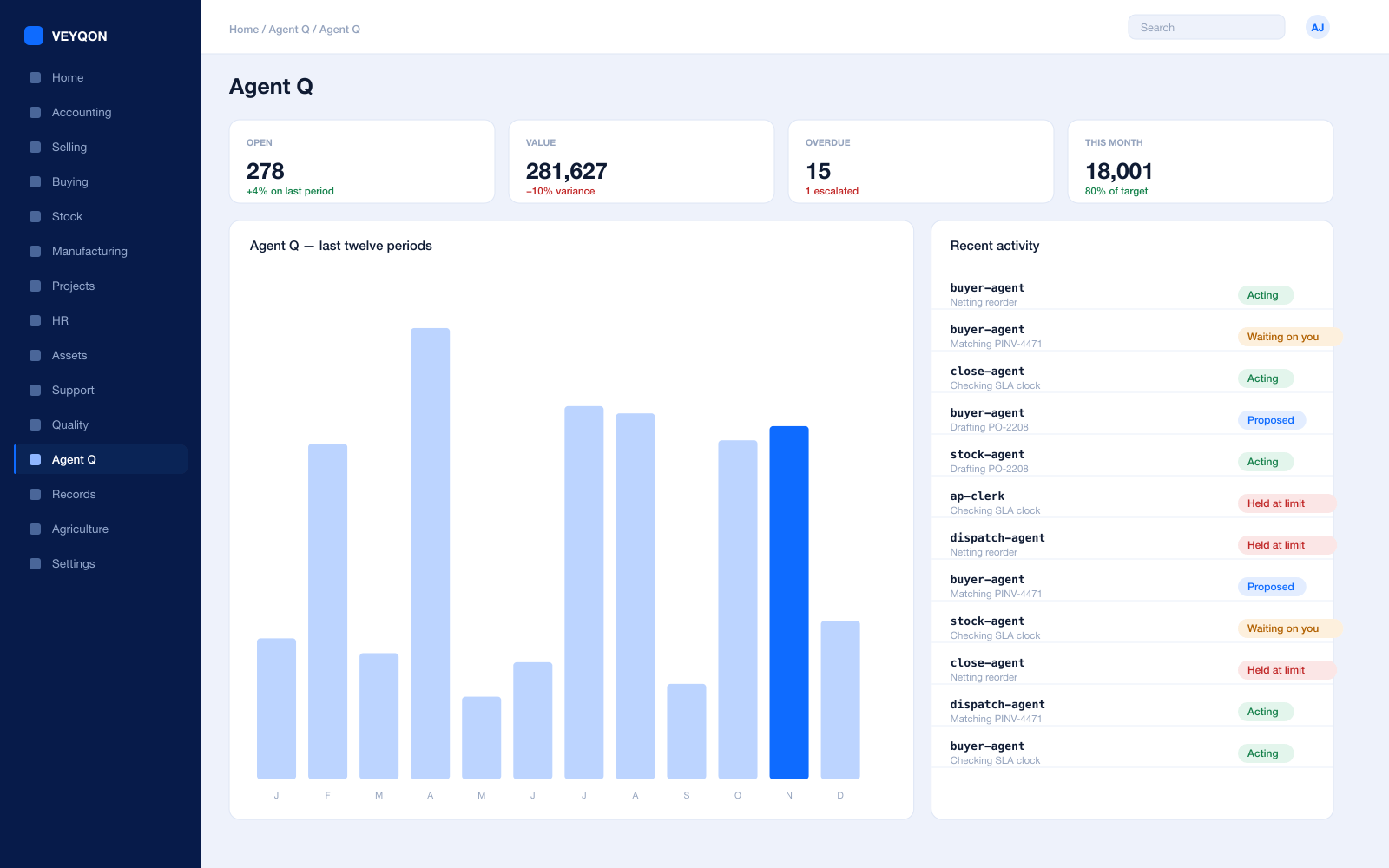
Agents that read your own records and act on them, scoped to how a professional services business runs.
Grounded in live records
Every answer is drawn from your own ledger with your permissions applied, and names the documents it used. Nothing is answered from a snapshot or a summary.
A role, not a prompt
Each agent is scoped like a job — accounts payable, procurement, dispatch, period close — with the same limits you would put on the person doing it.
Explicit tool permissions
An agent holds a named list of the actions it may take. Matching an invoice does not imply paying one.
Value and action limits
A hard ceiling per agent, per period, and per document type, which it cannot cross however it is asked.
The queue
What every agent is working on, what is waiting on a person, and what has been held — in one place, with the reason on each item.
Triggers
An arriving document, a breached threshold, a date, or a state change on a record. Agents start on events, not on somebody remembering.
Human approval gates
Anything over a limit routes to a named person, with the reasoning attached, so approving takes seconds rather than an investigation.
Escalation paths
Who it hands to when it reaches a limit, how long it waits first, and what that person sees when it arrives.
Segregation of duties
An agent cannot approve what it raised. The rule that applies to your people applies to your agents.
Full reasoning log
Every step is written to the audit trail on the document it touched, so a decision can be read back months later.
Ask in plain language
The console answers operational questions from live records and offers the next action, rather than handing back a paragraph.
Spend control
Ceilings per agent and per period, so autonomy runs to a budget you set rather than an open account.
Projects & Delivery
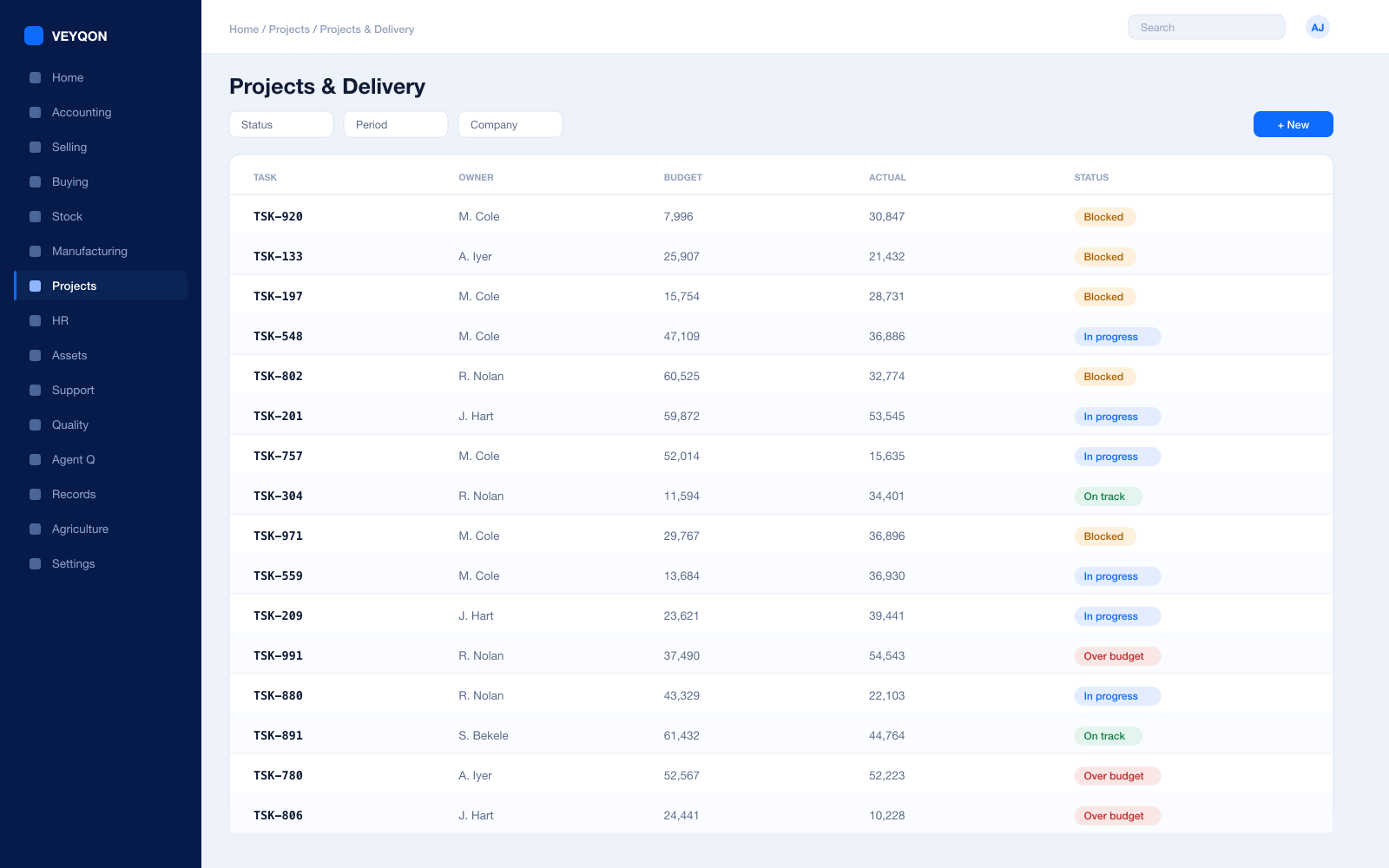
The engagement, the plan behind it, and whether it is still the shape you sold.
Project with budget and margin
Estimated cost, estimated billing, and actuals on one record, so margin is visible while the engagement is running.
Project templates
Repeatable engagement shapes with tasks and estimates prefilled, so the fifth of something is scoped like the fifth and not the first.
Tasks and dependencies
What has to happen before what, so a slipped workshop shows as a slipped delivery date rather than as a surprise.
Percent complete
Driven by task completion or by time, with a Gantt view for the conversation the client actually wants to have.
Task types and priorities
Work classified so a report can separate delivery from internal from pre-sales without anyone tagging it by hand.
Costing from time and expense
Project cost assembled from submitted timesheets and expense claims rather than estimated at month end.
Material and expense
Pass-through cost and purchased items booked against the project, so recoverability includes them.
Profitability
Actual cost against the contracted value, per project and per client, while there is still time to act on it.
Milestone billing
Invoicing on percentage completion or on defined events, with the schedule agreed at the point of sale.
Project on every document
The reference carried on orders, timesheets, expenses, and invoices, which is what makes the margin figure trustworthy.
Time & Utilisation
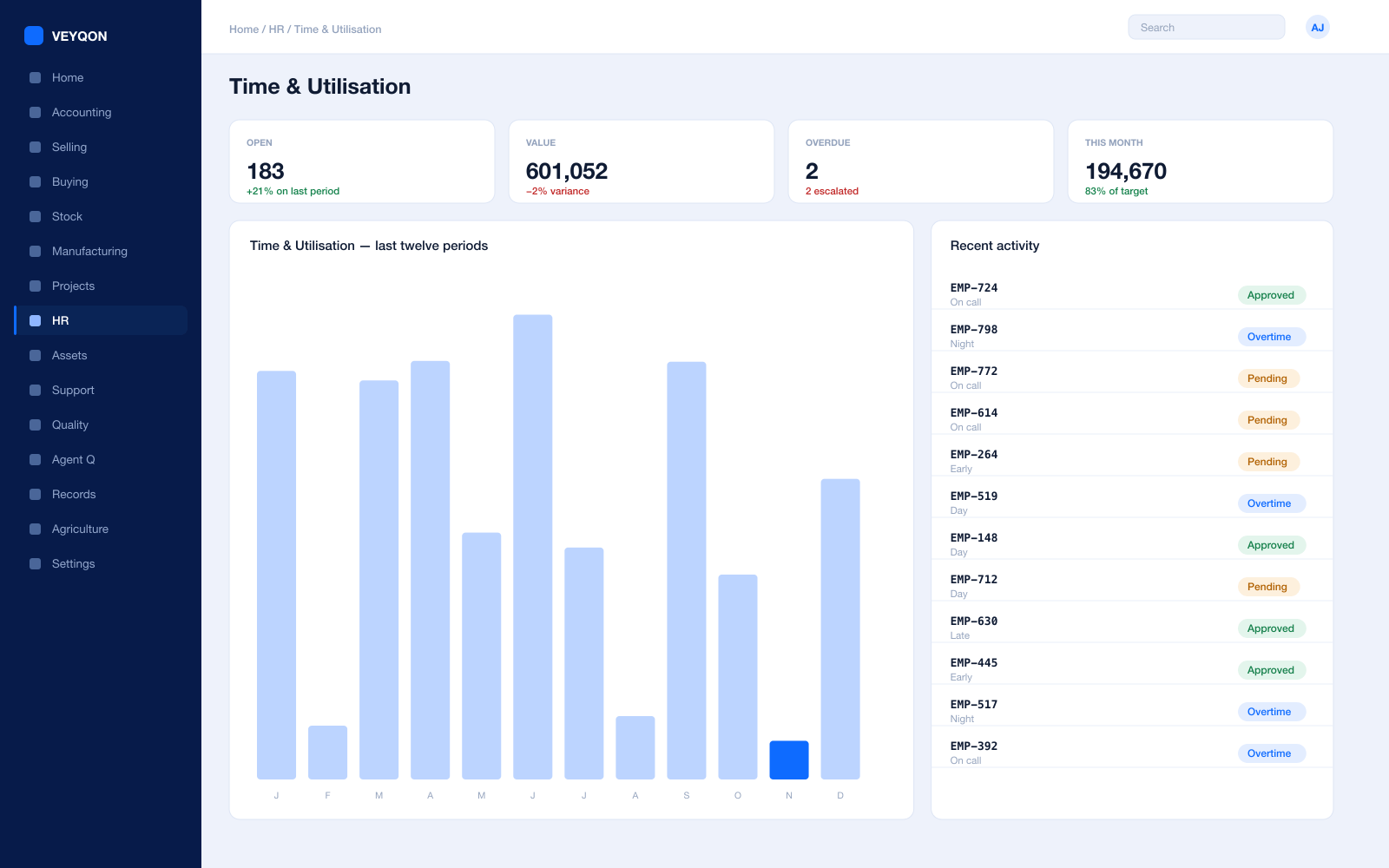
Recoverability you watch, rather than one you discover.
Timesheet
Hours per task per day per person, entered against the work rather than reconstructed from a calendar on the last Friday of the month.
Activity type
What the work actually was — and the thing a rate attaches to, so advisory and delivery are not billed identically.
Billable and non-billable
A flag per row, with total billable hours and total billable amount calculated from it rather than worked out afterwards.
Billing rate
What the client is charged per hour, per activity, with a rate card that can differ by customer.
Costing rate
What the hour actually costs, fetched from the activity cost for that employee or from the activity type.
Rates locked on submit
Once a timesheet is submitted neither rate can be edited — which is precisely what makes the margin number worth quoting.
Timesheet from a task
Created straight off the task dashboard, so logging time is a click from the work rather than a separate errand.
Percent amount billed
Billed hours and amount against billable, so under-billing shows up as a number instead of as a quiet write-off.
Timesheet to salary slip
The same submitted timesheet generating pay, so hours are entered once and two systems cannot disagree.
Billing & Revenue
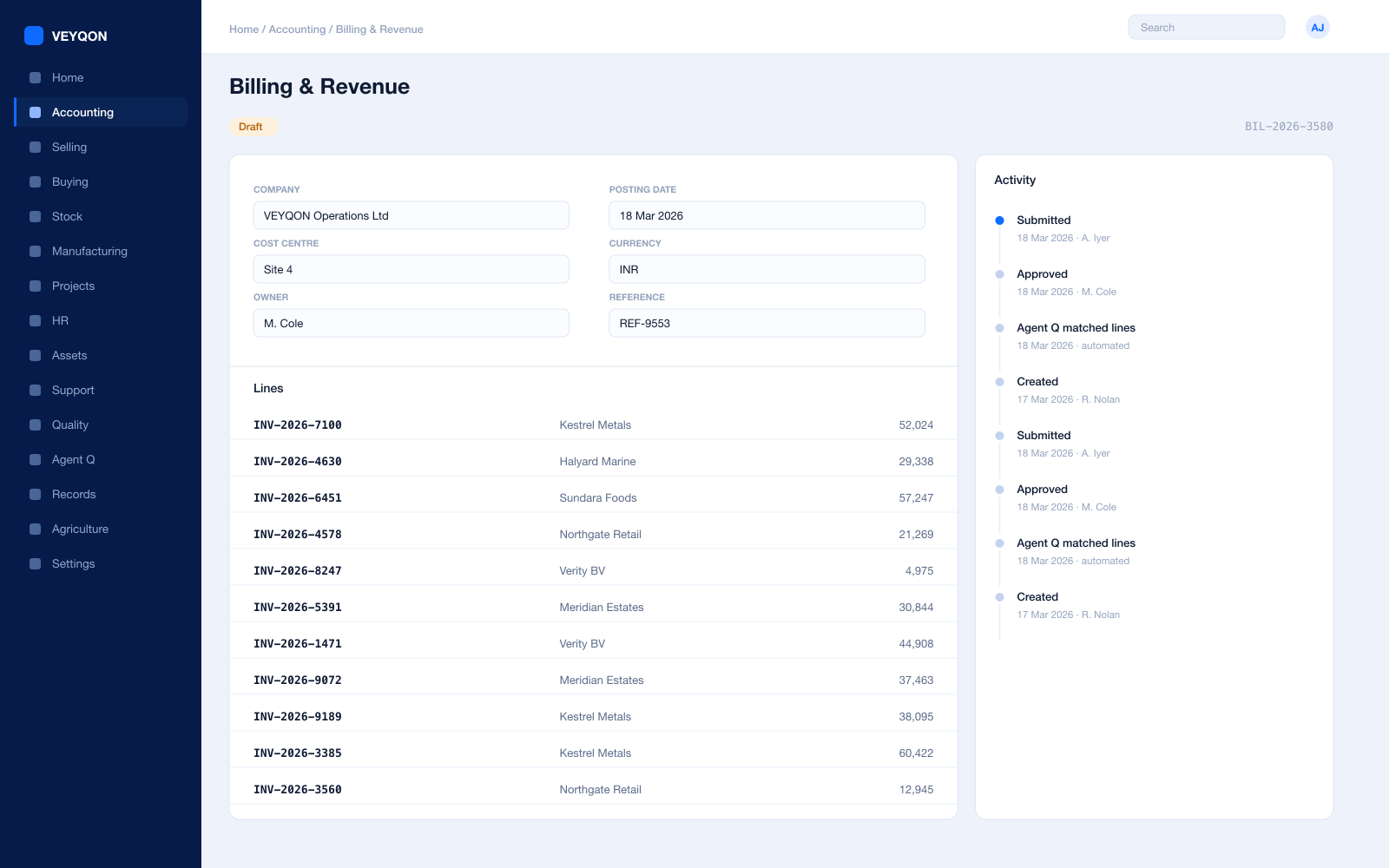
Getting paid for what was done, in the period it was done in.
Invoice from timesheets
Billable rows pulled onto a sales invoice with the detail attached, so a client query is answered rather than investigated.
Milestone billing
Invoicing on percentage completion or on defined events, with the schedule set when the work was sold.
Fixed price and time-and-materials
Both shapes on the same project record, because most engagements are one and then quietly become the other.
Retainers as subscriptions
Recurring billing on an interval and count, prepaid or postpaid, with the invoices generated rather than diarised.
Deferred revenue
Where a retainer is invoiced up front, revenue recognised across the service period rather than in the month it was billed.
Payment terms
Instalments with a portion each, credit days, and month-end due dates driving the schedule overdue is measured from.
Credit limits
Set on the client, the client group, or the company, blocking submission over the ceiling with a named role for exceptions.
Multi-currency invoicing
Bill a client in their currency and report in yours, with revaluation posting to the ledger.
Work in progress
Unbilled time carried as WIP against the project rather than appearing as a gap and then as a spike.
CRM & Pipeline
Pipeline that feeds resourcing, not just the revenue forecast.
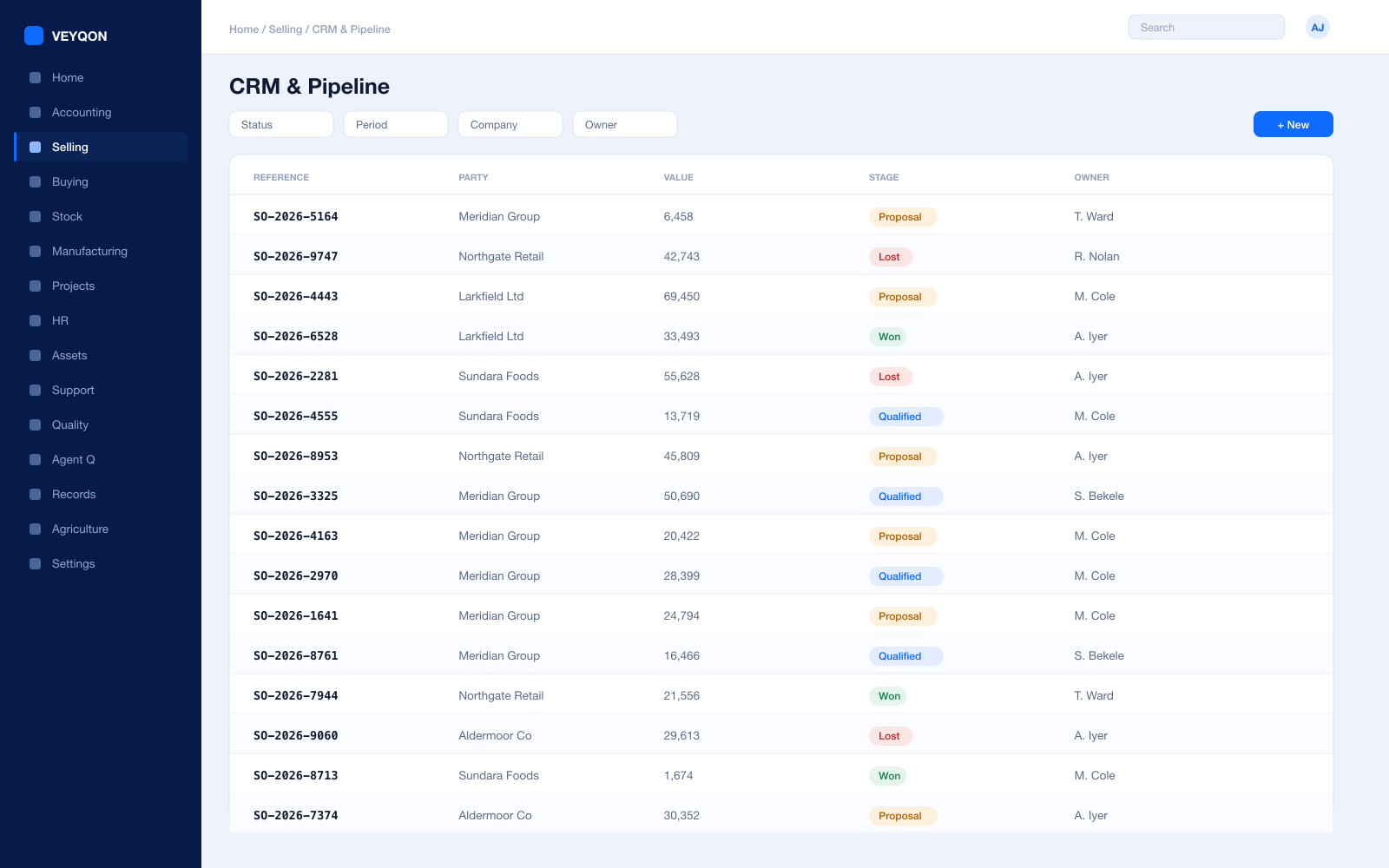
Leads
An unqualified enquiry with its source and territory captured at first touch rather than reconstructed later.
Opportunities
Value, probability, timing, and owner — which is what turns a pipeline into a resourcing input instead of a wish list.
Sales stages
Where a deal actually sits, so early discovery is not reported to the partners as a proposal.
Campaigns and sources
Which channel or referrer produced the work, traceable from the enquiry to the invoice it became.
Quotations
A proposal with scope, rates, validity, and terms, converting into a project when it is accepted.
Clients and contacts
Held once and reused across quotation, project, timesheet, and invoice rather than retyped into each.
Contribution split
A percentage per person on the order, which is how origination and delivery credit stop being an argument.
Targets
Targets by item group and fiscal year per person, with a commission rate where the model uses one.
People & Resourcing
Allocation against real availability, including the leave nobody remembered.
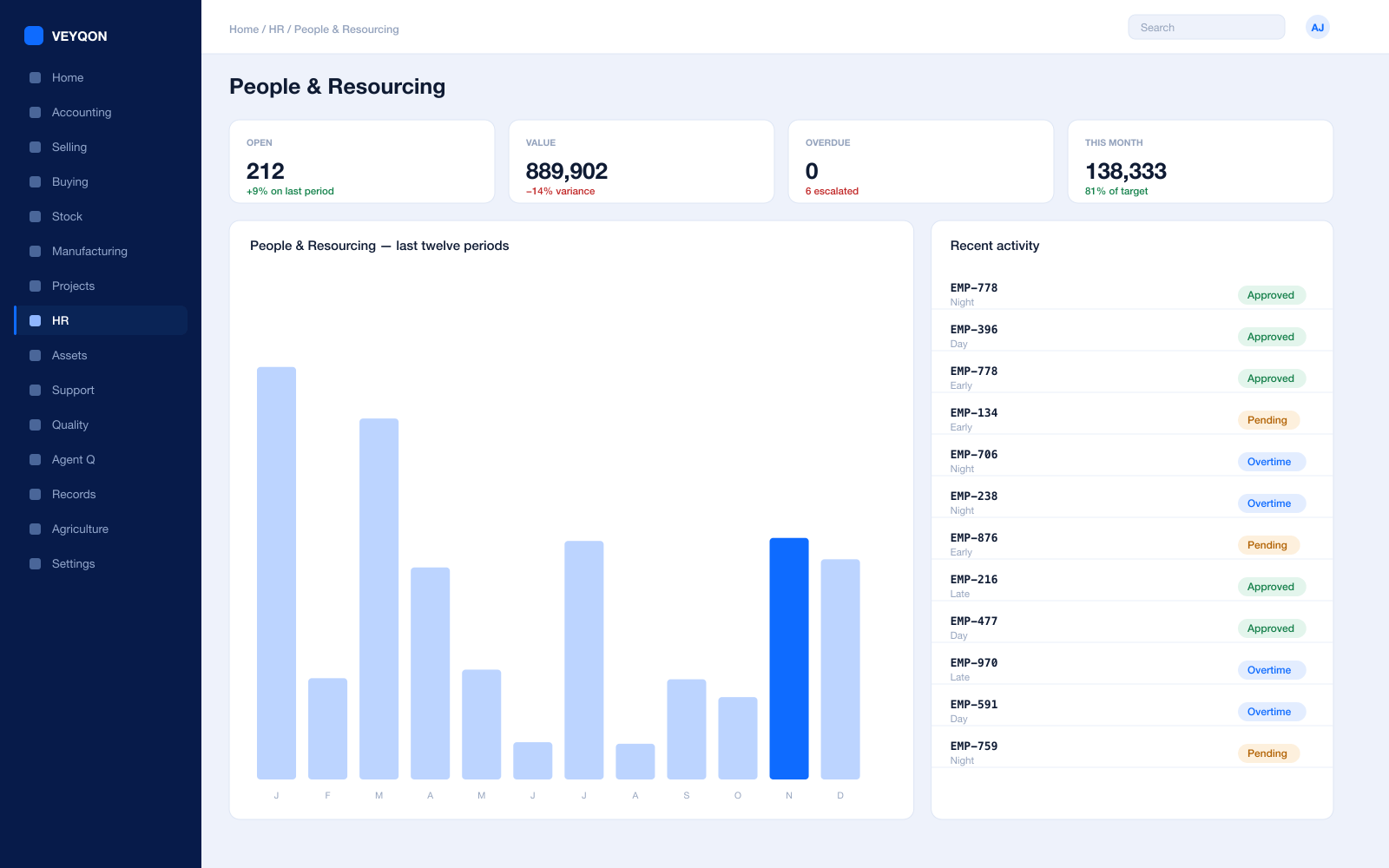
Employees and skills
The people, their grades, and what they can actually do — held on the record rather than in a partner’s head.
Leave and holiday lists
The working calendar that allocation is measured against, so a plan does not assume somebody who is in Greece.
Shift and availability
Working patterns and part-time arrangements reflected in capacity rather than averaged away.
Allocation
Assignment against real availability including other projects, so two engagements cannot book the same person twice.
Expenses and claims
Billable and non-billable claims against a project, approved and posted, and recoverable where the contract says so.
Payroll
Salary structures and runs with statutory deductions, fed by the same timesheets that fed the client invoice.
Appraisals and goals
Objectives and reviews held against the employee, next to the utilisation they actually achieved.
Training and certification
Qualifications with expiry dates that surface before they lapse — which matters when a client contract names them.
Employee cost rate
The activity cost per employee that costing rates are drawn from, maintained once rather than per project.
Accounts
Practice economics, not just a profit and loss.
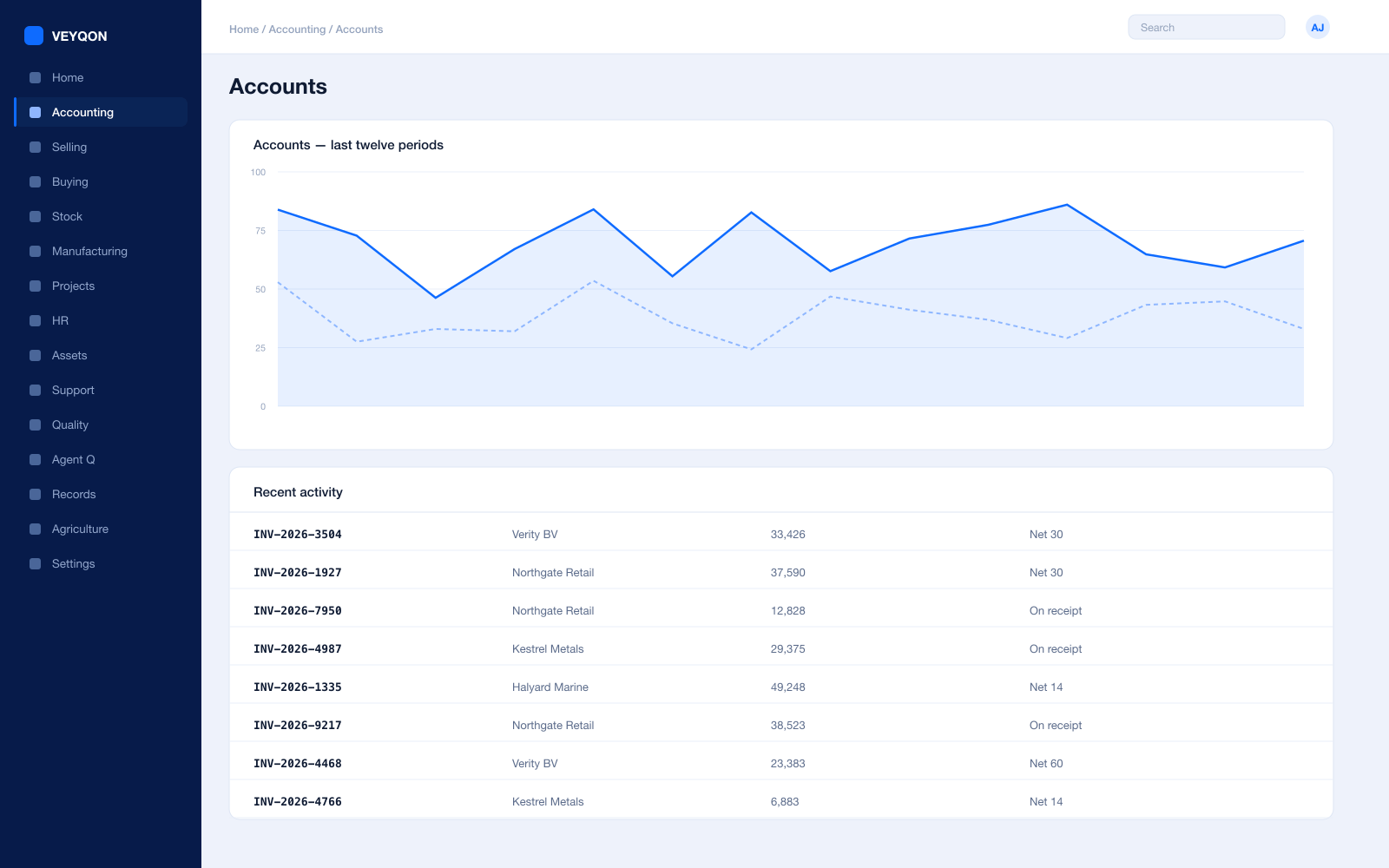
Cost centres by practice
Each service line or office as a cost centre, with allocation splitting shared cost across several by percentage.
Budgets
Against cost centres and projects, with the action on exceeding set to warn the person or stop the document.
Revenue recognition
Deferred revenue over a service period and WIP against unbilled time, so the month reflects the work rather than the invoicing.
Multi-currency
Clients billed and staff paid across borders, with revaluation posting to the ledger.
Period close
Accruals, reconciliation, and a period lock that stops anyone back-posting into a month you have already reported.
Statutory tax
VAT, GST, and withholding with your region’s filing formats.
Audit trail
Every posting carries who, when, and from which document — which is what an engagement review depends on.
Receivables and ageing
Ageing by client and by partner, off the same ledger the delivery team is looking at.
Support
Managed service commitments that have a clock on them.
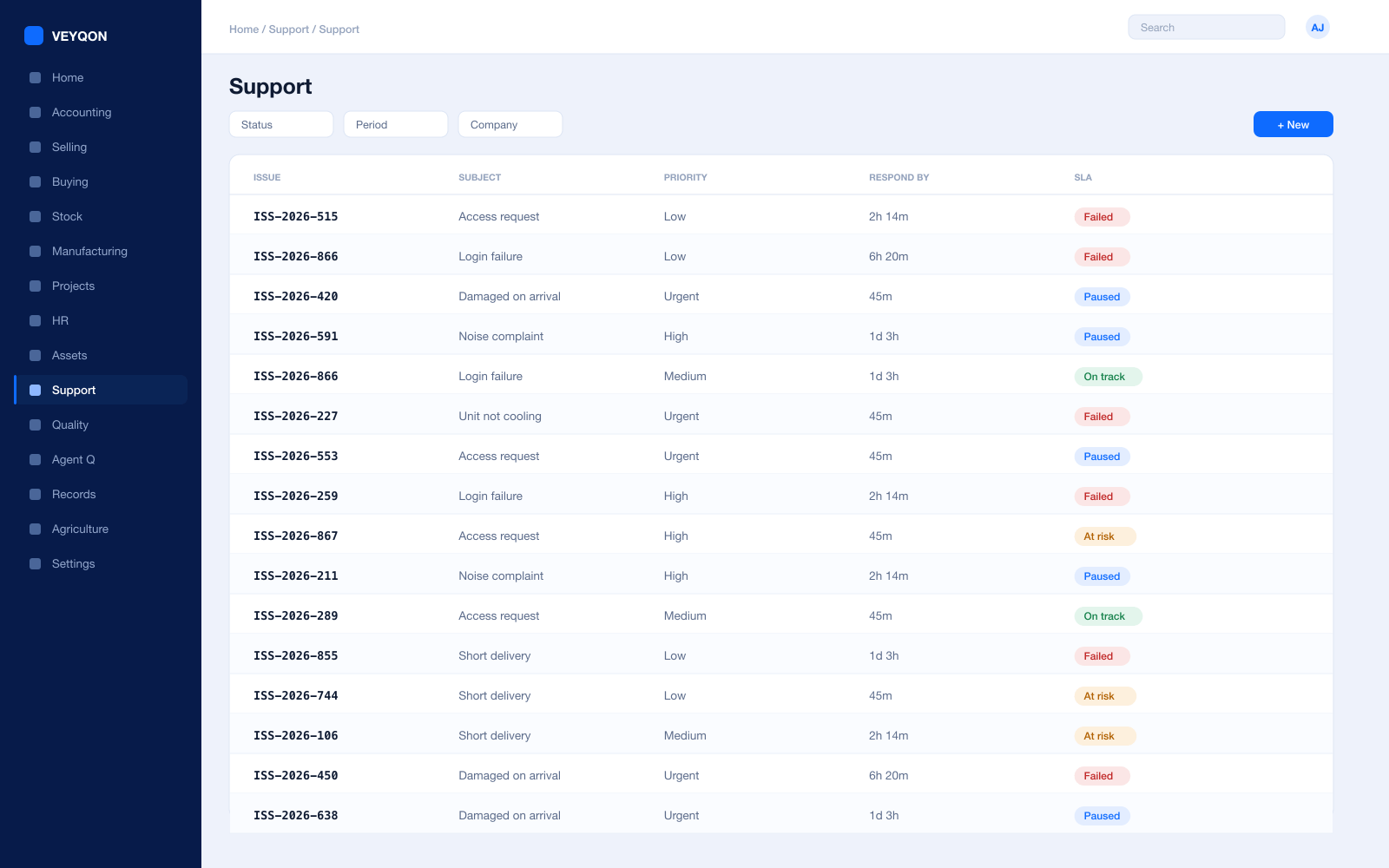
Issues
Raised by email, through the portal, or by hand, and linked to the client and the engagement they belong to.
Service level agreements
Priorities with a time to respond and a time to resolve, applied by client, client group, or territory.
Support hours
The clock runs only in the hours the contract actually covers, and stops on the days your holiday list says you are shut.
SLA pause
The timer holds while you are waiting on the client, and the hold time is added back when they respond.
Issue against the project
Support effort landing on the engagement it belongs to, so a managed service shows its true recoverability.
Resolution record
What was done, by whom, and when — attached to the issue rather than living in a mailbox.
Client portal
Clients raising and following their own tickets without an email thread nobody can audit.
Procurement
Subcontractors and pass-through cost, on the engagement they belong to.
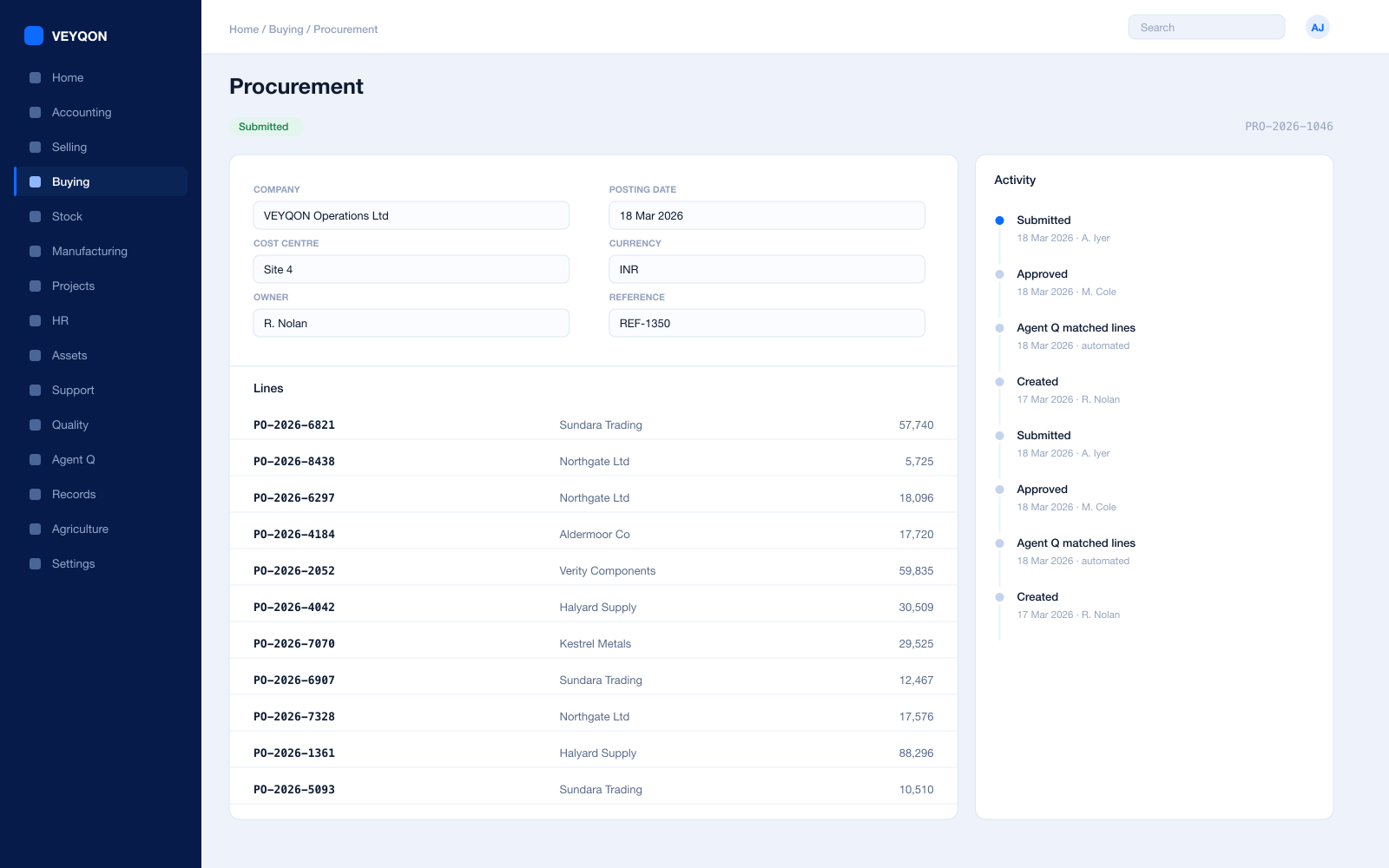
Material requests
Raised against a project or by hand, with approval routing by value and cost centre.
Purchase orders
Against supplier price lists, with a schedule per line and the project reference carried through.
Subcontractors
Associates and partner firms engaged on a purchase order, so their cost lands on the engagement rather than in overhead.
Supplier invoices to a project
Pass-through cost booked to the project, which is what makes it recoverable and visible in the margin.
Three-way matching
Order, receipt, and invoice reconciled before anything is paid, with the variance visible rather than absorbed.
Payment terms and runs
Scheduled against supplier terms, so a subcontractor is paid on the terms you agreed rather than when someone notices.
Integrations
Client systems, and the tools the delivery team already uses.
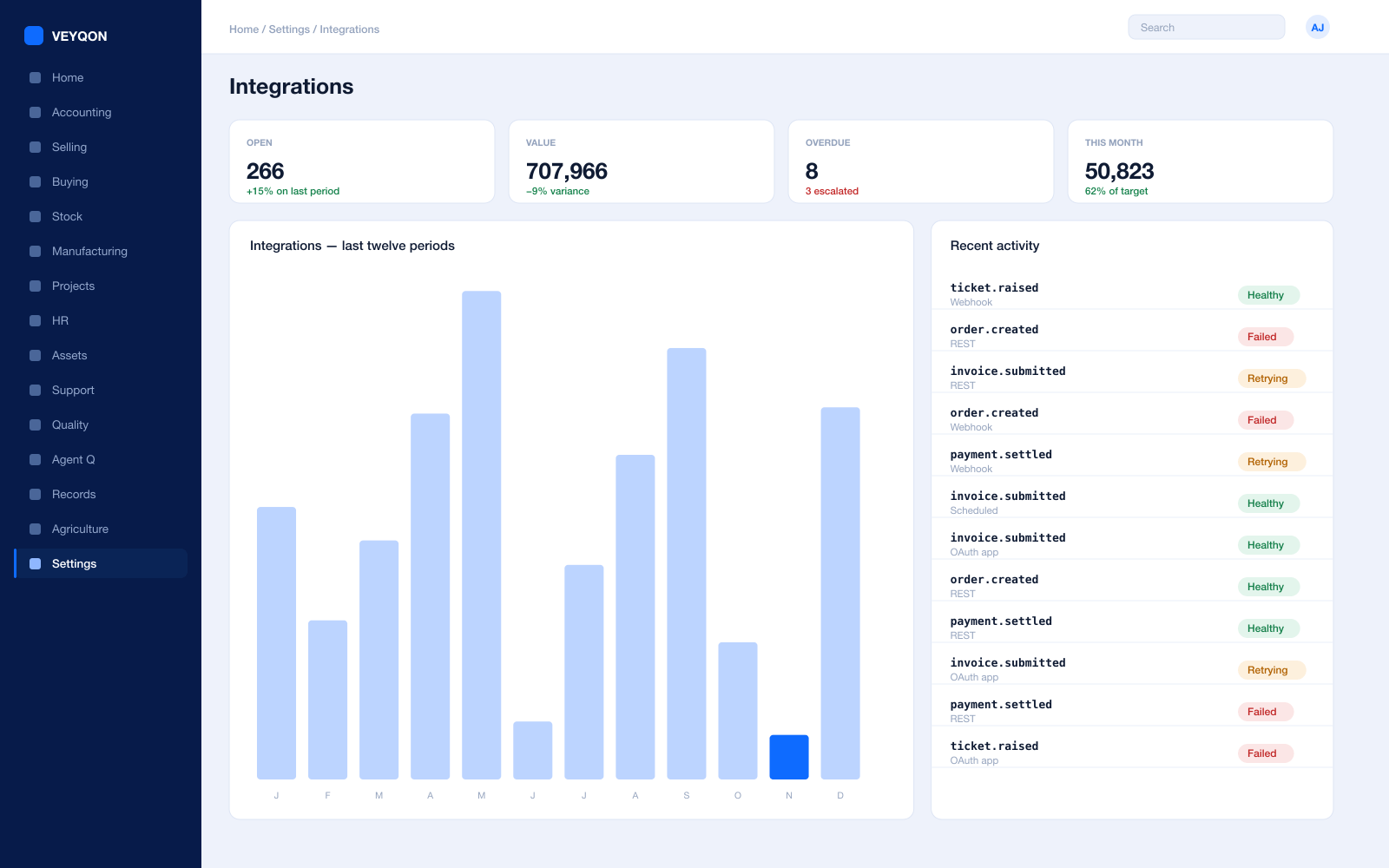
REST API on every record
Every document type is addressable over the API, with the same permissions the interface applies.
Webhooks
A state change on any document pushed to another system as it happens, rather than found on a nightly poll.
Scheduled jobs
Recurring imports, exports, and reconciliations on a calendar, with a log of what ran and what it did.
Bulk import and export
Spreadsheet import with validation, and export of anything you can see — including for a client who asks for their data.
Connected apps and OAuth
A client or partner system authorised against a scoped role rather than handed a shared password.
Client portals
Project status, documents, and invoices available to the client without an email thread nobody can audit.
One pass through professional services, end to end.
- 01
Scope
A template turns a sold engagement into tasks with estimates.
- 02
Staff
Allocation against real availability, including leave and other projects.
- 03
Track
Time posts daily; recoverability moves before it is too late to act.
- 04
Bill
Invoice from timesheets or milestones, with WIP carried correctly.
Running professional services on VEYQON, in four steps.
It is a subscription, not a project.
- 1
Subscribe
Pay by card. Provisioned straight away.
Minutes - 2
Bring your data
Balances, items, customers, suppliers.
Day one - 3
Switch modules on
Warehouses, limits, and approvals.
Week one - 4
Go live
Run parallel, then cut over.
You choose
All 10 modules included. Nothing sold separately.